
|
 IIR News Intelligence Digest Article |
|
Nuclear Energy The Green Answer for the Future of U.S. Energy SUGAR LAND--March 29, 2007--Researched by Industrial Info Resources (Sugar Land, Texas). The growing concern over global warming has spurred debate on social and political levels alike regarding clean, renewable energy sources taking the place of existing technology. The major contributor for global warming, according to studies, is greenhouse gases. Given solar, hydro, wind and biomass technologies, nuclear energy is the only installed and proven option to provide enough power needed to keep pace with our growing population as a country and a world, while drastically reducing the amount of carbon dioxide (CO2) released into the atmosphere. The need for energy in North America, as well as around the world, will necessitate society to move in a direction that will deliver the required electricity to meet the demand, and at the same time to reduce greenhouse gases and carbon emissions. By the year 2050, it is estimated that the world will need three times as much nuclear produced energy than exists today. With the growth of nuclear plants across the country, concerns about nuclear waste and safety arise. Experts believe that geological disposal is a much safer and efficient process for nuclear waste management over the long term as compared to the risk of reprocessing spent fuel. Safety is first, as well as a key issue within the nuclear industry, as it is with the government that has a responsibility to its people. Current technologies and processes deliver a very low risk of adverse effects occurring and the construction and operation aspects of a nuclear plant are placed under a stringent microscope. One of the greatest hurdles the nuclear industry needs to clear is the carbon tax credit. As of right now, the government does not include nuclear plants in the carbon-free emitting classification that allows for energy producers to receive tax subsidies or direct subsidies, both of which would lower the overall investment cost of a nuclear plant. The subsidies would allow nuclear power plants to compete with existing natural gas and coal-fired power plants. In 2002, over 20% of the United States electricity was supplied by nuclear power, compared to over 17% for the rest of the world. With demand growing to twice as much in 2020 and three times as much in 2050, government officials must not only decide but act on the implementation of more nuclear energy. The government is already significantly involved in the nuclear power industry given the need for safety, proliferation and waste issues. 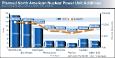 Click on the image at right to view a chart showing the breakdown of planned nuclear units by region.
North America currently has around 100 nuclear sites (74 commercial power plants and the remainder test and research), and there are over 400 worldwide, and as developing countries continue to build nuclear reactors to produce energy for their needs, the U.S. must take and play an active role in proliferation all over the globe. Developing countries could possibly account for one-third of all nuclear power produced by 2050. Through leadership, the U.S. can observe and monitor the other nuclear plants around the world, but it also will keep the country on top of nuclear technology, process development and waste disposal. The U.S. is also planning for a time when the natural resources and fossil fuels have been depleted, or are unavailable, given a geopolitical stance with nations that currently have an abundant reserve of natural gas or oil. For nuclear power to prosper and be made more available to the growing populations demand for electricity, the government must work with the nuclear industry to provide incentives and tax breaks to allow more feasible investment. Nuclear power should also be considered and categorized by the government as a carbon-free producer and thereby qualifying it for the tax credits other green energy sources are awarded. The public needs to be better educated in regards to the safety and reliability of nuclear power. As waste issues are addressed, more technology and time can be devoted to the storage or reprocessing of spent fuelAnd as the technology develops and the population grows, nuclear energy will be needed as a major energy supplier. The demand for energy is not going away. The pollution of fossil fuel energy producers, as well as finite natural resources being depleted makes nuclear energy the most prolific option available.  For details on North American nuclear power plants and expansion plans check out Industrial Infos newly updated Nuclear Power Industry Wall Map. Click on the image at right or contact Industrial Infos Member Services Hotline at 1-800-762-3361 to gain access to the most powerful industrial information available.
Industrial Info Resources (IIR) provides marketing communication services ranging from industrial database solutions to market forecasting, custom analytics, and specialty promotions that support high-level image campaigns. View these related products in our online catalogue North American Power Industry Spending Wall Map 2007 North American Power Industry Forecast Plant Contacts Mailing Lists |
| © 2026 ALL RIGHTS RESERVED. Industrial Info Resources, Inc. |

