Production
Safe Enough to Drink: Will New Hydraulic Fracturing Fluids Allay Public's Fears?
Privately, some natural gas executives say the only way to convince the public that fluids used in hydraulic fracturing ('fracking') are safe would be for an executive to drink them publicly. Looks like Halliburton heard the comments and took up the challenge.
Released Monday, August 29, 2011
Written by John Egan for Industrial Info Resources (Sugar Land, Texas)--Privately, some natural gas executives say the only way to convince the public that fluids used in hydraulic fracturing ("fracking") are safe would be for an executive to drink them publicly. Looks like Halliburton heard the comments and took up the challenge.
Earlier this month, during an address to the annual conference of the Colorado Oil & Gas Association (COGA) (Denver, Colorado), Dave Lesar, chairman, president and chief executive at Halliburton Company (NYSE:HAL) (Houston, Texas), extolled the merits of the company's new fracking fluid, which is manufactured from materials sourced entirely from the food industry. Lesar then asked another conference attendee to come to the podium and demonstrate how safe the new fluid was by drinking it, according to an Associated Press report that cited two people who attended Lesar's speech.
What that executive drank apparently was CleanStim Formulation, which Halliburton introduced last November as the first-of-its-kind hydraulic fracturing fluid. However, a Halliburton website said, "Now, are we saying you should eat the stuff? Nope. But when diluted and used as directed, we are saying it's an exciting new innovation in the field--one that reduces chemical exposure risk at and below the wellsite.
One person who saw the executive drink the fracking fluid at the Denver COGA conference, Environmental Defense Fund's Mark Brownstein, told the Associated Press: "I thought, if this stuff was so benign, why wouldn't the CEO drink it himself? I'm pleased to see Halliburton is taking steps to remove toxic chemicals from hydraulic fracturing fluid."
Brownstein called the August 3 event "a stunt," but he added: "This is very much indicative of the problem the industry has in assuring the public that they are in fact taking public concerns seriously."
"The industry is stepping up to plate and taking these concerns seriously," said Ken Carlson, a Colorado State University environmental engineering professor who also attended the COGA conference. "Halliburton is showing they can get the same economic benefits or close to that by putting a little effort into reformulating the fluids."
Over the last few years, Oil & Gas companies have used advanced drilling techniques and technology to develop trillions of cubic feet of gas previously thought to be uneconomical to produce. Now, the question is whether the burgeoning shale industry can convince antsy regulators, angry environmentalists and an anxious public that the process used to produce oil and gas from shale formations is safe.
Energy executives agree that the shale revolution could be slowed, halted, or even reversed by the actions of state or federal regulators, A-List Hollywood stars or localized protest groups. State and federal regulators are conducting separate investigations into the impact that hydraulic fracturing could have on local water supplies, livestock, and ecosystems. In the fracking process, huge amounts of water, chemicals, and proppants like sand are mixed and injected at high pressure to shatter the shale rock and release the hydrocarbons.
By any measure, the shale revolution has transformed the act of exploring for and producing oil and natural gas. Natural gas contained in U.S. shale formations has more than tripled since 2006, according to a recent estimate from the Potential Gas Committee. For more on this issue, see the May 3, 2011, article - U.S. Natural Gas Resource Base Grows, Keeping Prices Low.
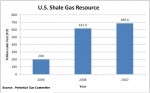 Click on image at right to see the dramatic growth of U.S. shale gas resources.
The U.S. has six major shale formations, and several smaller shale plays. Collectively, Industrial Info is tracking more than $13 billion of capital projects that are planned or under way at these six shale formations. Most of the $13 billion in project spending will be devoted to building processing facilities and pipelines to bring the shale gas to market. Billions of additional dollars have been and will continue to be invested in the shale wells themselves.
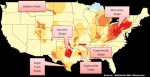 Click on image at left for a map of the six major U.S. shale formations.
The significant additions of new gas reserves--both from shale formations and other, more traditional plays--have helped to hold down natural gas prices. Natural gas is selling for about $4 per million British thermal units (MMBtu), and is projected to remain at this relatively low level for the next few years. Some experts even warn that excess supply could lower current natural gas prices by $1 or more per MMBtu.
One energy executive told Industrial Info, "Shale is THE big thing in the energy industry now--everyone's betting on shale to keep gas at $4 per MMBtu." But this executive shared the concerns of other executives about the public relations problems that have clouded the shale revolution: "Shale has two Achilles heels: public perception and wastewater handling," said a second energy executive.
The controversy over fracking practices has been widely, and generally negatively, covered by major national news media, including CNN, The New York Times, "60 Minutes," USA Today, The Wall Street Journal and The Philadelphia Inquirer.
Several Hollywood movie stars, including Ethan Hawke and Mark Ruffalo, have waged campaigns against fracking in recent years, alleging the practice contaminates local water supplies, places livestock in danger, and damages local ecosystems.
Whether federal and state regulators agree with the Oil Patch and give fracking a clean bill of health is today's multibillion-dollar question. One gas company executive told Industrial Info: "Eventually, the science on hydraulic fracturing will win, if we don't have problems on the surface" with wastewater treatment and disposal. "But remember, in today's world, perception is reality and facts are negotiable."
Industrial Info Resources (IIR) is the leading provider of global market intelligence specializing in the industrial process, heavy manufacturing and energy markets. IIR's quality-assurance philosophy, the Living Forward Reporting Principle, provides up-to-the-minute intelligence on what's happening now, while constantly keeping track of future opportunities.
/news/article.jsp
false
Want More IIR News Intelligence?
Make us a Preferred Source on Google to see more of us when you search.
Add Us On GoogleAsk Us
Have a question for our staff?
Submit a question and one of our experts will be happy to assist you.

Forecasts & Analytical Solutions
Where global project and asset data meets advanced analytics for smarter market sizing and forecasting.
Explore Our SolutionsRelated Articles
-
Alberta Heralds Start of New CCS ProjectJune 08, 2026
-
Trans Mountain Pipeline Could Accommodate More Crude OilJune 08, 2026
-
Upstream Responded to War-Related Spike in Oil PricesJune 05, 2026

Industrial Project Opportunity Database and Project Leads
Get access to verified capital and maintenance project leads to power your growth.
Discover Our DatabaseIndustry Intel
-
2026-2027 Investment Radar for Mexico, Central America & the CaribbeanPodcast Episode / May 29, 2026
-
Innovations Shaping the Next Era of Power GenerationPodcast Episode / May 22, 2026
-
The Role of Contract Manufacturing in Global Pharma GrowthPodcast Episode / May 8, 2026
-
2026 North American Labor OutlookPodcast Episode / Apr 24, 2026
-
2026 European Metals & Minerals Project Spending OutlookPodcast Episode / Apr 7, 2026