Written by John Egan for IIR News Intelligence (Sugar Land, Texas)
Summary
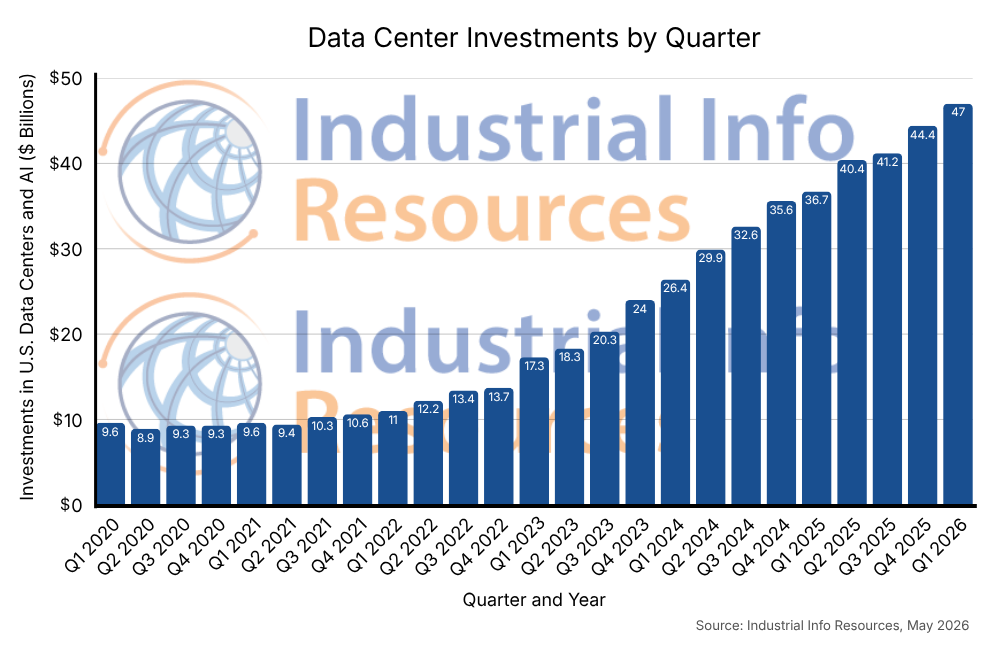
U.S. businesses invested more than $44 billion in data centers in the first quarter, continuing a rise in outlays aimed at winning the artificial intelligence contest. Those investments may jump even further based on planned capital expenditures from Big Tech companies.Capital Investments in Data Centers Continue to Soar
U.S. businesses invested $44.7 billion in data centers during the first quarter of 2026, a 28% gain over the year-earlier quarter, according to data released April 30 by the Bureau of Economic Analysis (BEA), a branch of the U.S. Department of Commerce.While a 28% gain would be healthy for any industry, there are signs that the industry's recent past capital outlays to build data centers are only a small down payment on tomorrow's digital economy. According to Industrial Info Resources data, data center developers and Big Tech firms plan to start construction on 2,913 data centers valued at approximately $2.4 trillion over the 2026-2030 period. For more information on these planned projects, the Industrial Info Resources Global Market Intelligence (GMI) Data Center Plant and Project databases offer key details--including key contractors, investment values and necessary equipment.
Companies Announce Huge Capex Plans for Data Centers
Planned capital outlays to build data centers have been turbocharged by announcements made by Big Tech firms during recent earnings calls with investors, bankers and analysts:- Amazon told investors its data center capex would rise to $200 billion this year.
- Microsoft plans to invest about $190 billion in data centers this year.
- Alphabet, parent of Google, put its planned capex this year at between $180 billion and $190 billion.
- Meta told investors it plans to make capex outlays of between $125 billion and $145 billion this year.
- Oracle said it plans to spend about $50 billion on data centers this year.
- CoreWeave said it planned to invest between $30 billion and $35 billion in data centers this year.
- Last year, Apple said it would invest $500 billion in U.S. data centers over the next four years.
Big Plans, but Big Headwinds Too
"Industrial Info Resources does not expect all proposed U.S. data centers over the 2026-2030 period to begin construction as planned," commented David Pickering, Industrial Info Resources' vice president of research for the Industrial Manufacturing sector, which includes data centers. "This is an extraordinarily dynamic industry, both in terms of technology advancement and AI aspirations. Projects will drop out. Projects will be delayed, typically due to supply chain bottlenecks. But new projects are sure to be added. Watch this space.""Six months ago," Pickering continued, "before Anthropic released Claude Code, we were a little skeptical of planned capex outlays to build data centers. Back then, there was no proven use case for AI data centers beyond generative AI chatbots, for which we believed the world had a limit. But Claude Code, which offers advanced coding capabilities, has redesigned a wide range of business processes and reportedly led to significant productivity gains by users across a number of industries. Competing platforms have since been introduced by Anthropic's competitors. So it seems a new phase of the AI arms race kicked off."
For an earlier, more skeptical assessment of Big Tech's data center aspirations, see October 13, 2025, article - Data Centers: Is the Buildout Starting to Become a Bubble?
Pickering noted rising local opposition to planned construction of data centers, which in some areas could constitute a difficult-to-overcome obstacle. Ultimately, the fate of data centers lies in thousands of city councils across the U.S. who must vote on zoning changes, tax incentives and permits that would allow developers and Big Tech firms to build data centers in their communities. And that local opposition is growing. For more on that, see April 8, 2026, article - Data Center Opposition Growing Across States.
Nearly a dozen states have considered some type of law pausing data center construction, but those bills have died amid a concerted lobbying effort by Big Tech firms. The Maine legislature passed an 18-month pause on construction of new data centers last month, but the governor vetoed it and the legislature could not muster the two-thirds majority necessary to override the veto. For more on that, see May 4, 2026, article - Maine Lawmakers Fail to Override Governor's Veto of Bill Pausing Data Center Construction.
By the Numbers
- $387 billion: The value of capital investment in U.S. data centers in 2025, according to Moody's Investors Service.
- $700 billion: Capital expenditures to build data centers in the U.S. in 2026, Moody's projected.
- $820 billion: Moody's estimate of 2027 capital outlays to build data centers in the U.S.
- $2.4 trillion: What Industrial Info Resources is tracking in planned capital outlays to build U.S. data centers over the 2026-2030 period.
States with Greatest Planned Data Center Capital Outlays
However many data centers are built by the end of 2030, some states continue to be particularly receptive to data center construction. According to Industrial Info Resources data, Texas, Virginia, Georgia and Pennsylvania are the states with the greatest dollar value of planned data center construction scheduled to begin construction between January 2026 and December 2030.Key Takeaways
- Technology companies and data center developers have significantly increased their planned capital outlays to build data centers in the U.S. this year, to an estimated $700 billion, according to the credit-rating agency Moody's.
- Industrial Info Resources is tracking plans to spend about $2.4 trillion to build new data centers in the U.S. over the 2026-2030 period.
- One factor driving data center capital investment is the release of the Claude Code platform, which has reportedly led to significant productivity gains among early users.
- Despite the aspirations of Big Tech firms, how many data centers get built in the U.S. depends heavily on thousands of city councils across the country that must vote on land rezoning, tax incentives and construction permits before data center construction can begin.
- There is growing local opposition to the construction of data centers in the U.S.
About Industrial Info Resources
Industrial Info Resources (IIR) is the leading provider of industrial market intelligence. Since 1983, IIR has provided comprehensive research, news and analysis on the industrial process, manufacturing and energy related industries. IIR's Global Market Intelligence (GMI) helps companies identify and pursue trends across multiple markets with access to real, qualified and validated plant and project opportunities. Across the world, Industrial Info Resources is tracking over 250,000 current and future projects worth $30.2 Trillion (USD).
/iirenergy/industry-news/article.jsp
false
Want More IIR News Intelligence?
Make us a Preferred Source on Google to see more of us when you search.
Add Us On GoogleAsk Us
Have a question for our staff?
Submit a question and one of our experts will be happy to assist you.
Explore Our EnergyLive Tools
EnergyLive Tools provide instant insight into new build, outages, maintenance, and capacity shifts across key energy sectors.
Learn MoreRelated Articles

Explore Our Enery Industry Reports
Gain the competitive edge with IIR Energy’s suite of energy market reports, designed for traders, analysts, and asset managers who rely on verified, real-time data.
Learn MoreIndustry Intel
-
2026 North American Labor OutlookPodcast Episode / Apr 24, 2026
-
2026 European Metals & Minerals Project Spending OutlookPodcast Episode / Apr 7, 2026
-
The Age of Critical Minerals in the AmericasPodcast Episode / Mar 20, 2026
-
2026 Regional Chemical Processing OutlookPodcast Episode / Mar 6, 2026
-
From Data to Decisions: How IIR Energy Helps Navigate Market VolatilityPodcast Episode / Nov 21, 2025