Written by Aaron Studwell, Ph.D., Energy Meteorologist & Analyst (Sugar Land, Texas)
Summary
The 2026 Atlantic hurricane season officially begins today. This launches a six-month period that historically produces some of the most significant weather-related disruptions to North American energy, industrial, and transportation infrastructure.Uncertainty Remains
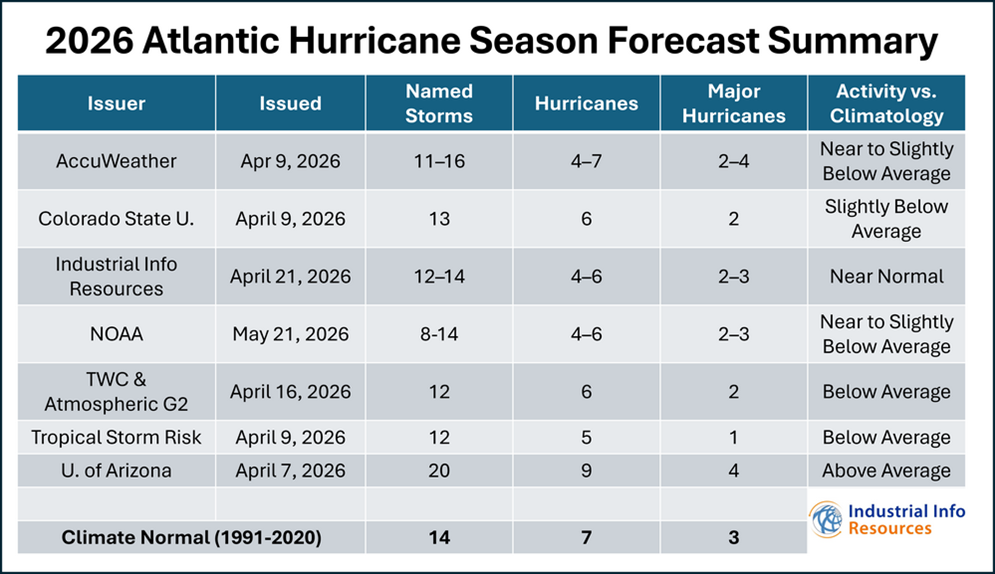
While forecasters generally expect Atlantic hurricane activity to remain below the elevated levels observed during recent seasons, uncertainty remains regarding the balance between a strengthening El Niño and persistently warm ocean temperatures across portions of the Atlantic. According to Industrial Info Resources data, there are 250 power- and energy-related projects under construction with a combined investment value of $141 billion in U.S. Gulf Coast states. Offshore, there are nine Oil & Gas Production projects under construction in the U.S. Gulf, worth $2 billion.According to Industrial Info Resources analysis, the 2026 Outlook is for 12 to 14 named storms, 4 to 6 hurricanes, and 2 to 3 major hurricanes. IIR also notes that the greatest risk to energy and industrial markets is not necessarily the total number of storms. Rather, "it only takes one storm" to make landfall near major concentrations of refining, petrochemical, power generation, transmission, or export infrastructure along the Gulf or Atlantic Coasts to become a historic event.
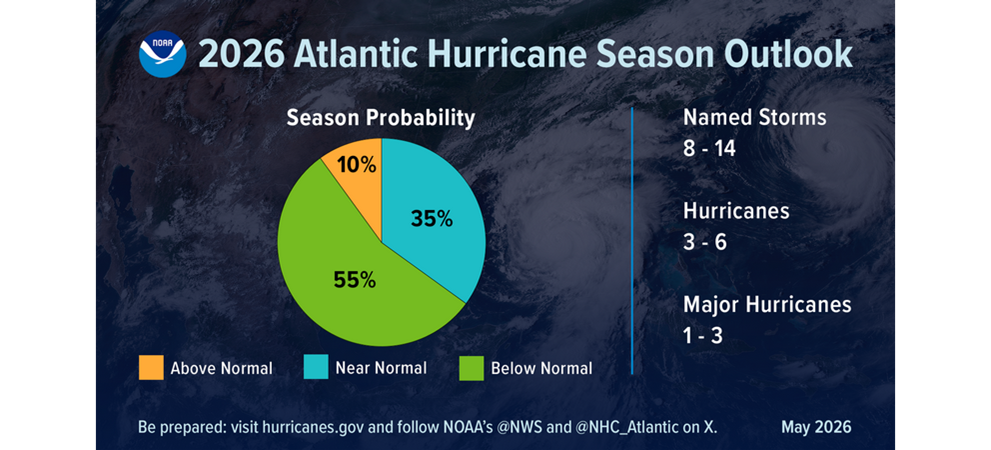
The U.S. National Oceanic and Atmospheric Administration (NOAA) recently issued its official outlook for the 2026 Atlantic hurricane season, forecasting 8 to 14 named storms, including 3 to 6 hurricanes and 1 to 3 major hurricanes. NOAA assigns a 55% probability to a below-normal season, a 35% chance of a near-normal season, and only a 10% chance of above-normal activity.
El Niño Expected to Become the Dominant Atmospheric Driver
The primary factor behind IIR and NOAA's outlooks, along with private-sector forecasts, is the expected development and strengthening of El Niño conditions across the equatorial Pacific Ocean.El Niño events typically increase upper-level winds across the tropical Atlantic and Caribbean Basin, creating strong vertical wind shear that disrupts the formation and organization of tropical cyclones. Seasonal forecast guidance indicates El Niño will likely strengthen through summer and remain in place during the peak of hurricane season from August through October.
Warm Atlantic Waters Continue to Support Tropical Development
Despite the anticipated El Niño influence, ocean temperatures remain a critical part of the seasonal outlook.Forecast guidance suggests sea-surface temperatures across portions of the Gulf of Mexico, Caribbean Sea and western Atlantic will remain above normal through much of the hurricane season. While temperatures are not expected to approach the record-breaking levels experienced in 2023, they remain warm enough to support tropical cyclone development and periods of rapid intensification.
This competing relationship between atmospheric suppression and oceanic support has emerged as the central theme of the 2026 hurricane outlook. Most major forecasting groups--including NOAA, Colorado State University, Tropical Storm Risk, AccuWeather, The Weather Company and Industrial Info Resources--anticipate near-normal to below-normal activity. However, forecast differences remain significant regarding the extent to which Atlantic warmth can offset increasing wind shear.
Energy Infrastructure Remains Vulnerable Regardless of Storm Totals
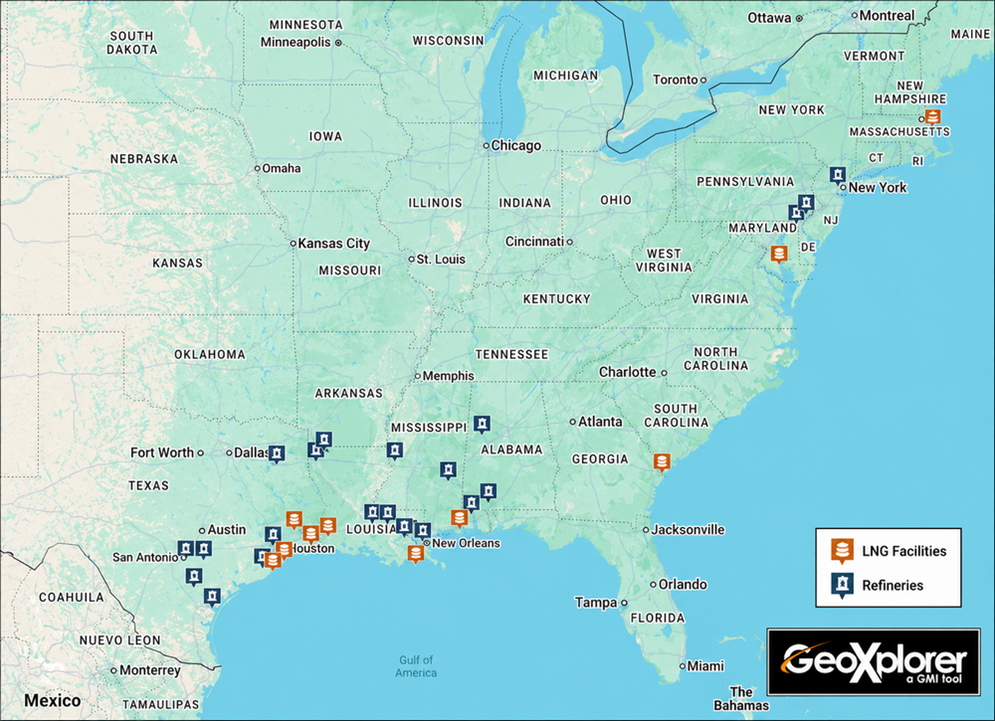
For energy and industrial operators, seasonal storm counts provide only part of the risk assessment.The Gulf Coast remains home to a substantial share of U.S. refining capacity, petrochemical manufacturing, liquefied natural gas (LNG) export infrastructure, offshore oil and gas production, and electric transmission assets. A single hurricane landfall or slow-moving tropical system can generate impacts that far exceed what seasonal statistics alone might suggest.
According to Industrial Info Resources data, there are 25 operational refineries and 14 LNG facilities along the Gulf and Atlantic coasts that could be subjected to impacts due to winds, storm surge, along with coastal and inland flooding risks.
Key Takeaways
- NOAA and Industrial Info Resources both forecast a near- to below-normal 2026 hurricane season.
- Industrial Info Resources projects 12-14 named storms, 4-6 hurricanes, and 2-3 major hurricanes.
- Developing El Niño is expected to suppress Atlantic tropical activity during peak season.
- Warm Gulf, Caribbean, and western Atlantic waters still support tropical development.
- Twenty-five operational refineries and 14 LNG facilities are in potential high impact regions.
About Industrial Info Resources
Industrial Info Resources (IIR) is the leading provider of industrial market intelligence. Since 1983, IIR has provided comprehensive research, news and analysis on the industrial process, manufacturing and energy related industries. IIR's Global Market Intelligence (GMI) helps companies identify and pursue trends across multiple markets with access to real, qualified and validated plant and project opportunities. Across the world, Industrial Info Resources is tracking over 250,000 current and future projects worth $30.2 Trillion (USD).
/iirenergy/industry-news/article.jsp
false
Want More IIR News Intelligence?
Make us a Preferred Source on Google to see more of us when you search.
Add Us On GoogleAsk Us
Have a question for our staff?
Submit a question and one of our experts will be happy to assist you.

Explore Our EnergyLive Tools
EnergyLive Tools provide instant insight into new build, outages, maintenance, and capacity shifts across key energy sectors.
Explore Our ToolsRelated Articles
-
Nigeria Aims for 62 GW Power Capacity by 2030, Driven by 77%...September 02, 2026
-
Egypt Plans Two More Reactors at El-Dabaa Nuclear PlantSeptember 02, 2026

Explore Our Enery Industry Reports
Gain the competitive edge with IIR Energy’s suite of energy market reports, designed for traders, analysts, and asset managers who rely on verified, real-time data.
View ReportsIndustry Intel
-
The Answer Age Starts with Trusted Data: Introducing IIR Envoy™ MCPPodcast Episode / Sep 1, 2026
-
European Chemicals and Transport Fuels OutlookPodcast Episode / Jul 10, 2026
-
2026 European Petroleum Refining Project OutlookPodcast Episode / Jun 26, 2026
-
Brazil: Efficiency, Innovation, and Opportunities in the Food & Beverage IndustryPodcast Episode / Jun 12, 2026
-
2026-2027 Investment Radar for Mexico, Central America & the CaribbeanPodcast Episode / May 29, 2026