Written by Aaron Studwell, Ph.D., Energy Meteorologist & Analyst (Sugar Land, Texas)
Summary
Extreme heat, drought and wildfires are simultaneously disrupting Europe's power generation, industrial logistics, transportation networks and economic activity. Industrial Info Resources tallies the damage from Europe's record summer temperatures.No Escape from the Heat
The scorching summer of 2026 across Europe will be remembered for the compounded energy and industrial disruption, rather than a straightforward increase in electricity demand. Successive heatwaves have raised cooling loads while restricting nuclear, hydroelectric and wind generation. Drought and falling river levels are disrupting fuel deliveries and industrial shipping. Additionally, widespread wildfires are threatening communities, transportation corridors, tourism and agricultural production.Western Europe recorded its hottest June on record. Across all European land areas, the average temperature was 1.8 degrees Celsius above the 1991-2020 average; this was the second highest for June in the climatological dataset. Numerous monthly and all-time temperature records were broken during the heatwave's most intense period.
Industrial Info Resources analysis demonstrates how weather can affect both sides of Europe's power balance at once. Increasing residential and commercial electricity demand was overlaid with increased cooling requirements for data centers and industrial facilities, while extreme heat and drought simultaneously reduced the availability of several major generation sources.
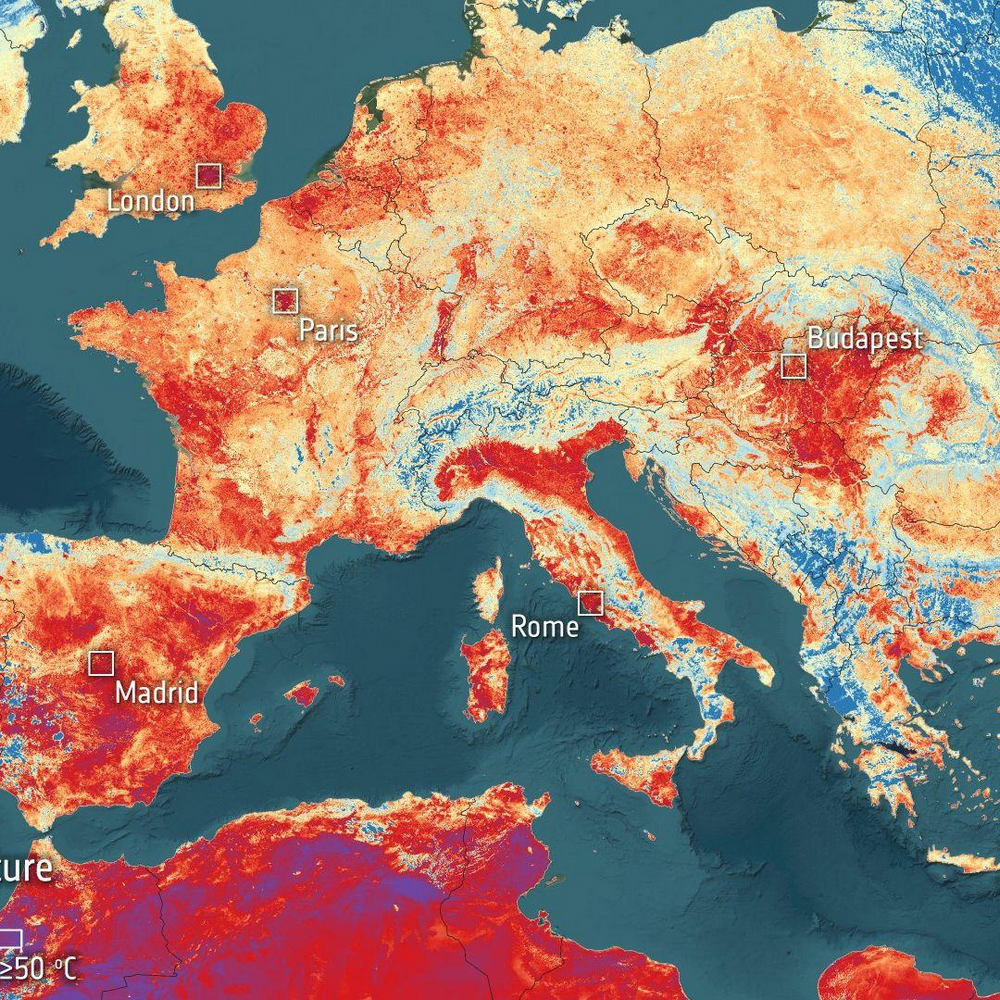 Copernicus Sentinel-3 land surface temperature map showing extreme heat across western and southern Europe during the June 2026 heatwave. Surface temperatures exceed 50 degrees Celsius (122 degrees Fahrenheit) in parts of Spain and France. Source: European Space Agency
Nuclear Power Constrained by Warm, Low Rivers
France's nuclear fleet illustrates the vulnerability of extreme weather. Many reactors draw cooling water from rivers, and they must comply with environmental limits on the temperature of water discharged back into those rivers. When river temperatures become too high, Electricité de France S.A. (EDF) will reduce reactor output, or even temporarily stop generation to prevent additional ecological stress.During the early-summer heatwave, unusually warm water in the Rhône, Garonne and other rivers led to generation restrictions at multiple French nuclear stations. Although these curtailments did not threaten national reliability, they removed several gigawatts of low-cost generation when electricity demand and wholesale prices already were rising.
More than 90% of EDF's electricity production in France depends on water, either directly through hydropower or indirectly as a cooling resource for nuclear and thermal plants. In 2025, nuclear and renewable resources supplied more than 95% of mainland French electricity, and the country recorded a net electricity export balance of 92.3 terawatt-hours. The surplus normally would provide an operational buffer; however, repeated summer curtailments could reduce France's ability to support neighboring markets during regional heat events.
These impacts on nuclear generation are now developing farther east as the season evolves. Romania shut both 706-megawatt units at its Cernavoda nuclear plant as historically low Danube flows restricted cooling water availability. The reactors normally provide about 20% of Romania's electricity. Hungary also reduced nuclear availability at the Paks plant, increasing regional reliance on imports and higher-cost generation.
Great Britain faced a different generation problem during the late-June heatwave. A ridge of high pressure settled over the U.K., yielding unusually hot conditions. This weather system also resulted in lower wind generation at a time of elevated electricity demand.
Great Britain's National Energy System Operator reported that the combination of low wind output, reduced gas-generation availability, and sustained demand created challenging operating conditions in late June. While grid frequency remained within operational limits, the episode required active system management and illustrated the need for dispatchable reserves during prolonged hot, calm weather.
This weather event was especially significant for Britain, as wind represents a major share of its power supply. Solar generation can perform strongly during clear summer weather, but output begins declining before the evening cooling peak ends. Low wind availability can therefore increase reliance on natural gas, electricity imports, storage and other balancing resources during the late afternoon and evening.
The result is not necessarily a shortage of total energy, but a shortage of flexible generation at the hours it is most valuable. As air conditioning adoption expands across northern Europe, grid planners will increasingly need to account for heat-driven evening electricity demand that historically has been far less significant than regional winter peaks.
Drought Disrupts Hydropower, Fuel and Industrial Logistics
Low river levels are extending their impact beyond nuclear generation. Serbia's largest hydropower plant, Djerdap 1, recently produced only about one-third of its normal electricity because of reduced Danube flows. Shallow water also limits barge and tanker loads to approximately 30% to 40% of capacity, while impacting water cooling at nearby coal-fired generation plants.Constraints also have developed on the Rhine, one of Europe's most important industrial waterways. Barges have been forced to sail with sharply reduced cargo loads, increasing the cost of moving petroleum products, chemicals, coal, ores and manufactured goods into Germany's industrial centers.
Some vessels reportedly operated at only about 20% of normal capacity; charges and additional shipments raise costs, even when factories remain operational. If conditions deteriorate further, companies may be forced to shift cargo to rail or trucks, draw down inventories, or reduce production. The problem is particularly significant for chemical plants, refineries, steelmakers and power stations that require continuous deliveries of high-volume raw materials.
Agriculture also is competing for diminished water supplies. Danube levels in Romania fell to their lowest point since 1996, resulting in irrigation restrictions and disruptions to shipping and tourism. Persistent heat can reduce crop yields, increase livestock stress and raise food-processing costs, adding another layer to Europe's inflation and supply-chain risks.
Elevated Wildfire Risk Persists Across Southern Europe
Wildfires transformed the heatwave from what started as an energy-system challenge into a broader regional emergency. The European Forest Fire Information System reported that more than 254,000 hectares (about 68,000 acres) had burned in the European Union by July 22, well above the 20-year average.Wildfires across southern Europe, including portions of France, Spain, Greece and other countries, have prompted evacuations, damaged homes and businesses, degraded air quality, and placed transportation and transmission infrastructure at risk. Tourism-dependent communities are losing revenue during the peak summer season, while agricultural operations face direct fire damage and interruptions caused by evacuations and road closures.
There also is an increased risk to the power supply and demand infrastructure, due to potential damage to transmission lines, substations and distribution networks. Utilities may de-energize equipment where fire or smoke threatens system integrity, while firefighting operations require significant electricity, fuel, water and transportation resources.
The economic effects will continue after flames are contained. Ash and erosion will contaminate reservoirs, rivers and coastal waters, affecting drinking-water systems, aquaculture and industrial users.
Looking Beyond El Niño
With El Niño continuing to intensify across the tropical Pacific, it's tempting to attribute every major heatwave to this phenomenon. However, Europe's record summer has been driven far more by regional weather patterns than by conditions across the Pacific Ocean basin.The dominant factor has been a persistent ridge over western and central Europe, reinforced by favorable North Atlantic patterns, including the North Atlantic Oscillation (NAO). This pattern has allowed hot, dry air to remain in place for extended periods, suppressing cloud cover and rainfall while maximizing daytime heating. Drought has further amplified temperatures by reducing soil moisture, allowing more incoming solar energy to heat the air instead of evaporating water.
El Niño may be contributing to a warmer global background state, but attribution studies indicate it is not the primary driver of Europe's current heat. Rather, it is the regional atmospheric circulation, coupled with an already warmer climate that has produced a prolonged heat, drought and elevated wildfire risk.
Key Takeaways
- Europe's extreme heat is increasing electricity demand while simultaneously reducing nuclear, hydroelectric and wind generation.
- Low river levels are restricting cooling water, hydropower production, and commercial shipping across major waterways, including the Danube and Rhine.
- Persistent ridging, drought and North Atlantic weather patterns--not El Niño alone--are the primary drivers of Europe's prolonged heatwave. /li>
About Industrial Info Resources
Industrial Info Resources (IIR) is the leading provider of industrial market intelligence. Since 1983, IIR has provided comprehensive research, news, and analysis on the industrial process, manufacturing, and energy-related industries. IIR's Global Market Intelligence (GMI) helps companies identify and pursue trends across multiple markets with access to real, qualified, and verified plant and project opportunities. Across the world, Industrial Info Resources is tracking over 250,000 current and future projects worth $30.2 trillion (USD).
/iirenergy/industry-news/article.jsp
false
Want More IIR News Intelligence?
Make us a Preferred Source on Google to see more of us when you search.
Add Us On GoogleAsk Us
Have a question for our staff?
Submit a question and one of our experts will be happy to assist you.

Explore Our EnergyLive Tools
EnergyLive Tools provide instant insight into new build, outages, maintenance, and capacity shifts across key energy sectors.
Explore Our ToolsRelated Articles
-
U.S. Data Center Construction Starts Still Soaring Despite S...October 20, 2026
-
Canada Builds Out Nuclear Power InfrastructureOctober 20, 2026
-
Paraguay Opens Doors to Nuclear EnergyOctober 20, 2026
-
Europe's Mild Winter Outlook Tests Natural Gas PreparednessOctober 16, 2026
-
South Korea's US$747 Billion Energy Transition PlanOctober 16, 2026

Explore Our Enery Industry Reports
Gain the competitive edge with IIR Energy’s suite of energy market reports, designed for traders, analysts, and asset managers who rely on verified, real-time data.
View ReportsIndustry Intel
-
Brazil Critical Minerals 2027: Rare Earths, Lithium, CopperPodcast Episode / Oct 16, 2026
-
US Craft Labor Outlook 2026: Wages, Per Diems, Data CentersPodcast Episode / Oct 16, 2026
-
Latin America Data Center Outlook 2026: Power, Hubs & GrowthPodcast Episode / Oct 9, 2026
-
Food and Beverage CapEx Outlook 2026: Tariffs, AI, AfricaPodcast Episode / Oct 9, 2026
-
North America Refining 2026: New Pipelines to PADD 5Podcast Episode / Oct 2, 2026