Written by John Egan for IIR News Intelligence (Sugar Land, Texas)
Summary
Worldwide use of electricity by data centers is expected to more than double by 2030, to about 950 terawatt-hours, though there are a number of factors that could push that number up or down, according to a new report from the International Energy Agency (IEA).Electricity Use, Data Centers and AI
According to Industrial Info Resources data, roughly 4,130 data centers are operating around the world; about 43% of those, or about 1,800, are in the U.S.Industrial Info Resources is tracking more than 4,500 data center projects worldwide that are scheduled to begin construction between January 2026 and December 2028, valued at about $2.63 trillion. Of that total, about 2,160 projects valued at about $1.74 billion are scheduled to be built in the U.S.
Powering those computer complexes has been a significant challenge for the Power Industry. For most of the past two years, a dynamic game of "moving the goalposts" has unfolded: Developers announce projects, utilities increase their planned capital outlays, Wall Street weighs in, and the whole cycle begins again. On a regular basis, lawmakers announce incentives to attract proposed projects to a certain area, while regulators, and occasionally lawmakers, set up guardrails to ensure that data centers pay their own way to build the electric infrastructure to serve those computer campuses.
Within the data center sector, there is a widespread assumption that not all announced data centers will be built as planned. Various factors could accelerate or decelerate the rate of construction over the next few years.
Making matters more complex, older, traditional data centers, which draw on large language models to handle simple online queries sent to chatbots such as ChatGPT and Gemini, are still being built, but they gradually are being eclipsed by agentic AI, which uses far more electricity than traditional data centers to perform a much wider range of tasks, including autonomously interacting with other AI systems.
While overall data center electricity use by AI is set to double by 2030, power use from those focused on agentic AI is poised to triple.
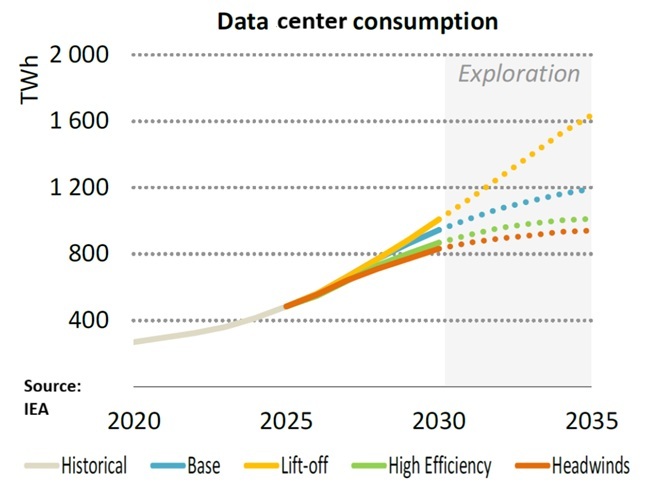
In a new report, "Key Questions on Energy and AI," released April 16, the International Energy Agency (IEA) uses four scenarios to project future global electricity use by this sector. Worldwide electricity use by data centers has risen from about 360 terawatt-hours (TWh) in 2023 to 416 TWh in 2024 and approximately 485 TWh in 2025, the IEA said.
It is a baseline assumption by the IEA that future electricity use will rise. But by how much, and how fast? The 138-page report explored factors that could accelerate, and decelerate, the rate of electric demand growth from data centers and AI.
By the Numbers
In "Key Questions on Energy and AI," the agency used the four scenarios it unveiled in last year's report on this topic to look further into the future of data centers' impact on electricity use around the world:
- In IEA's Base Case, global electricity use by data centers is estimated to rise to 945 TWh in 2030 and 1,193 TWh in 2035.
- The agency's Lift-Off scenario estimated that electricity use reaches 1,008 TWh in 2030 and 1,637 TWh in 2035.
- In a third case, High Efficiency, worldwide electricity use by data centers hits 868 TWh in 2030 and 1,013 TWh in 2035.
- IEA's Headwinds scenario sees electricity use by data centers rising to 833 TWh globally in 2030 and 942 TWh in 2035.
Factors that Could Accelerate Electric Demand Growth
The IEA report explored several factors that could push AI energy use past the Base Case and into--or beyond--the Lift-Off scenario. One of those factors is the dramatic efficiency gains AI has recorded, which could lead to increased future demands on data centers, which could in turn push up electric demand growth estimates.Measured per individual task, the new IEA report said, "the energy efficiency of AI is improving at a rate unprecedented in energy history. Software and hardware advances have resulted in energy use per AI task dropping by at least an order of magnitude annually in recent years. Simple text queries now typically consume less electricity than running a television over the same period of time."
"However," it added, "new energy-intensive AI applications are increasingly being launched and used, such as those for video generation, reasoning and agentic tasks. These kinds of tasks can consume hundreds or thousands of times more energy per query than simple text generation. The energy demand of AI is therefore the result of three rapidly evolving and uncertain trends: improvements in efficiency; surging uptake; and changing model capabilities, which can unlock new and, in many instances, far more energy-intensive use cases."
Factors that Could Slow Electric Demand Growth
The IEA report explored several factors that could slow data center construction and electric demand growth through 2030 and 2035. These include:- Local opposition to data centers, based on concerns over electric costs and the environmental impact of data centers.
- Public policies that slow, rather than accelerate, the construction of data centers.
- Ongoing supply chain problems, both with procurement of electric generators and associated electric infrastructure to power the data centers, as well as the limited availability of high-speed chips that are the heart of AI.
- Availability of capital. Until late-2025, data center developers and tech companies planned to fund construction of data centers using their own money, drawing on operating revenue and retained earnings. However, as planned projects soared, and those companies sought capital from Wall Street in the form of bonds, stock issuance or private capital, Wall Street pushed back.
Key Takeaways
- Worldwide electricity use by data centers increased about 17% in 2025 compared to 2024 to a total of about 485 terawatt-hours (TWh).
- In IEA's Base Case, global electricity use by data centers is estimated to rise to 945 TWh in 2030.
- Electricity use by data centers could reach an estimated 1,008 TWh in 2030 under fast-growth scenarios explored by the agency in a new report.
- But in two slower-growth cases, electricity use by data centers could rise less rapidly, to between 833 TWh and 868 TWh in 2030.
About Industrial Info Resources
Industrial Info Resources (IIR) is the leading provider of industrial market intelligence. Since 1983, IIR has provided comprehensive research, news, and analysis on the industrial process, manufacturing, and energy-related industries. IIR's Global Market Intelligence (GMI) helps companies identify and pursue trends across multiple markets with access to real, qualified, and verified plant and project opportunities. Across the world, Industrial Info Resources is tracking over 250,000 current and future projects worth $30.2 trillion (USD).
/iirenergy/industry-news/article.jsp
false
Want More IIR News Intelligence?
Make us a Preferred Source on Google to see more of us when you search.
Add Us On GoogleAsk Us
Have a question for our staff?
Submit a question and one of our experts will be happy to assist you.

Explore Our EnergyLive Tools
EnergyLive Tools provide instant insight into new build, outages, maintenance, and capacity shifts across key energy sectors.
Explore Our ToolsRelated Articles

Explore Our Enery Industry Reports
Gain the competitive edge with IIR Energy’s suite of energy market reports, designed for traders, analysts, and asset managers who rely on verified, real-time data.
View ReportsIndustry Intel
-
2026-2027 Investment Radar for Mexico, Central America & the CaribbeanPodcast Episode / May 29, 2026
-
Innovations Shaping the Next Era of Power GenerationPodcast Episode / May 22, 2026
-
The Role of Contract Manufacturing in Global Pharma GrowthPodcast Episode / May 8, 2026
-
2026 North American Labor OutlookPodcast Episode / Apr 24, 2026
-
2026 European Metals & Minerals Project Spending OutlookPodcast Episode / Apr 7, 2026