Written by John Egan for IIR News Intelligence (Sugar Land, Texas)
Summary
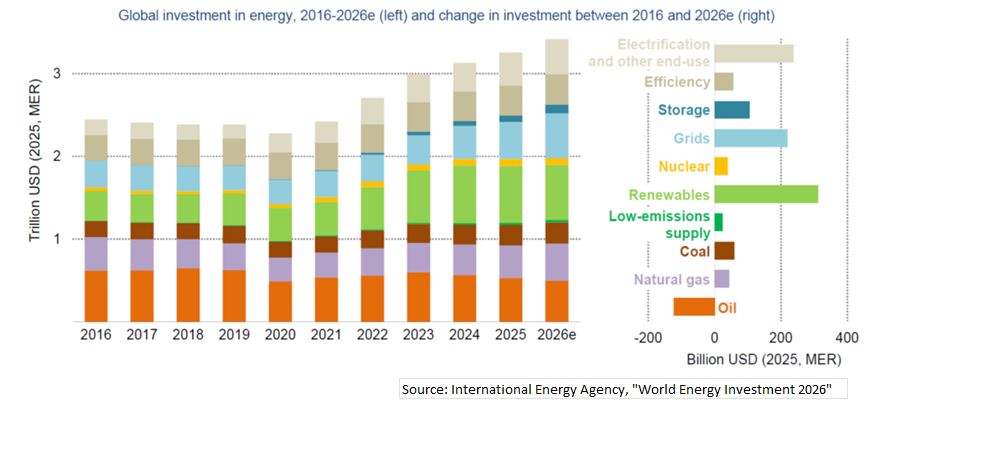
Global capital investment in energy is expected to reach about US$3.4 trillion in 2026, 5% higher than 2025 spending and a continuation of the long-term post-COVID increases in annual outlays for energy, according to a report from the International Energy Agency. Nearly 60% of spending will go to the Electric Power sector. Within the Power sector, spending on renewables and grids are set to outstrip investment in fossil fuel generation this year, the agency forecast. Nations are prioritizing domestic spending in an attempt to insulate themselves from the world's second major energy shock in five years.Global Energy Investment Overview
The world is expected to make capital investments of about US$3.4 trillion this year in energy, up roughly 5% from last year's spend of US$3.2 trillion, according to the International Energy Agency's "World Energy Investments 2026" report, released May 28.Approximately US$2.2 trillion, or 59%, of global energy capital investments will go to the Electric Power sector this year, the agency forecast. In contrast with recent years, more investment will be directed towards grids and storage rather than generation. According to Industrial Info Resources data, there are more than 6,000 Power Industry projects under construction globally, with a total investment value of US$1.68 trillion.
Worldwide fossil fuel extraction projects are expected to receive roughly US$1.2 trillion in capital outlays this year, a slight increase over 2025 spending, the energy agency forecast. A projected decline in oil investment is expected to be largely offset by the anticipated growth in spending for natural gas and coal this year, it said.
By the Numbers
- US$3.4 trillion: Projected worldwide capital spending on energy this year.
- US$2.2 trillion: Amount of projected global energy spend going to Electric Power projects in 2026.
- US$1.2 trillion: Amount of projected global capital spending this year on fossil fuel extraction.
"Building alternative routes to market, strengthening supply chains, allowing for greater redundancy and lower utilization rates for back-up infrastructure, and investing in inventories and other buffers all make the energy system more secure, but also more expensive," it observed.
Boxer Mike Tyson once said, "Everybody has a plan until they get punched in the face." The world's energy producers and consumers have been punched in the face twice in the last five years: the current Middle East conflicts and the ongoing Russian war against Ukraine. How they respond likely will affect the availability, flow and terms of capital investment for the energy sector in the years to come.
Power Sector Investments
Investment in generation is expected to be led by renewables, including solar, wind and hydro, at about US$650 billion, followed by natural gas (slightly over US$100 billion), nuclear (US$80 billion) and coal (approximately US$70 billion), according to the IEA report.Grid investments around the world will continue to surge in 2026, growing nearly 20% to about US$550 billion, the IEA report predicted. Investments in battery energy storage systems (BESS) is expected to grow by more than 35% this year, to an expected US$110 billion. China, the U.S. and Europe are seen as the largest BESS markets in 2026, as they have been for several years.
The agency said the shift to investments in the electric grid and battery energy storage "is a welcome rebalancing of investment flows. Previous editions of the 'World Energy Investment' reports have highlighted how grid investments were lagging those for generation, creating electricity security risks."
The EIA said the nuclear power industry "is making a strong comeback, and could gain further momentum." About 78,000 megawatts (MW) of new nuclear capacity is under construction in 15 countries. and capital outlays this year are expected to exceed US$80 billion.
The report said "orders for new natural gas-fired power plants surged to 130,000 MW in 2025, a 25-year high, with U.S. data center demand a major factor. Until 2023, most gas-fired power plant approvals were made in gas-importing countries, but now the United States and the Middle East dominate the order books, pushing anticipated global investment in gas-fired power to nearly US$120 billion in 2026."
Fossil Fuel Investment
The IEA expects investments in oil will decline in 2026, the third consecutive year that companies are prioritizing returning surplus cash flow to stockholders over investing in new exploration and production. It added, "there are signs that oil companies are recalibrating their expectations for upcoming years, on the assumption that oil prices will settle back above the pre-conflict baseline as countries replenish their inventories."But that decline in oil-related capital spending should be offset by rising investments in global natural gas supply, which IEA calculated will rise to approximately US$330 billion this year, the highest level in a decade.
Coal supply investments have been rising and are seen as reaching about US$180 billion in 2026, the highest level since 2012. China is responsible for nearly 70% of this spending and for almost all approvals of new coal-fired power plants, the report continued. India is the second largest investor in coal supply, and its investments have tripled over the last decade.
Investments Have Reduced Supply Vulnerabilities
The report noted that "oil shocks in the 1970s led to explosive growth in public and corporate spending on R&D (research and development) and innovation, the effects of which are still being felt. A repeat performance today would have a huge influence on future energy trends, although energy is now competing with other innovation priorities in artificial intelligence (AI) and defense."Previous energy shocks have led to "step-changes in policy attention to demand-side efficiency," the report continued. Energy efficiency policies have expanded in recent years, and around US$350 billion is invested worldwide each year in efficiency improvements annually. The IEA said nearly 20 countries have already announced new policies to improve efficiency as a result of the current energy crisis.
Investments in renewables, nuclear, electrification and efficiency in the past decade "have tangibly improved energy security in major fuel-importing regions and reduced emissions," according to the report. These investments in five importing regions (China; the European Union; Japan and Korea; Southeast Asia; and India) avoided around US$260 billion in fossil fuel import costs in 2025, "and the benefits are set to be considerably larger in 2026."
Changing perceptions of energy risk and supply security "are expected to spur renewed interest in a range of domestically available energy resources; for key fuel-importing countries, this creates upside for renewables, nuclear and potentially also for coal."
According to Industrial Info Resources data, energy-related industries--including Electric Power; Oil & Gas Production, Pipelines and Terminals; Petroleum Refining; Alternative Fuels; and Metals & Minerals--plan to begin construction of about 98,042 capital projects valued at roughly $14.8 trillion by the end of 2030.
The countries with the largest dollar value of planned energy capital projects over that time are:
- China (US$2.5 trillion)
- U.S. (US$2.2 trillion)
- India (slightly over US$1 trillion)
- Australia (approximately US$687 billion), and
- Brazil (about US$588 billion)
- Global capital spending on energy will increase about 5% this year, to about US$3.4 trillion, according to a new report from the International Energy Agency.
- Within the Electric Power sector, spending will shift to grids and storage from generation.
- In fossil fuel extraction, oil capital spending will decline this year while outlays for gas and coal are expected to rise.
About Industrial Info Resources
Industrial Info Resources (IIR) is the leading provider of industrial market intelligence. Since 1983, IIR has provided comprehensive research, news and analysis on the industrial process, manufacturing and energy related industries. IIR's Global Market Intelligence (GMI) helps companies identify and pursue trends across multiple markets with access to real, qualified and validated plant and project opportunities. Across the world, Industrial Info Resources is tracking over 250,000 current and future projects worth $30.2 Trillion (USD).
/iirenergy/industry-news/article.jsp
false
Want More IIR News Intelligence?
Make us a Preferred Source on Google to see more of us when you search.
Add Us On GoogleAsk Us
Have a question for our staff?
Submit a question and one of our experts will be happy to assist you.

Explore Our EnergyLive Tools
EnergyLive Tools provide instant insight into new build, outages, maintenance, and capacity shifts across key energy sectors.
Explore Our ToolsRelated Articles
-
Google Goes Nuclear in Nordic Data Center PushSeptember 21, 2026
-
Climate Risk Emerges as Power-Plant Design QuestionSeptember 18, 2026
-
U.S. Developers Re-use Coal-Fired Infrastructure for New Pow...September 18, 2026
-
Brazil Proposes First BESS Project in 2027 Transmission Auct...September 18, 2026

Explore Our Enery Industry Reports
Gain the competitive edge with IIR Energy’s suite of energy market reports, designed for traders, analysts, and asset managers who rely on verified, real-time data.
View ReportsIndustry Intel
-
2026 US Data Center Outlook: Power, Land & CoolingPodcast Episode / Sep 18, 2026
-
2026 Global Power Demand Outlook: Gas, Nuclear & RenewablesPodcast Episode / Sep 18, 2026
-
2026 Oil & Gas CapEx Outlook: Middle East, LNG & PermianPodcast Episode / Sep 4, 2026
-
The Answer Age Starts with Trusted Data: Introducing IIR Envoy™ MCPPodcast Episode / Sep 1, 2026
-
European Chemicals and Transport Fuels OutlookPodcast Episode / Jul 10, 2026