
Written by John Egan for IIR News Intelligence (Sugar Land, Texas)
Summary
Global sales of electric and hybrid vehicle hit 20 million units in 2025, and are projected to reach 23 million cars and trucks this year, despite unfavorable market conditions in the U.S., according to a new report from the International Energy Agency.Global EV Sales Surged in 2025, Expected to Continue
The world gobbled up electric and hybrid vehicles last year, mostly made in China, a new report from the International Energy Agency (IEA) said. That trend is expected to accelerate even faster this year, driven in part by energy security and energy affordability issues raised by the U.S.-Israeli war against Iran, which has effectively closed the Strait of Hormuz, leading to soaring prices for gasoline and diesel. About 20% of the world's crude oil and natural gas traverse the Strait each day.Industrial Info Resources data find 1,078 electric vehicle (EV) capital projects being developed around the world, worth an estimated US$288 billion, with the U.S. and China far and away the leading countries.
A number of automakers, most recently Honda, have sharply trimmed or abandoned their EV efforts in the face of unrelenting hostility from the Trump administration. For more on that, see May 15, 2026, article - U.S. Consumers Mull EVs Amid Higher Gasoline Prices.
More than 20 million electric and hybrid vehicles were sold around the world last year, with China accounting for over 50% of those sales, followed by Europe, noted the IEA report, "Global EV Outlook 2026," which was released May 20. The report includes battery electric vehicles, plug-in hybrid vehicles and extended-range electric vehicles. The report grouped all three types of electrified vehicles under the electric vehicle (EV) umbrella.
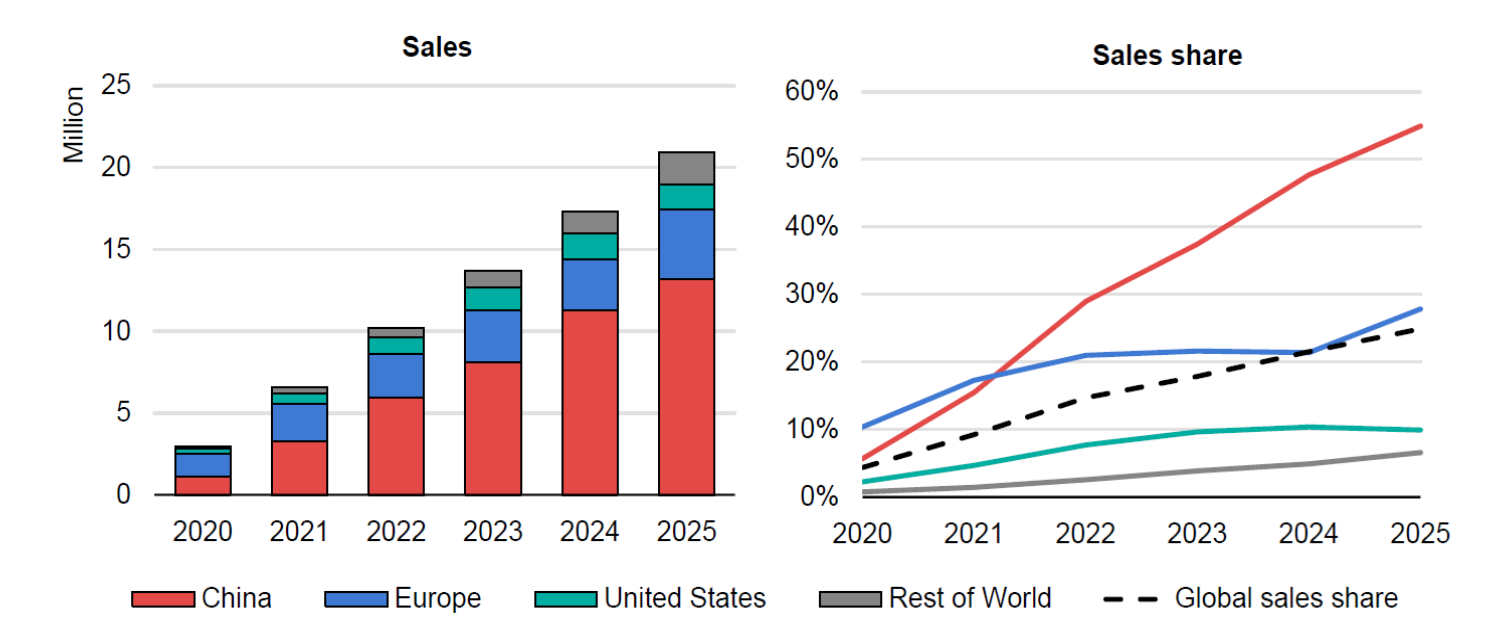 EV sales and share of sales in various regions over the past few years. Source: IEA
The energy agency projected that 23 million EVs will be sold in 2026, driven in part by soaring fuel prices stemming from the Mideast conflicts, which are rekindling concerns about energy affordability and energy security in many countries.
"Electric car sales set new records in close to 100 countries last year," said IEA Executive Director Fatih Birol in a statement accompanying the report. "The growing popularity of EVs has marked a major shift for car markets and the energy system as a whole--and it is providing some relief now amid the largest oil supply shock in history."
"Looking ahead," he continued, "the falls we have seen in battery prices and the potential policy responses to the current global energy crisis are set to provide further momentum in EV markets."
In 2025, Europe saw the strongest growth among major EV markets, with electric car sales rising by more than 30% following an increase in the stringency of the European Union's CO2 standards for cars, the report said. China's growth in EV sales slowed slightly, in part due to a temporary halt to its trade-in policies, but EVs still accounted for nearly 55% of all new vehicle sales.
In the U.S., EV sales remained relatively stable at just under 10% of car sales, though the end of EV tax credits coincided with a drop in sales at the end of the year. All told, U.S. consumers purchased about 1.5 million EVs last year. The Trump administration's decision to end the $7,500 federal tax credit for purchase of a new EV, effective in the fourth quarter of last year, led to a 45% reduction in Q4 EV sales. Those sales had risen at a 15% pace for the first three quarters of 2025 compared to 2024.
Chinese automakers supplied 60% of global electric car sales in 2025, while European and North American automakers were each responsible for about 15% of global sales, the IEA noted. China is the world's largest car market, with about 30 million units sold per year. The U.S. is the world's second-largest vehicle market, with approximately 15 million to 16 million units sold each year.
Energy Security and Affordability Loom Large
The EV report said, "The ongoing energy crisis resulting from the conflict in the Middle East has brought reliance on oil imports into sharp focus in many countries. The road transport sector represents close to half of oil demand today, and policy responses to the long tail of the current crisis stand to shape the global car market for years to come."The energy agency noted that "the oil crisis of the 1970s prompted the introduction of fuel efficiency standards, which resulted in close to a doubling of the fuel economy of conventional cars between 1975 and today, while during the Covid-19 pandemic, many countries introduced EV subsidies to boost uptake and support a broader economic recovery."
Last year, around the world, EVs avoided the consumption of around 1.7 million barrels of oil per day, primarily in countries that have implemented fuel economy and CO2 standards, such as China and the European Union, according to the report. Some countries in Southeast Asia--including Vietnam, the largest EV market in the region--already have announced plans to expand or extend EV tax incentives as part of their response to the current energy crisis.
One reason EVs in the U.S. have been slow to take off has been their cost compared to vehicles powered by internal combustion engines (ICEs). In the U.S., roughly 40% of new ICEs are priced over $50,000 while 60% to 80% of EVs are prices at that level.
In the U.S., the EV value proposition often turns on the sharply lower operating costs for an EV compared to an ICE. Depending on local electricity prices, it can cost less that $6 to charge an EV for a 100-mile trip while an ICE using gasoline and diesel would cost double or even triple that.
"Hopefully, the Middle East conflicts will get resolved soon, which should lead to lower fuel prices," commented David Pickering, senior vice president of research for the Industrial Manufacturing Industry. "But vehicle fuel prices, while painful now, tend to be a secondary consideration for new car and truck buyers. Too many people can't get past the cost of a new EV, particularly with all the uncertainties in the U.S. economy right now. If carmakers can succeed at bringing prices down, they will do better here."
By the Numbers
- Over 20 million: number of electric vehicles sold around the world in 2025, according to a new report from the IEA
- About 23 million: number of new EVs expected to be sold around the world in 2026, the agency predicted.
- Worldwide electric vehicle sales rose about 20% in 2025, to more than 20 million new vehicles.
- Global sales of EVs are expected to reach about 23 million units in 2026.
- Energy security and energy affordability are key issues affecting the ongoing competition between EVs and vehicles powered by internal combustion engines.
- In the U.S., EV penetration has been limited by high initial costs, despite significant savings in operating costs, notably fuel costs.
About Industrial Info Resources
Industrial Info Resources (IIR) is the leading provider of industrial market intelligence. Since 1983, IIR has provided comprehensive research, news and analysis on the industrial process, manufacturing and energy related industries. IIR's Global Market Intelligence (GMI) helps companies identify and pursue trends across multiple markets with access to real, qualified and validated plant and project opportunities. Across the world, Industrial Info Resources is tracking over 250,000 current and future projects worth $30.2 trillion (USD).
/iirenergy/industry-news/article.jsp
false
Want More IIR News Intelligence?
Make us a Preferred Source on Google to see more of us when you search.
Add Us On GoogleAsk Us
Have a question for our staff?
Submit a question and one of our experts will be happy to assist you.

Explore Our EnergyLive Tools
EnergyLive Tools provide instant insight into new build, outages, maintenance, and capacity shifts across key energy sectors.
Explore Our ToolsRelated Articles
-
Construction Equipment Leads to U.S. Manufacturing SpendingOctober 13, 2026
-
Gulf Coast Industries Brace for Hurricane IsaiasOctober 09, 2026
-
GlobalFoundries Reaches Supply Agreement with TSMC for AI Ch...October 09, 2026
-
Isaias Forecast to Become First Hurricane of 2026 as Gulf En...October 07, 2026
-
European Union Posts Record Growth in RoboticsOctober 06, 2026

Explore Our Enery Industry Reports
Gain the competitive edge with IIR Energy’s suite of energy market reports, designed for traders, analysts, and asset managers who rely on verified, real-time data.
View ReportsIndustry Intel
-
Latin America Data Center Outlook 2026: Power, Hubs & GrowthPodcast Episode / Oct 9, 2026
-
Food and Beverage CapEx Outlook 2026: Tariffs, AI, AfricaPodcast Episode / Oct 9, 2026
-
North America Refining 2026: New Pipelines to PADD 5Podcast Episode / Oct 2, 2026
-
Biomanufacturing Onshoring 2026: GLP-1, CDMO and ReshoringPodcast Episode / Oct 2, 2026
-
2026 US Data Center Outlook: Power, Land & CoolingPodcast Episode / Sep 18, 2026