
Written by John Egan for IIR News Intelligence (Sugar Land, Texas)
Summary
Wholesale power costs in the PJM market are poised to continue surging given the results of that grid manager's electric capacity auction. PJM said it would pay electricity generators about $16.4 billion in capacity payments over a 12-month period starting June 1, 2028. An independent monitor said about $6.3 billion of those costs stemmed from data centers. Meanwhile, the grid manager said it was concerned about slimmer reserve margins, as new demand continues to outpace new supply.Results of PJM Capacity Auction
PJM will pay around US$16.4 billion to electric generators for being available to produce electricity between June 1, 2028 and May 31, 2029, according to the results of the grid manager's most recent capacity auction, announced Tuesday.Joe Bowring, president of Monitoring Analytics, an independent group monitoring PJM, said in an interview with Industrial Info Resources that $6.3 billion of those costs would stem from data centers that planned to be operating in PJM's footprint during the 2028/2029 year.
"This is not something the data centers are actually paying themselves," he said. "This is a cost being imposed on all customers in the PJM footprint."
Jeffrey Shields, PJM's senior manager of external communications, would not comment on the Monitoring Analytics estimate, saying only, "Their numbers are their numbers." Neither would he break out the incremental costs that planned data centers were creating for the over 67 million customers living in areas that receive wholesale power from PJM.
The planned addition of numerous data centers across PJM's 13-state footprint has been a significant factor driving up retail electricity prices in that region. Retail prices in PJM are up about 49% over the last five years, faster than the national increase of about 33%, according to Heatmap News. Prior capacity payments represent between 8% and 15% of total wholesale electric power costs, Shields said.
PJM only operates in the wholesale market; exactly how much retail electric prices could change, and for which class of customers, depends on decisions made by local electric utilities that take wholesale power from PJM, and by state utility commissions.
State utility commissions are under pressure to create tariffs that prevent residential customers from subsidizing data centers and other large energy loads. The results of the PJM capacity auction likely will feed into that debate, the outcome of which could shape how many data centers are built, where and under what terms.
Planned Data Center Construction Continues to Soar
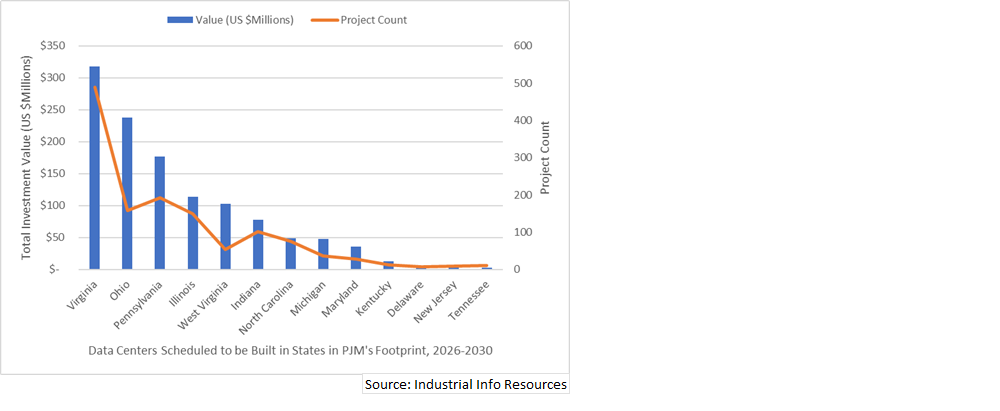
According to Industrial Info Resources data, 1,321 data centers are scheduled to be constructed in PJM's footprint between January 2026 and December 2030. The aggregate value of these proposed facilities is about US$1.18 trillion. That represents approximately 41% of the 3,238 data centers that are scheduled to be built across the U.S. over that five-year timeframe. The total investment value (TIV) of all proposed data centers to be constructed in the U.S. over that five-year period is about US$3.3 trillion.Within the PJM footprint, the states with the largest dollar value of planned data centers beginning construction over that five-year period are Virginia, Ohio, Pennsylvania and Illinois. The Industrial Info Resources Global Market Intelligence (GMI) Industrial Manufacturing Project Database offers a list of these detailed project reports.
PJM, Capacity Costs and Price Caps
PJM, which operates the regional transmission network across 13 states and the District of Columbia, said on it procured 138,317 megawatts (MW) of electric capacity at the capped price of about $325 per megawatt-day for the 2028-2029 period, a 2.5% decrease from the prior capacity auction price of $333.44 per megawatt-day.The capacity auction price has been capped by the Federal Energy Regulatory Commission (FERC), which has jurisdiction over regional transmission organizations, following PJM's capacity auction results in 2024, when prices rose 880%. For more on that, see September 11, 2024, article - Chickens Come Home to Roost: PJM Capacity Prices Soar Over 800%.
Capacity payments are made to generators that legally commit to producing electricity when a grid manager orders it. It is separate from energy, or generation, payments, which is the actual wholesale price companies are paid to generate electricity. That price is set in the day-ahead market operated by PJM.
Generators with winning capacity and generation bids will be paid twice: once for being prepared to generate electricity, and a second time, at a price to be determined by the market, for the actual production of electricity.
Capacity Shortfall Continues
The capacity of the resources procured in the auction, plus other committed resources, fell about 6,831 MW short of PJM's desired reliability requirement. The reserve margin of 14.7% is less than the 20% the grid manager prefers, but it said the shortfall "does not necessarily mean that the PJM system will be unable to serve load reliably in the delivery year; it means that PJM would have to operate with slimmer reserves and a greater level of risk."The 2028/2029 capacity supply mix will continue to be weighted toward natural gas: Natural gas was the fuel for 46% of the winning capacity bids, while 20% went to nuclear, 18% went to coal and 5% was awarded to demand response programs. Hydro, wind, oil and solar accounted for a total of about 9% of the winning capacity bids.
PJM said coal bids decreased about 2,941 MW from the prior auction, primarily from retirements or conversion to natural gas. Some coal-fired generators that participated in the most recent auction that did not participate in the last auction, which was held last December for the 2027/2028 year. PJM conducts planning on a rolling three-year cycle. It holds auctions every six months.
By the Numbers
- 138,317: The amount of electric generating capacity, in megawatts, that was selected by PJM in its latest capacity auction for the 2028/2029 period
- $325: The price awarded to generators, on a megawatt-day basis, for committing to generate electricity when needed during 2028/2029
- $6.3 billion: The estimated capacity costs created by data centers in the PJM footprint over the 2028/2029 period for providing electricity if needed
New Demand Continues to Outpace New Supply
"These auction results show that demand for electricity continues to grow faster than electricity supply," said David Mills, president and chief executive of PJM, said in a statement announcing the capacity bid results. "At the same time, PJM recognizes how this supply-and-demand imbalance impacts the reliability of the system and costs for consumers."The organization added, "While the price cap and floor may reduce volatility, they do not solve the underlying supply-demand imbalance. Addressing that challenge requires bringing more resources onto the system to meet the pace of demand growth."
Placing a cap and a floor around capacity prices affects bidders' actions. An auction without price caps likely would have produced more in capacity bids, but at prices that exceed the cap imposed by FERC.
As it has for the last few auctions, PJM said surging demand from proposed data centers was the main driver of rising capacity bids.
PJM Struggles to Balance Supply and Demand
PJM manages the transmission network that delivers wholesale electricity to parts or all of Delaware, Illinois, Indiana, Kentucky, Maryland, Michigan, New Jersey, North Carolina, Ohio, Pennsylvania, Tennessee, Virginia, West Virginia and the District of Columbia. In recent years, Northern Virginia has emerged as a global data center hub.Actual and planned demand from data centers have scrambled utility capital budgets and caused electric reliability organizations to issue a rare Level 3 Alert about the reliability of the nation's bulk power system. For more on that, see February 18, 2026, article - Data Center Demand Drives DTE's Five-Year Capex Increase, to $36.5 Billion and May 7, 2026, article - NERC Issues Heightened Alert Over Data Center Loads on U.S. Power System.
FERC recently issued a show-cause order for regional transmission groups to either justify or change their interconnection tariffs for large electric loads like data centers, advanced manufacturing plants and cryptocurrency mines. A 30-day progress report is expected any day and a final report is due in August. For more on that, see June 29, 2026, article - FERC to RTOs: Expedite Interconnection of Large Electric Loads.
In its July 14 statement, PJM listed a variety of steps it was taking to expedite the interconnection of new generation resources and close the gap between projected electric demand and supply.
Key Takeaways
- On July 14, PJM released the results of its electric capacity auction for 2028/2029.
- The auction resulted in a market-clearing price of $325 per megawatt-day for generators willing to legally commit to providing electricity is called on to do so.
- The capacity auction is separate from the actual generation of electricity, the price of which will be set by the market.
- Natural gas continued to be the dominant fuel used by capacity providers.
- PJM's reserve margin dipped to 14.7%, less than the 20% margin it would prefer, because demand for electricity in the region is growing faster than supply.
- PJM said there was no reason for concern that the lights would go out for the over 67 million people and businesses served by the transmission network it operates.
About Industrial Info Resources
Industrial Info Resources (IIR) is the leading provider of industrial market intelligence. Since 1983, IIR has provided comprehensive research, news and analysis on the industrial process, manufacturing and energy related industries. IIR's Global Market Intelligence (GMI) helps companies identify and pursue trends across multiple markets with access to real, qualified and validated plant and project opportunities. Across the world, Industrial Info Resources is tracking over 250,000 current and future projects worth $30.2 Trillion (USD).
/iirenergy/industry-news/article.jsp
false
Want More IIR News Intelligence?
Make us a Preferred Source on Google to see more of us when you search.
Add Us On GoogleAsk Us
Have a question for our staff?
Submit a question and one of our experts will be happy to assist you.

Explore Our EnergyLive Tools
EnergyLive Tools provide instant insight into new build, outages, maintenance, and capacity shifts across key energy sectors.
Explore Our ToolsRelated Articles

Explore Our Enery Industry Reports
Gain the competitive edge with IIR Energy’s suite of energy market reports, designed for traders, analysts, and asset managers who rely on verified, real-time data.
View ReportsIndustry Intel
-
Latin America Data Center Outlook 2026: Power, Hubs & GrowthPodcast Episode / Oct 9, 2026
-
Food and Beverage CapEx Outlook 2026: Tariffs, AI, AfricaPodcast Episode / Oct 9, 2026
-
North America Refining 2026: New Pipelines to PADD 5Podcast Episode / Oct 2, 2026
-
Biomanufacturing Onshoring 2026: GLP-1, CDMO and ReshoringPodcast Episode / Oct 2, 2026
-
2026 US Data Center Outlook: Power, Land & CoolingPodcast Episode / Sep 18, 2026