
Written by John Egan for IIR News Intelligence (Sugar Land, Texas)
Summary
First-quarter net profits shot up for three large, independent, gas-oriented U.S. exploration and production companies, driven by higher demand, stemming in part from the cold snap early in the quarter, which led to increased production and increased prices. A large loss on derivatives pushed down earnings at a fourth company.Profits Surge Based on Weather, Demand and Prices
Three large, independent, gas-oriented U.S. exploration & production companies reported sizable gains in profitability for the first quarter of 2026 versus the comparable year-earlier quarter. The producers were EQT Corporation, Range Resources Corporation and Antero Resources Corporation. Earnings at a fourth independent driller, Coterra Energy Incorporated, while sizable, were dragged down by large losses on derivatives.First-quarter net profits for the four companies reached about $2.8 billion, the highest January-to-March level in at least five years. According to Industrial Info Resources data, there are 750 active capital projects in the U.S. that are related to gas production, processing, transportation and storage, with a total investment value of $124 billion.
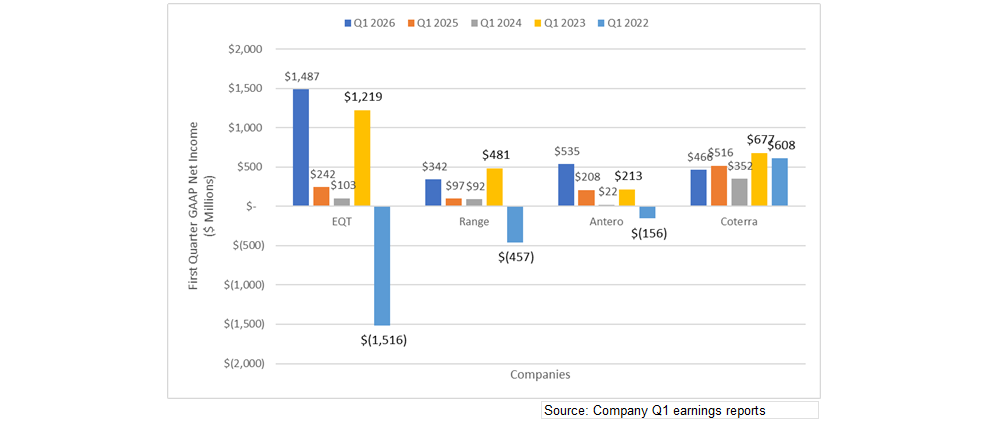
Strong domestic demand for gas, aided by rising demand from electric power generators to serve the burgeoning data center sector, was the main factor driving surging first-quarter results.
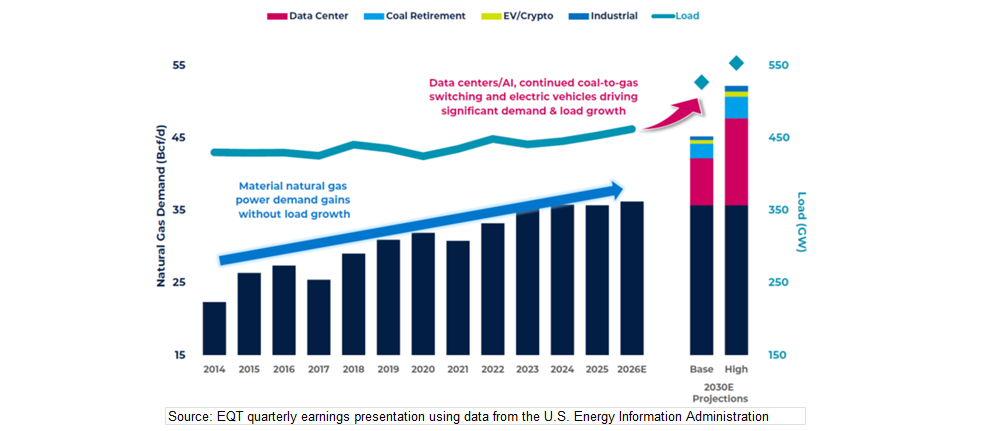
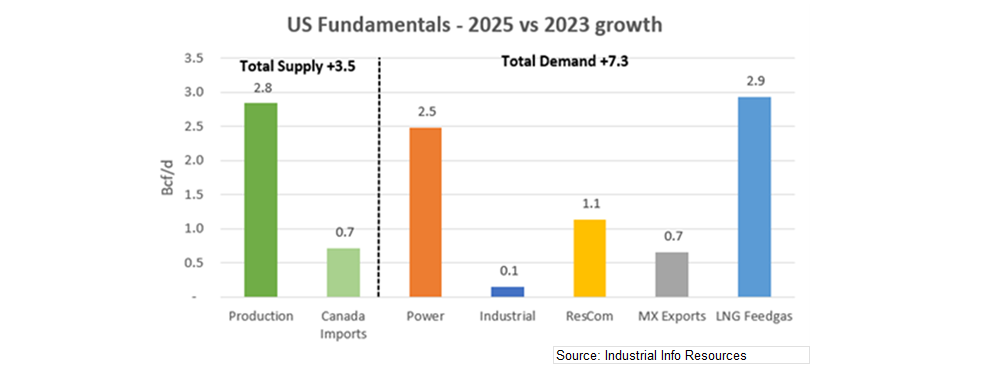
"The long-lived gas bubble is over," she continued. "Across North America, between 2023 and 2025, demand has risen about 7.3 billion cubic feet of gas per day (Bcf/d), more than twice the level of new production." She said four key pillars drove the surge:
- Liquefied Natural Gas (LNG) Feed Gas: Up 2.9 Bcf/d
- Power and Data Centers: Massive load growth from Electric Power, manufacturing reshoring and artificial intelligence infrastructure, up about 3 Bcf/d
- U.S.-Mexico Exports: Up 1 Bcf/d via increased cross-border pipeline utilization
- Residential and Commercial customer demand volatility, driven mainly by shifting weather patterns
Range Resources
First quarter net income for Range Resources jumped about 252% compared to year-earlier results: $342 million compared to $97 million for the first three months of 2025. The company reported results April 21.Range Resources operates exclusively in the Appalachian Basin, where a shortage of outbound transportation capacity has kept prices lower than the national average. The company said revenue from gas sales rose about 45%, to about $658 million, in the just-completed quarter on flat production. Range Resources reported receiving an average of about $3.60 per thousand cubic feet of gas (Mcf) in the first quarter, up about 45% over the year-earlier quarter but more than $1 per Mcf under the national average.
Revenue from sales of natural gas liquids (NGLs), by contrast, dipped slightly compared to the January-March 2025 period. Oil sales revenue nearly doubled on a 75% increase in production, but oil accounts for a small portion of the company's production. Natural gas accounts for about 68% of Range Resources' production. Overall production of hydrocarbons was flat at about 2.2 billion cubic feet of gas equivalent per day (Bcfe/d).
During the just-completed period, the company increased its dividend, repurchased $27 million of shares, and cut its net debt load by $384 million. As of March 31, 2026, the company had $1.5 billion of availability remaining under the share-repurchase program.
EQT
First-quarter income for this Pittsburgh-based integrated gas company shot up about 512%, to just under $1.5 billion from about $242 million in the year-earlier period. Revenue nearly doubled, to $3.4 billion from $1.7 billion in the January-March 2025 period. Both quarters had hefty derivatives losses.EQT said sales of natural gas rose 8% and its realized price averaged about $5.07 per Mcf in the just-completed period, up approximately 39% from the $3.77 per Mcf it received in the comparable year-earlier quarter. Those prices reflected the effects of hedging. Natural gas accounted for over 90% of the company's production on a thousand cubic foot equivalent (Mcfe) basis. EQT reported results April 21.
The Pittsburgh company said production was above the high end of guidance due to strong well performance, system pressure optimization and "exceptional execution" during Winter Storm Fern. Capital spending for the quarter was approximately $608 million, 4% below the low-end of guidance.
During the just-completed quarter, EQT used some of its free cash flow to repay about $2 billion in debt. It ended the quarter with about $5.6 billion in debt, down substantially from the $13.6 billion it carried at the end of the third quarter 2024, driven by acquisitions.
On their earnings call, EQT officials also said that the recent "open season" for transportation on the company's Mountain Valley Pipeline caused them to increase the planned takeaway capacity approximately 20%, to 600 dekatherms per day from 500 dekatherms per day. That decision was made during the fourth quarter of 2025. Assuming regulatory approval, construction is expected to begin in the winter of 2026-2027, and commercial operations are slated to start in mid-2028.
Antero
Net income shot up 157% in the just-completed quarter for this Denver-based independent producer, which reported earnings April 29. Profits for the just-completed period reached $535 million compared to $208 million for the first three months of 2025.Quarterly revenue from gas sales jumped 68%, to $1.3 billion from $780 million in the year-earlier quarter, on a 21% increase in production. Antero reported a 23% bump in realized prices for its natural gas for the quarter: $4.86 per Mcf after the impact of settled derivatives compared to $3.85 for the year-earlier period.
The company said about 88% of its first-quarter gas production, about 2.3 Bcf/d, was sold into an "LNG fairway," where it was able to access premium pricing. Natural gas accounted for about 68% of Antero's first-quarter production. It operates exclusively in the Appalachian Basin.
In contrast to the good news on gas, quarterly revenue from oil and NGL sales slipped. The Denver-based independent producer said weak pricing held down NGL revenue during the quarter, which fell 10% to about $504 million. Crude oil sales generated about $47 million in revenue, off about 7% from year-earlier results. On a gas-equivalent basis, hydrocarbon sales rose 13% to a record 3.9 Bcfe/d.
During the just-completed period, Antero closed two strategic transactions that were announced in late 2025: the acquisition of HG Energy LLC for $2.8 billion in cash plus the assumption of HG Energy's commodity hedge book, and the sale of its Utica Shale upstream assets in Ohio for $800 million in cash. Antero officials said the HG transaction should boost second quarter production growth 6% while lowering its cash costs 15% from the first quarter.
Coterra
In its last quarter as a stand-alone public company, Coterra's net earnings fell about $50 million, to $466 million from $516 million on flat revenue. First-quarter results were dragged down by a $434 million loss in derivatives. In the comparable year-earlier quarter, Coterra's results included a $112 million loss on derivatives.Coterra reported results May 6 in a 10-Q form filed at the U.S. Securities & Exchange Commission. The Houston-based company merged with Devon Energy Corporation in an all-stock transaction that closed May 7. For more on that transaction, see February 3, 2026, article - Devon-Coterra $58 Billion Tie-up Targets Large Inventory of Sub-$40 Wells.
For the just-completed period, Coterra reported modest gains in revenue from the sale of oil and gas, and a small decline in revenue from sale of NGLs.
On an oil-equivalent basis, the company said first-quarter production rose to 771,000 BOE/d from 747,000 BOE/d in the first quarter of last year. Production of oil and NGLs increased while gas production dipped. Price realizations for gas rose 28% from year-earlier levels while NGL prices fell by a similar percentage. Oil price realizations were slightly lower than the year-earlier quarter.
By the Numbers
- $2.8 billion: The collective net earnings of four large U.S. gas-oriented independent E&P companies, the highest first-quarter profits in at least five years.
- $4.79: Average first-quarter spot price per million British thermal units of natural gas at Henry Hub, Louisiana
- 15%: Average increase in gas prices compared to the first three months of 2025, when prices averaged $4.15 per MMBtu.
- Strong demand growth for natural gas, both for domestic use and for export, led to higher prices and soaring increases in first-quarter profitability for three large U.S. independent gas drillers.
- Domestic demand growth was boosted by Winter Storm Fern in January 2026.
- Earnings by a fourth driller, Coterra, slumped in part due to a large commodity derivatives charge.
- Demand growth has outpaced production gains in recent years, potentially signaling the end of the "gas bubble."
About Industrial Info Resources
Industrial Info Resources (IIR) is the leading provider of industrial market intelligence. Since 1983, IIR has provided comprehensive research, news and analysis on the industrial process, manufacturing and energy related industries. IIR's Global Market Intelligence (GMI) helps companies identify and pursue trends across multiple markets with access to real, qualified and validated plant and project opportunities. Across the world, Industrial Info Resources is tracking over 250,000 current and future projects worth $30.2 Trillion (USD).
/iirenergy/industry-news/article.jsp
false
Want More IIR News Intelligence?
Make us a Preferred Source on Google to see more of us when you search.
Add Us On GoogleAsk Us
Have a question for our staff?
Submit a question and one of our experts will be happy to assist you.

Explore Our EnergyLive Tools
EnergyLive Tools provide instant insight into new build, outages, maintenance, and capacity shifts across key energy sectors.
Explore Our ToolsRelated Articles
-
First Oil Reached at Alaska's Pikka ProjectMay 20, 2026
-
Two New U.S. LNG Projects Pick Up FundingMay 19, 2026

Explore Our Enery Industry Reports
Gain the competitive edge with IIR Energy’s suite of energy market reports, designed for traders, analysts, and asset managers who rely on verified, real-time data.
View ReportsIndustry Intel
-
The Role of Contract Manufacturing in Global Pharma GrowthPodcast Episode / May 8, 2026
-
2026 North American Labor OutlookPodcast Episode / Apr 24, 2026
-
2026 European Metals & Minerals Project Spending OutlookPodcast Episode / Apr 7, 2026
-
The Age of Critical Minerals in the AmericasPodcast Episode / Mar 20, 2026
-
2026 Regional Chemical Processing OutlookPodcast Episode / Mar 6, 2026