Reports related to this article:
Written by Jesse Broehl, Editor-in-Chief, Breaking Energy News (BEN), IIR News Intelligence, (Sugar Land, Texas)
Summary
This July could see 22 utility-scale power plant projects totaling 4,505 MW and valued at approximately $5.83 billion kick off in North America.Potential U.S. Power Plant Project Kickoffs Total 4.5 Gigawatts
This July could see 22 utility-scale power plant projects totaling 4,505 megawatts (MW) and valued at approximately $5.83 billion kick off in North America, according to IIR Energy's confirmed tracking of power plant projects.
Not every one of these projects will actually kick off in July, but this analysis narrows down the list to those that will or those likely to kick off in coming months. This provides a snapshot of where the energy marketplace is growing and highlights where a steady stream of contracting requests for proposals (RFPs) may originate for projects with ongoing contracting.
These projects (see list and details here) are considered to have a medium or high probability of kicking off, based on IIR Energy's analysis of verified project metrics. Dozens more of low probability projects are excluded. Industrial Info Resources determines status after confirming major project milestones.
Solar Power Plants Lead the Spending Cycle
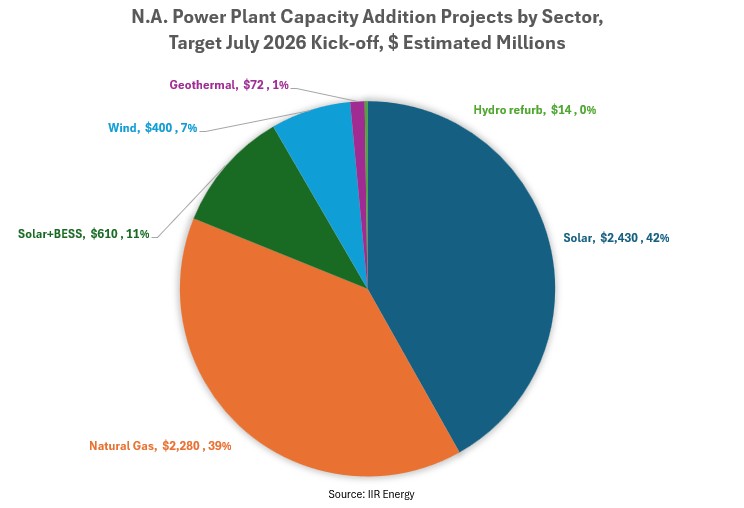
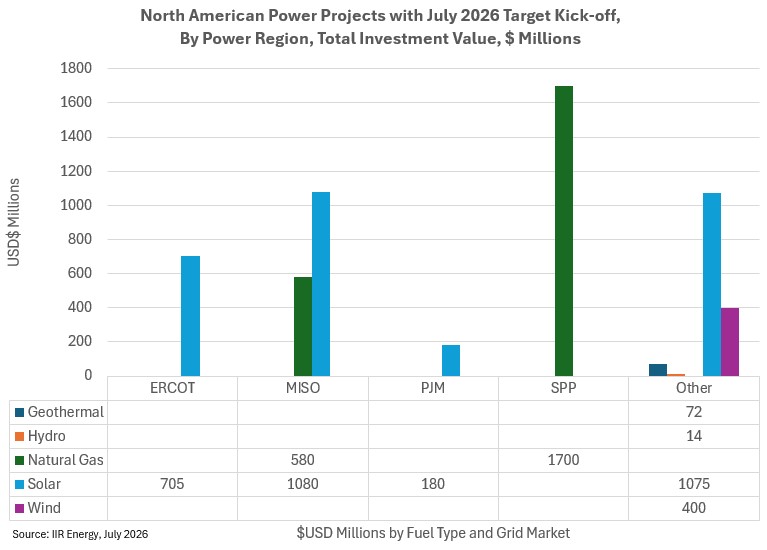
After a similar analysis for June saw natural gas power plants leading the types of power plants, this July sees solar megawatt nameplate capacity edging ahead. In fairness, this common tracking by total plant megawatt leaves out the more nuanced consideration of capacity factors. In other words, gas plants operate more often at their maximum MW-level capacity than wind and solar. However, a comparison of estimated total investment value (TIV) across power sectors also shows solar well ahead with over $3 billion TIV to just over $2.2 billion for natural gas plants.
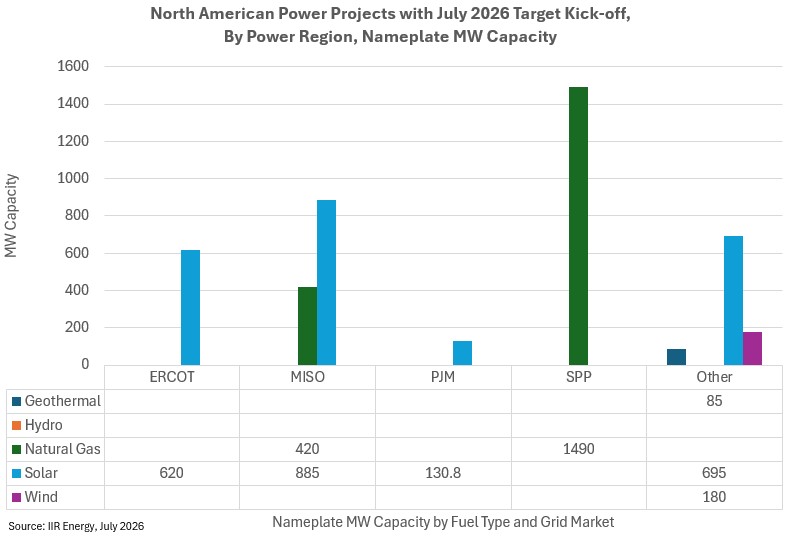
This analysis splits up standalone solar plants from solar plants with co-located battery energy storage systems (BESS). Standalone solar is the dominant power plant type for likely July kickoffs, representing 46% of the estimated TIV, or around $2.43 billion. That is from 12 solar projects and just over 3,040 MW of nameplate capacity. The specific plants are too numerous to detail here, but see the list and details here. Solar plants with BESS took third place in the ranking, discussed further below.
Natural Gas Takes Second Place with Two Large Plants
Natural gas power plants follow in second place for likely July kickoffs at 39%, or around $2.2 billion. This is from two projects totaling 1,910 MW. The two plants are the 1,490-MW Bison Power Generation Plant in Ray, North Dakota, owned by Basin Electric Power Cooperative and the 420-MW Lyon County Natural Gas-Fired Lyon county Peaking Generating Station, located in Garvin, Minnesota, and owned by Xcel Energy. The gas plants are located in the SPP and MISO grids, respectively.
Solar Plus Battery Energy Storage Systems in Third Place
As noted above, the third-place ranking for power plant generation projects likely kicking off in July are solar plants with co-located BESS (Solar+BESS). These topped $610 million in estimated value from two plants, one of which is two-phases at the massive Coconino plant in Arizona, with a 400-MW solar+BESS phase and a second 206-MW solar+BESS phase.
These two Coconino plant phases are actually part of an even larger project. If all planned phases proceed to completion by the end of 2028, the total capacity could be 1200 MW of solar and 400-MW of BESS and total $2.6 billion in investment value. The plant is developed by Clēnera, a subsidiary of Enlight Renewable Energy, is one of the largest solar and storage projects in the U.S.
The other solar+BESS plant is the more modest by comparison 40-MW Santa Isabel project, owned by AES Corporation (soon to be acquired by Blackrock).
There is big demand for natural gas plants, driven by increasing needs for baseload and dispatchable power versus intermittent renewables. However, solar is often outpacing natural gas on monthly or quarterly kickoffs for a multitude of reasons: Solar plants has seen consistent cost reductions in recent years, making them competitive in most locations with gas plants, solar is relatively quicker to develop and build than gas plants, strong corporate demand for renewable energy power purchase agreements, and last but not least tax credits. Solar plants are kicking off construction to secure phasing out tax credits (see last section of this article: July Project Starts are Less Impacted by U.S. Federal Opposition to Renewables).
Only One Wind Project Kicking Off in Canada
Only one wind project has a July kickoff in North America; the 180-MW Foret Domaniale Windfarm, developed by EDF Renewables Canada Incorporated. The plant is located in Caplan, Quebec, and utilizes 30 Vestas EnVentus V162-6.0 wind turbines. The scale of the wind turbines is notable: the model name denotes a 162-meter rotor diameter and 6 as the per-unit nameplate MW capacity. This is the only one of the 22 projects with target July kick-off that is located in Canada.
Rare Kickoffs of Geothermal Projects
Geothermal power plants rarely make an appearance in new power plant kickoffs but this July two projects have a target kickoff. Geothermal plants in the right locations are a proven technology, but finding those ideal locations is a challenging development process, making these rare as new projects compared to more conventional power plants.
The largest of the two geothermal projects with a July kickoff is the 25-MW Central Geotermoelectrica Los Humeros unit addition, located in Perote, Veracruz, Mexico. The unit addition is located at the existing 115-MW Los Humeros Geothermal Power station, operated by state-owned utility Comision Federal de Electricidad.
The second geothermal project with planned kickoff is the repower phase 2 of the 38-MW Puna Geothermal Power plant, located in Pahoa, Hawaii. Twelve generating units totaling 38 MW have been operating for over 30 years at the plant, converting the island's ample subterranean heat to create electricity for Hawaii's big island. The repower project will replace the aging 12 turbines with four modern and more efficient units, eventually bringing the plant to 46 MW of nameplate capacity (more at BigIslandNow.com).
Hydroelectricity Projects Kicking Off
Hydroelectric projects are also not very common, but one is targeting to kick off this month; the 105-MW hydro unit #2 refurbishment at the Central Hidroelectrica A. Albino Corzo (Penitas) hydro plant. One of the four 108-MW units operating since 1986 will be replaced with a new 105-MW unit. The plant is operated by state-owned utility Comision Federal de Electricidad.
July Project Starts are Less Impacted by U.S. Federal Opposition to Renewables
The pie chart accompanying this article may raise the question of how so many renewable energy projects are still targeting a July kick-off despite the well-publicized roadblocks the Trump administration and a Republican-controlled Congress have put up. These headwinds have less of an impact on plants in advanced development nearing kick-off. Instead, the barriers are more impactful at slowing projects currently in early-stage development. In other words, the downturn in renewables from today's government actions will be more impactful removing megawatts from project construction starts one or more years from now.
To the contrary, many renewable energy projects in the U.S. officially began construction in 2025 and 2026 in order to qualify for tax credits. Projects not officially under construction by July this year will not qualify for future tax credits, per the One Big Beautiful Bill Act (OBBBA) laws passed by Congress in 2025.
Projects that did meet the July threshold for starting construction will have up to four years until July 2031 to complete construction and come online. A common criticism of this policy is that tax credits appear to have been removed by the U.S. federal government via the OBBBA law, but these construction terms effectively allow huge numbers of projects to gradually be built and commissioned over the next four years. Tax credits can start flowing as late as July 2031, and begin running for 10 years on a per kilowatt-hour (kWh) credit basis. Therefore, so-called expired tax credits are still in effectively in place until 2040.
Key Takeaways- Kickoffs of solar plant projects outpace those for natural-gas-fired plants in July.
- Most likely natural gas power plant kickoffs have a TIV of about $2.2 billion.
- Only one wind project is likely to kick off in North America.
About Industrial Info Resources
Industrial Info Resources (IIR) is the leading provider of industrial market intelligence. Since 1983, IIR has provided comprehensive research, news and analysis on the industrial process, manufacturing and energy related industries. IIR's Global Market Intelligence (GMI) helps companies identify and pursue trends across multiple markets with access to real, qualified and validated plant and project opportunities. Across the world, Industrial Info Resources is tracking over 250,000 current and future projects worth $30.2 Trillion (USD).
Want More IIR News Intelligence?
Make us a Preferred Source on Google to see more of us when you search.
Add Us On GoogleAsk Us
Have a question for our staff?
Submit a question and one of our experts will be happy to assist you.

Explore Our EnergyLive Tools
EnergyLive Tools provide instant insight into new build, outages, maintenance, and capacity shifts across key energy sectors.
Explore Our ToolsRelated Articles
-
Seasonal Issues, Low Oil Prices, Curb North Dakota Productio...November 25, 2025
-
Massive Gas Turbine Demand Powers Up Siemens, Other Provider...November 19, 2025

Explore Our Enery Industry Reports
Gain the competitive edge with IIR Energy’s suite of energy market reports, designed for traders, analysts, and asset managers who rely on verified, real-time data.
View ReportsIndustry Intel
-
North America Refining 2026: New Pipelines to PADD 5Podcast Episode / Oct 2, 2026
-
Biomanufacturing Onshoring 2026: GLP-1 Drives CapexPodcast Episode / Oct 2, 2026
-
2026 US Data Center Outlook: Power, Land & CoolingPodcast Episode / Sep 18, 2026
-
2026 Global Power Demand Outlook: Gas, Nuclear & RenewablesPodcast Episode / Sep 18, 2026
-
2026 Oil & Gas CapEx Outlook: Middle East, LNG & PermianPodcast Episode / Sep 4, 2026