Written by John Egan for IIR News Intelligence (Sugar Land, Texas)
Summary
Four large integrated oil supermajor firms reported sharply different first-quarter profits amid the ongoing Middle East conflicts. Compared to the year-earlier quarter, profits fell for U.S.-based ExxonMobil Corporation and Chevron Corporation but shot up for U.K.-based BP Plc and Shell Plc.Profits Mixed Amid Mideast Conflicts
The U.S.-Israeli war on Iran, launched February 28, and to a lesser extent the Israeli-Lebanon war, had sharply different impacts on the profitability of four international integrated supermajor oil companies: Exxon Mobil Corporation, Chevron Corporation, BP Plc and Shell Plc.According to Industrial Info Resources data, these four companies are developing a total of about 1,667 capital and maintenance projects around the world in the following industries: Electric Power, Oil & Gas Production, Oil & Gas Pipelines, Oil & Gas Terminals and Petroleum Refining. The collective value of these projects is about $251.4 billion.
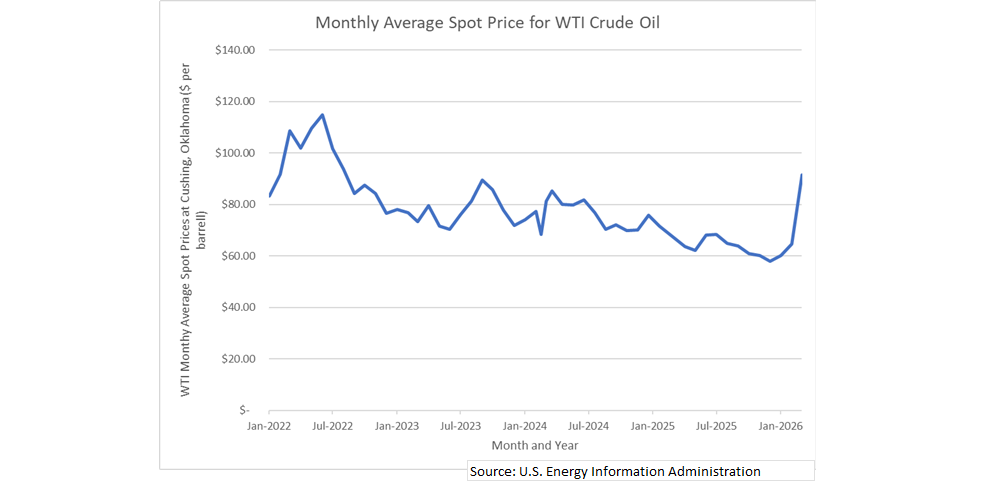
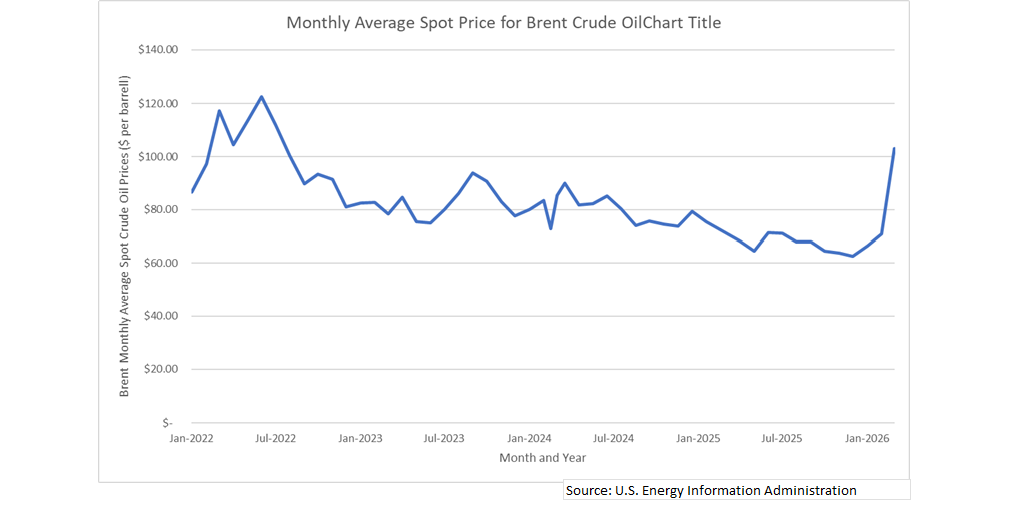
Although prices for West Texas Intermediate (WTI) and Brent crude oil shot up in the last month of the quarter, the effect was felt differently among the four companies. Before reporting earnings, some companies had warned investors that profits would be off in the quarter, but that it was mainly a matter of timing: Once the Strait of Hormuz reopened, future production and results would grow, they said.
See graphs below showing the average monthly spot prices for WTI and Brent crude. oil.
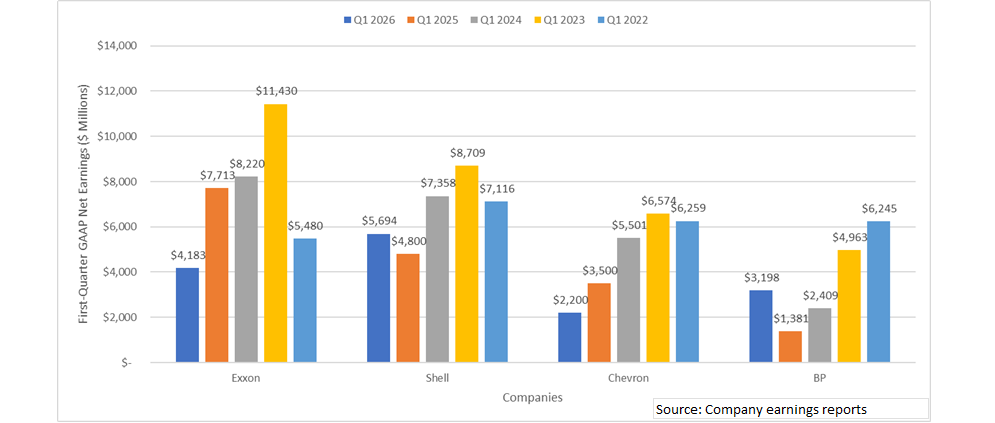
Collectively, first-quarter profitability for the four integrated supermajors fell to about $15.3 billion, roughly $2.1 billion less than the year-earlier quarter and less than half of the record $31.7 billion in net earnings reported in the first-quarter of 2023.
See chart below showing the earnings of the four companies.
ExxonMobil
First-quarter profit sank 45% for the Spring, Texas-based supermajor, to about $4.2 billion from $7.7 billion in the comparable year-earlier quarter despite an increase in revenue to $85.1 billion from $83.1 billion.The company said "unfavorable estimated timing effects" involving commodity derivatives cut earnings by $3.9 billion while another $700 million was shaved off the bottom line due to what the company called "settled financial hedges that were not offset by the associated physical shipments due to Middle East supply disruptions." ExxonMobil reported earnings May 1.
Crude oil production rose slightly compared to year-earlier results: about 4.6 million barrels of oil equivalent per day (BOE/d) from last year's January-March production of about 4.5 million BOE/d. Roughly 27% of the company's earnings came from U.S. operations. Globally, profits at the Exploration & Production (upstream) segment fell 15%, to $5.7 billion from year-earlier results of $6.8 billion.
Domestic production of oil and gas increased in the quarter, to just under 1.6 million barrels per day (bpd) from 1.4 million bpd. U.S. production of natural gas increased to 3.6 billion cubic feet per day (Bcf/d) from 3.3 Bcf/d in the comparable year-earlier period.
The company lost about $501 million in its Refining & Marketing (downstream) business, including chemicals and specialty products. By contrast, that segment earned slightly over $1.4 billion in the first quarter of 2025. Results were hurt by timing issues and one-time charges.
Global refinery throughput fell to 3.5 million bpd from 3.8 million b/d in the year-earlier period. U.S. throughput was flat. Most of the throughput reductions came from Europe and Asia Pacific.
The company said it cut structural costs by about $600 million in the just-completed period, bringing to $15.6 billion the cumulative structural cost savings since 2019. These cost reductions are expected to reach $20 billion by 2030, ExxonMobil projected.
Chevron
Houston-based Chevron on May 1 reported first-quarter earnings of $2.2 billion, down 37% from the $3.5 billion in earned in the year-earlier period. The upstream profits rose 4% but the downstream business lost $817 million in the quarter, a reversal from last year when the downstream segment earned $325 million in that segment. Results for the just-completed quarter included negative timing effects of about $2.9 billion.The company said production grew compared to the year-earlier quarter "largely due to the acquisition of Hess Corporation (Hess) and growth in the Gulf of (Mexico) and the Permian Basin, partly offset by downtime at the company's 50% owned affiliate Tengizchevroil (TCO) and curtailments in the Middle East (Israel and the Partitioned Zone between Saudi Arabia and Kuwait)."
In its U.S. upstream segment, Chevron said production rose 24% on an oil-equivalent basis, to slightly more than 2 million BOE/d from 1.6 million BOE/d in last year's first quarter. It said the growth came from the Hess acquisition, higher production in the Permian Basin and the Gulf of Mexico following project startups.
Overseas oil and gas production rose slightly in the just-completed period.
Quarterly profits at the U.S. downstream segment rose 90%, to $196 million from $103 million in the first three months of 2025. But that was more than undone by losses overseas, which slightly exceeded $1 billion compared to a profit of $222 million in the comparable year-earlier period.
During the quarter, Chevon, the only major oil company that continued to operate in Venezuela as the country drifted into socialism and resource nationalism, announced a two-part agreement to expand its heavy oil interest in a Venezuelan joint venture and acquired the rights to develop an area in the Orinoco Oil Belt.
BP
First-quarter profits soared 132% for this London-based supermajor: $3.2 billion versus $1.4 billion in the comparable year-earlier period. Unlike its U.S. peers, BP's results included a $2.5 billion favorable adjustment to earnings.The company credited "exceptional" performance by its oil traders with helping plump first-quarter profits. Gas marketing and trading, by contrast, turned in an "average" result, the company said.
Overall global production of oil and gas was roughly flat with year-earlier results. The company said its price realizations for crude oil and natural gas were lower than they were in the comparable year-earlier period.
Higher production in the Gulf of Mexico and strong performance at its BPX Energy subsidiary helped offset the impact of disruptions in the Middle East and a North Sea asset divestment at the end of 2025, BP said in its earnings announcement April 28.
The company said its upstream operations in the Middle East, located in Iraq, Oman and Abu Dhabi, produced about 411,000 BOE/d in 2025. It did not include a first-quarter assessment of production there but noted "heightened volatility leading to notable differences between marker prices used in our rules of thumb and realized prices due to price lags, price caps, timing of liftings and contract structures."
In its Middle Eastern downstream business, BP said it experienced "margin dislocations driven by three main factors: crude differentials, product yields and freight costs."
During the quarter, BP continued its process of narrowing its business and disposing of non-core assets. Asset sales reached $248 million in the just-completed period, slightly less than first-quarter 2025 asset sales but significantly behind fourth-quarter 2025's disposal of $3.6 billion in assets.
The company said it continues to expect asset sales will generate $9 billion to $10 billion this year, about $6 billion of which is tied to the sale of 65% of the Castrol lubricants business. That transaction, announced last December, is expected to close by yearend 2026. BP will continue to retain a 35% stake in Castrol.
Meg O'Neill became BP's chief executive officer April 1 after being selected last December. She said the company performed well during the quarter, despite having to lock out about 800 union employed at its Whiting, Indiana, refinery during the quarter. She reiterated the goal of making BP simpler, stronger and more valuable.
Shell
London-based Shell, which reported earnings May 7, posted a profit of about $5.7 billion on sales of $69.7 billion for the first quarter. Earnings were up about $900 million on a $400 million gain in revenue compared to the year-earlier period.While oil and gas production dipped slightly on an oil-equivalent basis compared to the fourth quarter of 2025, the company said it expected production to decline meaningfully in the second quarter. Shell reported operations for oil and gas in two segments. One saw a 40% jump in realized priced for crude oil in the quarter while the other said prices rose 22% compared to the respective prices in the October-December 2025 period.
Turning to its liquefied natural gas (LNG) business, Shell said liquefaction volumes were up slightly compared to the preceding quarter, but a significant decline is anticipated for the next quarter. LNG sales volume fell slightly from the preceding quarter; the company did not hazard a guess as to second-quarter LNG sales volumes.
Downstream margins rose to about $16.88 per barrel, more than double the $6.21 it posted for the first quarter of 2025. Refinery and chemicals utilization rates rose to 99% and 85%, respectively, compared to 95% and 76%, respectively, for the previous quarter. The company's trading operations had "significantly" greater profitability, it added. "Adjusted profit" from trading shot up to $1.93 billion from $449 million in the year-earlier quarter.
The company recently announced plans to acquire Canadian oil firm ARC Resources, which is expected to add about 370,000 BOE/d to its production.
When reporting its results, Shell said it would repurchase $3 billion of its shares over the next three months. It also increased the common-stock dividend 5% as part of its plan to distribute 40% to 50% of cash flow from operations to shareholders.
By the Numbers
- $15.3 billion: the combined first-quarter net earnings for ExxonMobil, Chevron, Shell and BP.
- $2 billion: The amount of decline in net earnings for the four companies from the year-earlier quarter.
- 52%: the decline in first quarter 2026 net profits from the record $31.7 billion the four companies earned in the first quarter of 2023.
- The conflicts in the Middle East has very different effects on four integrated supermajor oil and gas companies: Earnings fell for U.S.-based ExxonMobil and Chevron but soared for U.K.-based BP and Shell.
About Industrial Info Resources
Industrial Info Resources (IIR) is the leading provider of industrial market intelligence. Since 1983, IIR has provided comprehensive research, news and analysis on the industrial process, manufacturing and energy related industries. IIR's Global Market Intelligence (GMI) helps companies identify and pursue trends across multiple markets with access to real, qualified and validated plant and project opportunities. Across the world, Industrial Info Resources is tracking over 250,000 current and future projects worth $30.2 Trillion (USD).
/iirenergy/industry-news/article.jsp
false
Want More IIR News Intelligence?
Make us a Preferred Source on Google to see more of us when you search.
Add Us On GoogleAsk Us
Have a question for our staff?
Submit a question and one of our experts will be happy to assist you.

Explore Our EnergyLive Tools
EnergyLive Tools provide instant insight into new build, outages, maintenance, and capacity shifts across key energy sectors.
Explore Our ToolsRelated Articles
-
Feed Gas for U.S. LNG Dipped in Q2July 27, 2026
-
War-Related High Oil Prices Not Supporting SLB RevenueJuly 27, 2026

Explore Our Enery Industry Reports
Gain the competitive edge with IIR Energy’s suite of energy market reports, designed for traders, analysts, and asset managers who rely on verified, real-time data.
View ReportsIndustry Intel
-
European Chemicals and Transport Fuels OutlookPodcast Episode / Jul 10, 2026
-
2026 European Petroleum Refining Project OutlookPodcast Episode / Jun 26, 2026
-
Brazil: Efficiency, Innovation, and Opportunities in the Food & Beverage IndustryPodcast Episode / Jun 12, 2026
-
2026-2027 Investment Radar for Mexico, Central America & the CaribbeanPodcast Episode / May 29, 2026
-
Innovations Shaping the Next Era of Power GenerationPodcast Episode / May 22, 2026