Written by Aaron Studwell, Ph.D., Energy Meteorologist & Analyst for IIR News Intelligence (Sugar Land, Texas)
Summary
An exceptionally strong El Niño is expected to shape North America's winter weather, shifting heating demand, strengthening the southern storm track, and creating regional challenges for renewable generation and water supplies into spring 2027.Above Normal Temperatures for Parts of North America A strengthening El Niño is expected to dominate North America's winter weather pattern, favoring above-normal temperatures across much of Canada and the northern tier of the United States, while directing an active storm track across the southern states. The resulting temperature and precipitation contrasts could have significant implications for natural gas demand, electricity generation, water supplies, and industrial operations through winter and into spring 2027.
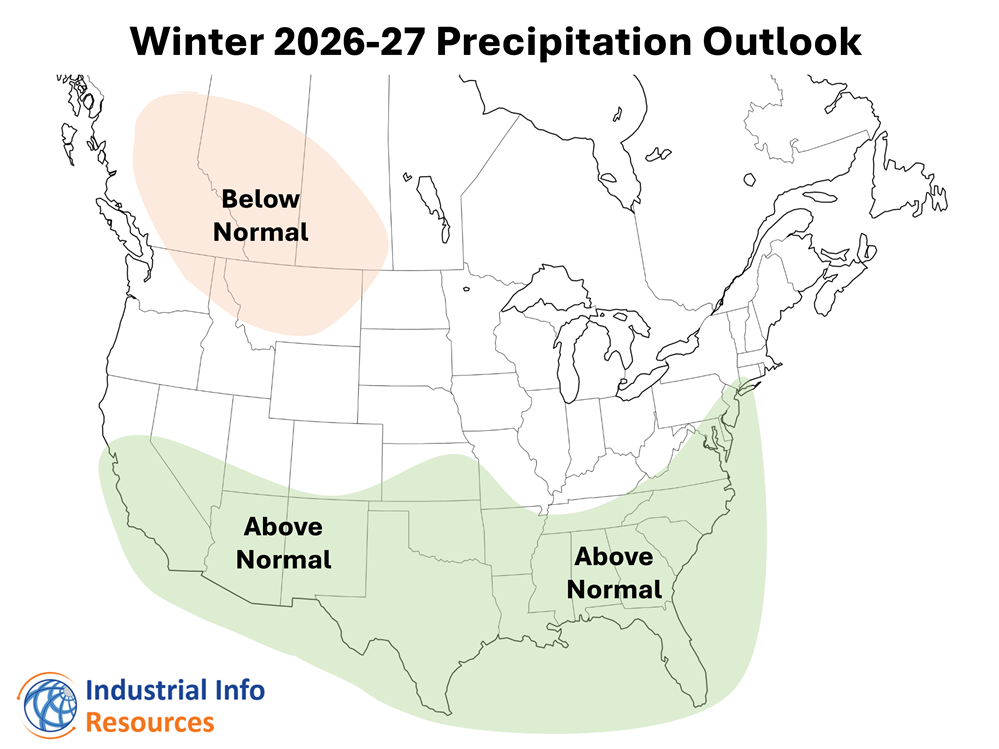
The Industrial Info Resources outlook for December 2026 through February 2027 favors above-normal temperatures across the Pacific Northwest, northern Plains, Great Lakes, Northeast, along with most of Canada and southern portions of Mexico. Elsewhere, near-normal temperatures are expected across the southern tier of the United States, and northern and central Mexico.
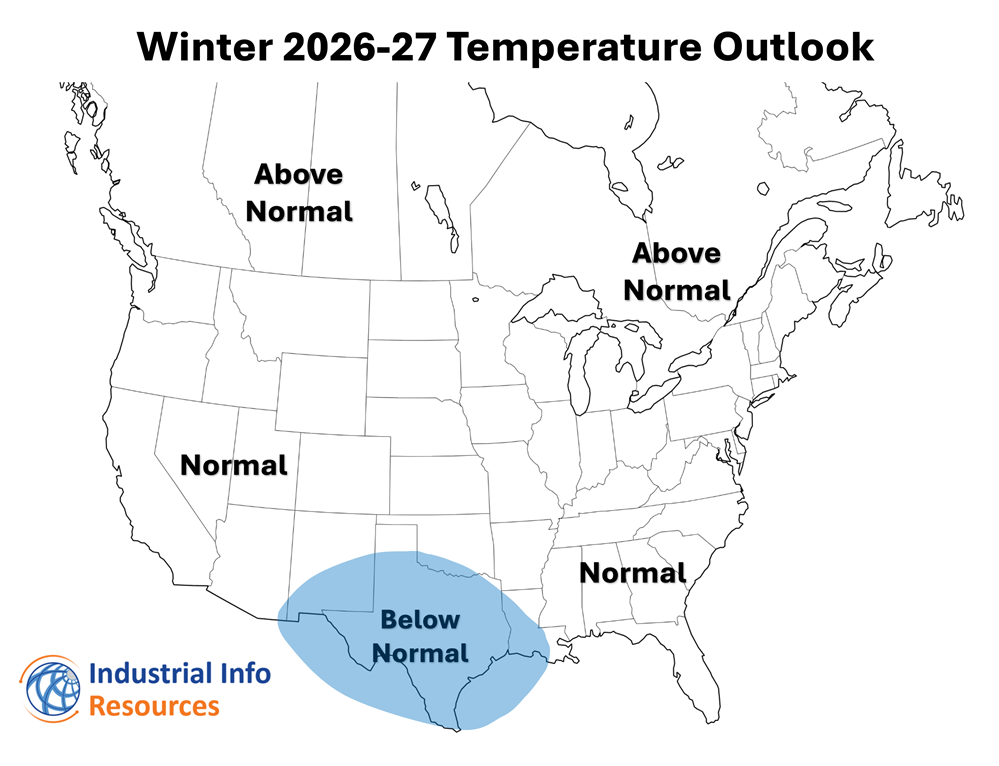 Precipitation forecasts favor wetter-than-normal conditions across California, the Southwest, southern Plains, Gulf Coast, Southeast, and Atlantic Seaboard. Conversely, drier conditions are favored across the northern Rockies, portions of the northern Plains, and parts of the Great Lakes region.
 According to Industrial Info Resources analysis, these contrasting conditions could reduce seasonal heating demand across northern energy markets while increasing weather-related operational risks across southern transportation, industrial and electricity networks.
Industrial and Energy Implications
The temperature outlook suggests reduced population-weighted heating degree days (HDDs) across portions of Midcontinent Independent System Operator (MISO) , PJM Interconnection, Southwest Power Pool (SPP) and southern Canada compared with a typical winter. Persistent warmth across the northern tier would generally moderate residential and commercial natural gas consumption, although periodic Arctic outbreaks could still produce substantial short-term demand spikes.Across the Electric Reliability Council of Texas (ERCOT) and the southeastern United States, more frequent cloud cover, precipitation and near-normal temperatures may support comparatively greater heating requirements during individual storm periods. However, seasonal averages should not be interpreted as forecasts of individual cold events.
The active southern storm track introduces additional operational considerations for Gulf Coast refineries, petrochemical facilities, liquefied natural gas (LNG) export terminals, and transportation corridors. Heavy rainfall, flooding, strong winds and occasional winter storms could disrupt logistics and electricity distribution. Industrial facilities from Texas and extending east into the Southeast may experience greater weather-related variability than northern facilities benefiting from relatively mild conditions. Renewable generation will also reflect the regional differences.
An enhanced subtropical jet could support stronger wind generation opportunities across California and portions of the southern United States. However, storm-related variability, icing, and temporary turbine shutdowns could produce substantial fluctuations in output.
Forecast guidance favors relatively calm conditions across much of central North America, suggesting periods of reduced wind generation potential across portions of SPP and MISO. These conditions could require greater reliance on dispatchable generation, particularly during high-demand periods.
Solar power generation may face seasonal challenges across California, Texas and the Southeast as frequent storm systems increase cloud cover. Northern regions may experience fewer storm-related reductions, although shorter daylight hours and snow accumulation will continue to limit winter output.
Hydroelectric generation presents a particularly important longer-term concern
The seasonal drought outlook favors worsening drought across portions of the northern Rockies, along with northeastern Oregon, and eastern Washington. Below-normal winter precipitation could reduce mountain snowpack, limiting spring runoff and potentially affecting hydroelectric reservoir storage and generation during spring and summer 2027.Conversely, wetter conditions across California, Nevada, Arizona, Colorado and New Mexico could improve soil moisture, snowpack and reservoir inflows. Increased Sierra Nevada snowfall would be particularly beneficial for California's hydroelectric resources, although exceptionally heavy precipitation could create flood-management challenges.
The ultimate hydroelectric response will depend on whether winter precipitation falls as snow or rain, spring temperatures and the timing of snowmelt.
Meteorological Drivers and Forecast Uncertainty
The primary driver will be an unusually strong, east-focused El Niño. In September 2026, the National Oceanic and Atmospheric Administration (NOAA) reported that Niño-3.4 sea surface temperature anomaly reached +2.1°C, while the October 19 weekly analysis indicated +2.4°C. The CPC assigns an 83% probability that the October--December Relative Oceanic Niño Index will exceed +2.5°C, a major climatological threshold. This could potentially surpass previous events in the historical record.The anomalously warm tropical Pacific waters will force changes in the atmospheric patterns, which favor an enhanced subtropical jet stream. Pacific disturbances can consequently track across California and the southern United States before intensifying along the Atlantic coast. If this East Coast development aligns with an Arctic outbreak, it could lead to significant icing and snowfall along the Eastern Seaboard.
Meanwhile, upper-level ridging over central and eastern Canada supports persistent warmth across southern Canada, the Great Lakes, and into northeastern United States.
One unusual feature is the coexistence of a strongly positive El Niño-Southern Oscillation (ENSO) phase and negative Pacific Decadal Oscillation (PDO). This combination has little historical precedent at the projected ENSO intensity, limiting the usefulness of traditional analog forecasts.
Current guidance suggests El Niño will remain the dominant influence, with the negative PDO potentially shifting the Canadian ridge eastward without substantially changing the broader precipitation pattern.
Stratospheric conditions introduce another uncertainty
A predominantly westerly Quasi-Biennial Oscillation (QBO) generally favors a stronger stratospheric polar vortex. However, recent ensemble guidance indicates possible vortex weakening during early winter, while seasonal models suggest additional weakening by January.A major stratospheric disruption could encourage high-latitude blocking and increase the potential for colder conditions across eastern portions of North America. However, such an event would need to influence the lower atmosphere before substantially changing prevailing winter patterns.
Conclusions
Overall, confidence is relatively high in the broad El Niño-driven temperature and precipitation pattern, but lower in the timing of individual winter storms, Arctic outbreaks, and stratospheric influences.For energy and industrial operators, the primary considerations are reduced northern heating demand, increased southern storm exposure, and potentially significant regional differences in renewable generation and spring hydrological availability.
Key Takeaways
- An exceptionally strong El Niño is expected to dominate North America's winter weather pattern.
- Above-normal temperatures across Canada and the northern U.S. could reduce natural gas heating demand.
- An active southern storm track increases precipitation and infrastructure risks across the southern U.S.
- Calm conditions may limit central U.S. wind generation, while increased cloud cover reduces solar output across California, ERCOT and the Southeast.
- Northern Rockies drought threatens spring hydroelectric generation, while wetter conditions could improve Southwest water supplies.
- The unusual combination of strong El Niño and negative PDO increases seasonal forecast uncertainty.
- Potential stratospheric polar vortex weakening could alter winter temperatures, if its influence reaches the lower atmosphere.
About Industrial Info Resources
Industrial Info Resources (IIR) is the leading provider of industrial market intelligence. Since 1983, IIR has provided comprehensive research, news and analysis on the industrial process, manufacturing and energy related industries. IIR's Global Market Intelligence (GMI) helps companies identify and pursue trends across multiple markets with access to real, qualified and validated plant and project opportunities. Across the world, Industrial Info Resources is tracking over 250,000 current and future projects worth $30.2 Trillion (USD).
/iirenergy/industry-news/article.jsp
false
Want More IIR News Intelligence?
Make us a Preferred Source on Google to see more of us when you search.
Add Us On GoogleAsk Us
Have a question for our staff?
Submit a question and one of our experts will be happy to assist you.

Explore Our EnergyLive Tools
EnergyLive Tools provide instant insight into new build, outages, maintenance, and capacity shifts across key energy sectors.
Explore Our ToolsRelated Articles
-
U.S. Remains Key to Iberdrola's Power Sector BuildoutOctober 22, 2026
-
42,822 Boilers and Counting: Industrial Info Resources Has t...October 22, 2026

Explore Our Enery Industry Reports
Gain the competitive edge with IIR Energy’s suite of energy market reports, designed for traders, analysts, and asset managers who rely on verified, real-time data.
View ReportsIndustry Intel
-
Brazil Critical Minerals 2027: Rare Earths, Lithium, CopperPodcast Episode / Oct 16, 2026
-
US Craft Labor Outlook 2026: Wages, Per Diems, Data CentersPodcast Episode / Oct 16, 2026
-
Latin America Data Center Outlook 2026: Power, Hubs & GrowthPodcast Episode / Oct 9, 2026
-
Food and Beverage CapEx Outlook 2026: Tariffs, AI, AfricaPodcast Episode / Oct 9, 2026
-
North America Refining 2026: New Pipelines to PADD 5Podcast Episode / Oct 2, 2026