Podcast Overview
Presenters



Video Language
Hello and welcome. This podcast is brought to you by Industrial Info Resources. Since 1983, we have been providing global market intelligence on the energy and industrial markets. And through the combination of our trusted data, which is validated and qualified direct from source, and our analytics and forecasting tools and solutions, we help our customers stay connected and in tune with the latest project and investment opportunities and those trends occurring across the world. My name is Shaheen Chohan, I am the Vice President of Global Analytics at Industrial Info Resources. I'm based in our Dubai office and I've been with the company for about 15 years now.
Now, to help unpack these insights, I am delighted to be joined by Shane Mullins, who is our VP for Energy Products and Markets, and who has a specific expertise in natural gas markets. And I'm also joined by Britt Burt, who is our Senior VP of Power Research Operations. Welcome, gentlemen.
Now today we will be taking a look at the new wave of data center capacity build-out and with it the billions of dollars of capital investment that is flowing at pace into the sector. Now, you may be wondering why we are discussing data centers and capital investments with a power and a natural gas expert. Well, the reality is that the sheer size and pace of data center capacity development — certainly in the US — is starting to intensify energy demand growth, whilst also placing some additional strains on what is already an aging electrical grid.
So with that, Shane, before we really get into some of those trends that we're seeing, maybe you could just talk to us a little bit about the investments that we're seeing, and maybe start by defining where that infrastructure build-out is originating from, from an end user perspective.
Shane Mullins (02:19):
Yeah. Well, for many, many years we've been tracking capital projects for data centers, and we've seen for the most part a lot of that investment taking place in the US — a little over 60%. But it's really taken off in Europe and also in Southeast Asia. One of the big things that's changed for me in the last year is getting involved with data center coverage. We've been reporting on data center projects for many, many years. But we're in the answers age now, and our clients are asking questions that we need to be able to answer — and that's helping them forecast what the electric demand forecast looks like for data center development. So we've created a unit database — one unit per building, phased with a timeline — to allow our clients to visualize how this data center demand is going to grow from the standpoint of electric demand. And so from that we're able to create several new views as part of our coverage.
Shaheen Chohan (03:20):
So when you talk about the data sets that you and the team are researching, we're talking not just about the physical infrastructure being invested in, but also the power side. Can you just share a little bit about what you mean by power demand?
Shane Mullins (03:35):
It's been phenomenal. What we're looking at now is how is that data center going to connect to the grid — whether it be by electric utility or electric substation — and lately, which natural gas pipeline is it going to connect to? And basically where data center development is gravitating towards is where they can get the energy that they need. Just in the past year, we've seen over 64 500-plus megawatt scale hyperscale data center campuses get announced, and very few of them are going to have the electricity they need from the electric grid. So now it's all about how are they going to support themselves? Who's going to go in and build power plants next to these data centers? Are they going to put in behind-the-meter generation, and what types of technologies are they looking at at each individual project — to help not only our equipment and service providers, but also the energy traders, the companies that get involved in natural gas trading and sales, and just a whole host of new clientele that we're working with to assist on this product line.
Shaheen Chohan (04:38):
Now, I've just shown here a kind of heat map from our GeoXplorer, based on the underlying projects that your collective teams are researching around the world. Of that $1.4 trillion or so of active capital investments being tracked, there are obviously some noteworthy hotspots around the world, but clearly we can see that North America has the biggest pipeline of data center activity still at the planning and engineering stage — way bigger than any other region. Why is the US in particular being seen as the epicenter of some of this investment? Why is it occurring in the US and not as much elsewhere?
Shane Mullins (05:14):
Traditionally, a lot of the world's internet traffic flows right through the US — 50% of the world's internet traffic flows through Northern Virginia. And then from there, our government agencies use big data, and we've had a huge build-out for the last 20 years. And the big change that you see in that heat map from the standpoint of investment is that data centers have gone from two kilowatts per rack to 22kW per rack, and now 132kW per rack. And by 2027, the data centers that will be installing equipment will be at 600kW per rack. The investment involved behind that — rack costs have gone from $100,000 to $5 million per rack. And so there's almost $1 trillion worth of development taking place just in the US alone, because of that and with AI and the training that's going on for AI.
You've heard about OpenAI, Elon Musk, the XAI data center — they're putting in power equipment themselves. Elon Musk's Memphis data center now has 35 gas turbines, and OpenAI is installing gas turbines out in Abilene, Texas, and they're already at five buildings under construction at this point. So it's really just a different ballgame now that we're looking at data centers with these types of rack sizes for training AI.
Shaheen Chohan (06:51):
Now, Britt, I'd like to lean into the whole power demand side of things. Clearly what Shane is saying is there's a new wave of electricity demand coming. How are we going to meet that? In terms of both the fuel type and also grid supply — certainly in the US, where we're seeing this incredible scaling of capacity coming online — and you've talked for many years about this very urgent and critical need to upgrade the grid. How are we going to meet this?
Britt Burt (07:23):
Well, the need to update the grid was there prior to the data centers, and that only magnifies it, to be quite honest. The grid is very old — much of it over 40 years old in the United States. So those needs for infrastructure upgrade are still there. If we get down to the generation sources and the energy sources that will provide the electricity for this, it's going to have to be a variety of different sources and methods.
Traditionally, data centers have always touted the fact that they wanted to use renewable energy, and for many years we've seen solar farms and wind farms sign long-term power purchase agreements with some of the developers of these data centers. But solar and wind energy alone is not going to get us there — it's going to take a variety of things. And I think right now the most obvious is natural gas. We're seeing that across the country with all the major power providers. Entergy, I'll start with — has been very aggressive in building out new combined cycle facilities. We see other players: Vistra, Talen, Constellation — that are very aggressive in that market. And that's from the natural gas side.
Apart from that, I believe we're going to have to see more capacity from the nuclear providers as well — particularly the small modular reactors. By and large, I believe it's going to be the small modular reactors, as you and I have talked about before. There are also some conventional restarts of conventional nuclear facilities. Three Mile Island is one. Palisades up in Michigan is another. There's talk of restarting the Duane Arnold facility in Iowa, and even in South Carolina — there's a scanner out for bids for completing Unit 3 at the Sumner site, which they had started construction on and backed away from because they didn't need the power demand. And ironically, now they do.
And then there are other forms that we're seeing — geothermal being developed for data centers. And last but not least, coal plants are being kept operating longer to support data centers, and there are even some power purchase agreements being signed with coal plants.
Shaheen Chohan (09:59):
Yeah, it's quite interesting. I think we saw the Trump administration issue their Fast 41 permitting for specific mine development, and funnily enough coal was on there, right. So I guess you're going to have to locate the data center capacity where there is the provision of sufficient electricity. And that's the thing — we're going to see some co-location, maybe some direct-connected facilities. Do you think, Shane?
Shane Mullins (10:31):
Yeah. Not every site is going to be able to pull from the grid 500 megawatts or a gigawatt. And now we're seeing sites where there are so many buildings that we're talking about five or six gigawatts worth of electricity demand, and the grids are just not going to be able to support that. And so we are seeing data centers being developed in combination with companies jumping in to build a power plant next door. Williams Company is building two power plants right now, and Exxon and Chevron are jumping in.
And we're also seeing data centers themselves — which used to put in diesel generators — now starting to look at natural gas fired generator technology so they can run them more often than 150 or 200 hours a year, but also fuel cell technology. Fuel cells can later be adapted for hydrogen when that's ready. And they also produce a higher concentration of CO2, so data centers can put in natural gas fuel cell technology and install their own carbon capture technologies as well.
Shaheen Chohan (11:36):
So guys, this exponential growth in demand for electricity must be putting pressure on some of those equipment OEMs to try and fulfill the pace of demand for the power going into these data centers. Would that be correct?
Britt Burt (11:54):
Yes, very much so. All the major OEMs are experiencing orders for gas turbines that we haven't seen since the last boom — the last major build-out of gas turbines across the country and globally. Recently, we saw the President of Siemens Energy state that in 2022 they booked one gas turbine order, and now they're backlogged. The CEO of GE Vernova just recently mentioned that in the first quarter alone they booked seven gigawatts of orders for gas turbines, raising their backlog to about 29GW. By and large, the delivery time on a gas turbine right now is three years. By and large, the delivery time on a gas turbine right now is three years. So it is placing a strain on the supply of gas turbines, but there is more manufacturing capacity on the way. GE is spending $600 million on new manufacturing capability that will be coming online in a couple of years to help mitigate some of that.
Shaheen Chohan (13:03):
I want to stay with the power piece for a little bit more — it's an important component of the growth of the sector. Can you just educate folks a little bit about the two sides of power demand? There's what you call the front of the meter, and then there's what's behind the meter. Can you share a little bit about those definitions?
Shane Mullins (13:22):
Well, when we look at data center demand, traditionally it's demand that's hitting the grid — behind the meter — or data center developments that are planning on not pulling from the grid necessarily, but producing their own power on site without pulling from the grid, or only pulling from the grid when it's advantageous. Data centers are going to get all the renewable energy they can get off the grid. And when it's not there to support them, they'll switch on their gas power generators or other technologies that they can deploy on site. And some of those are renewable energy sources like solar panels and battery storage to back it up as well. So we do see that taking place as well.
Shaheen Chohan (14:09):
And hence your interest — as you said, you really can't have a conversation about gas markets without factoring in the discussion about data centers. So clearly, one of you referenced the fact that data center operators and owners do have and are seeking out some of those alternative lower carbon sources. But really, the reality of it is that we're going to lean probably more heavily on the gas side of things — certainly for the near term.
Shane Mullins (14:37):
I believe so, yeah. This is why we're seeing data center development for large campuses taking place in the Haynesville and northern Louisiana. Britt mentioned Entergy building out these combined cycle power plants for Meta there. We're seeing in the Appalachia region in Ohio and Pennsylvania data centers being developed — they're taking advantage of the Appalachian gas there that's stranded without enough takeaway capacity to keep growing that basin. So there's going to be in-basin demand created by data center development there, and also in West Texas. I mean, there are a lot of pipeline companies that are chasing data center developers to supply them with the gas that they need.
Shaheen Chohan (15:24):
And Britt, you know, there are great intentions to try and add renewables to the mix, and that's happening across the market wholesale. Just stepping back a little bit with your power hat on — do you think that renewables, full stop, are coming online at a sufficient pace, not only to meet the increase in just general wholesale electricity demand, but now this surge of demand coming from data centers? I'm referencing specifically because we've seen a little bit of a challenge to new build offshore wind. Correct?
Britt Burt (16:05):
Oh, absolutely. The new administration has put some constraints on offshore wind that I believe are going to be there for the duration of this term. Will renewable sources come online to supply data centers? Yeah, I believe so — later down the line, somewhat. There are constraints we haven't talked about yet, which is the backlog of the interconnect queues — these facilities gaining permission and approval to tie into the grid themselves. And there's been such a wave of development of solar and battery developments that it's overwhelming the approval process for the independent system operators and the regional transmission organizations. And so that's really slowed down the development somewhat of battery and solar, along with other issues we've talked about in the past, such as supply constraints and things like that.
PJM, which is basically on the East Coast, recently made a move to put natural gas fired applications for generation ahead of renewables — moving the natural gas fired applications to the forefront of that approval process. It's caused a little bit of a stir, but they know that natural gas fired generation is a reliable form of electricity for the data centers.
Shane Mullins (17:42):
Yeah, I think after seeing wholesale power prices go up this summer by 800%, that changed the minds.
Britt Burt (17:47):
Exactly right.
Shaheen Chohan (17:54):
Now I want to discuss the impact on data center construction and specifically go back to tariffs. We can't really have a conversation without touching on tariffs. The current state — and this is a daily, constantly shifting picture.
Shane Mullins (18:05):
It is a moving target. Very much a moving target.
Shaheen Chohan (18:11):
Semiconductor imports — the last time I looked, certainly off the back of the 2nd April Rose Garden announcement, semiconductor imports were kind of given something of an exemption, I think. But the reality of it is a number of the semiconductors that do get imported are wrapped up in finished product or finished equipment, and they are actually being tariffed. So do we think that this is now quite a big issue or a big consideration for anybody sitting with a data center project still at the planning or engineering stage? Do you think we may see some bottlenecks or challenges or disruptions to the supply chain of some of this critical equipment required for moving these things forward?
Shane Mullins (19:01):
There could be a rethink on timelines. Right now, we just don't have the clarity that we need — not until July when this is all settled. There's a lot of negotiations going on with the existing trading partners, and we don't know what's going to get worked out as far as tariffs are concerned. But my bigger concern is labor. You've got data center expansions that are requiring 3,000 personnel, competing with power plant projects — combined cycles that need a lot of labor, as well as a lot of labor for semiconductors. So that might slow down some construction more from a labor standpoint than anything else.
Right now there's 16GW of data center capacity under construction. We just reached a new milestone where we have over 30GW of data center capacity online, up from just 19GW three years ago. So a tremendous amount is underway. I don't think we're going to see that same pace over the next several years — what would probably be more likely is 10 to 15GW of data center capacity built out in each of the next four to five years. So we're not going to see the same pace that we're seeing this year over the next three to four years, but it will still be a very fast pace of building.
Shaheen Chohan (20:05):
I mean, it's still a sizable juggernaut coming through the system. Maybe if I could just keep you on the hook just a little longer — I'd love to have one final summary from each of you with your respective hats on as to what you want our end users and listeners today to stay tuned to.
Shane Mullins (20:31):
I would just say that there are some who would say that we're expecting a slowdown, that the boom might come to an end. But this is the world's gold rush right now. As Kevin O'Leary would say — who's developing his own 7,500 megawatt data center up in Ontario — we're in the answers age, and we're moving away from training AI on public data to millions of companies adopting AI to train AI on their own intellectual property. This is just getting off the ground. The train has left the station — plenty of development ahead of us.
Britt Burt (21:02):
It's getting pretty exciting from the power perspective. It's exciting for me because we haven't seen growth in demand for electricity for a very long time. I believe over the next several years we're going to see 3% per year in growth of demand, maybe even more. There are going to be pockets of the country where that's as high as 8%. Historically, it's been around 1% or less.
Shane Mullins (21:31):
Yes. If you go back to that heat map — the 2 to 3% per year growth — that's not taking place evenly across the United States. There are hotspots where utility companies are seeing the greatest amount of demand growth that they've seen in a generation. So it's all hands on deck getting ready for that. And so that's why we are seeing combined cycle power projects finally get to the point where they can be greenlighted.
I think the big thing people are trying to wrap their heads around right now is how much of this is real. We talked about the boom and the potential slowdown, and so there is uncertainty on the electricity demand side as well. But without a doubt the growth is there, and I think that's going to continue for a while. I think the stark realization is this is real, and we're behind on developing the power plants that we need to meet this demand.
Shaheen Chohan (22:28):
Well, thank you, gentlemen. Love the topic — you can't stop either of you! Listen, if any of you who've tuned in have got any further questions that you'd like to put across to Shane or Britt, then please reach out to them directly — you can see their contact details there. All that leaves me to do now is say a very big thank you to everybody who's joined us. Thanks for joining the discussion. I hope we have helped you better navigate some of the currents of change we are seeing right now. Thank you.
Recent Podcast Episodes
Data Centers
Latin America Data Center Outlook 2026: Power, Hubs & Growth
Can Latin America become the next data center hub? IIR experts unpack 2026 trends across São Paulo, Querétaro, Santiago, and grid limits.
Food & Beverage
Food and Beverage CapEx Outlook 2026: Tariffs, AI, Africa
Why are food producers spending cautiously despite strong demand? IIR experts unpack 2026 CapEx trends across ROI-driven budgets, AI and automation, and emerging markets.
Refining
North America Refining 2026: New Pipelines to PADD 5
Is North America's refining system built for what's coming? IIR experts unpack 2026 trends across PADD 5 pipelines, Canadian crude, and modular refineries.
Pharmaceutical & Biotech
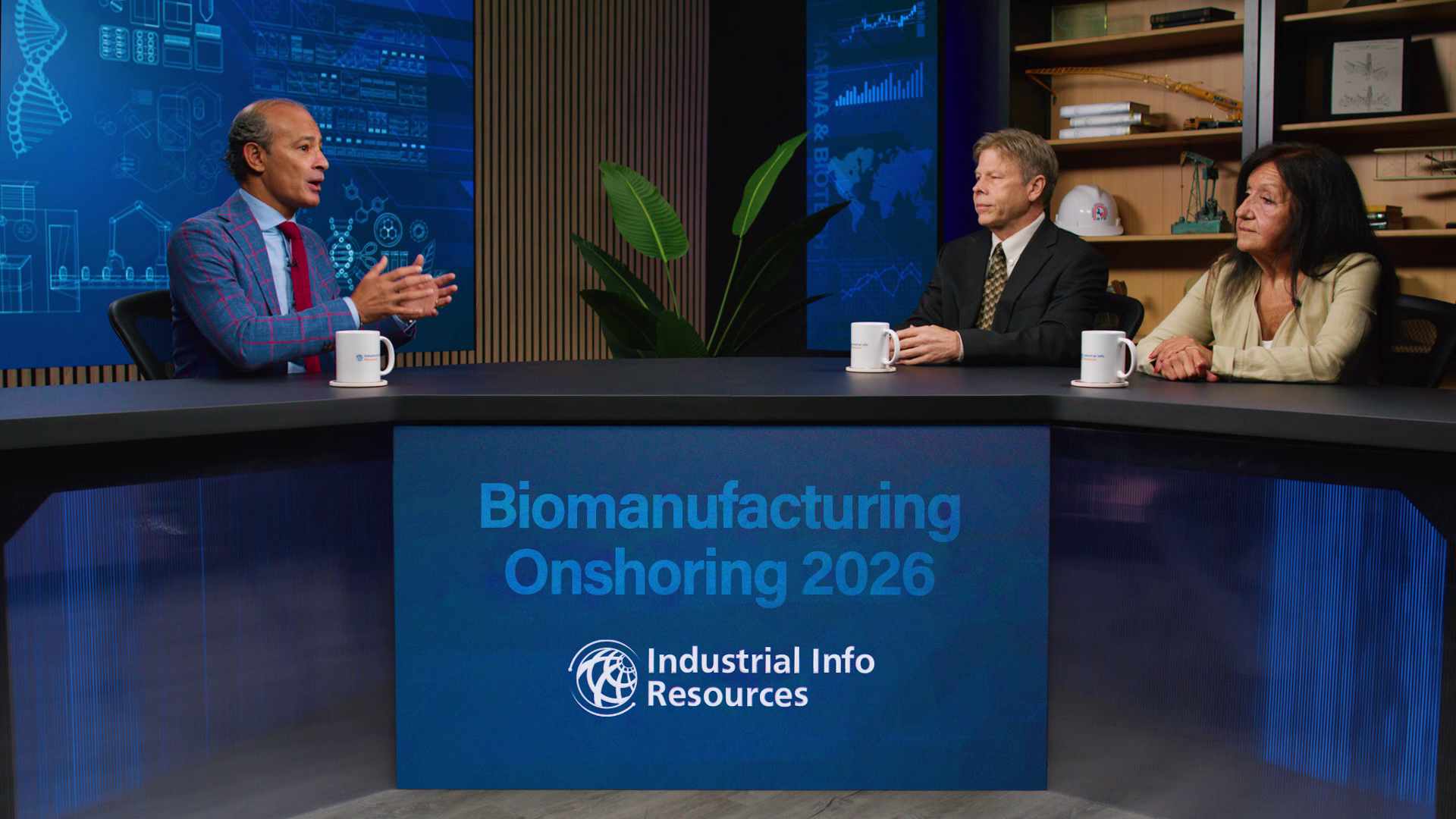
Biomanufacturing Onshoring 2026: GLP-1, CDMO and Reshoring
Could pharma's onshoring boom outlast the tariffs that sparked it? IIR experts unpack 2026 trends across GLP-1 manufacturing, CDMO growth, and biomanufacturing site selection.