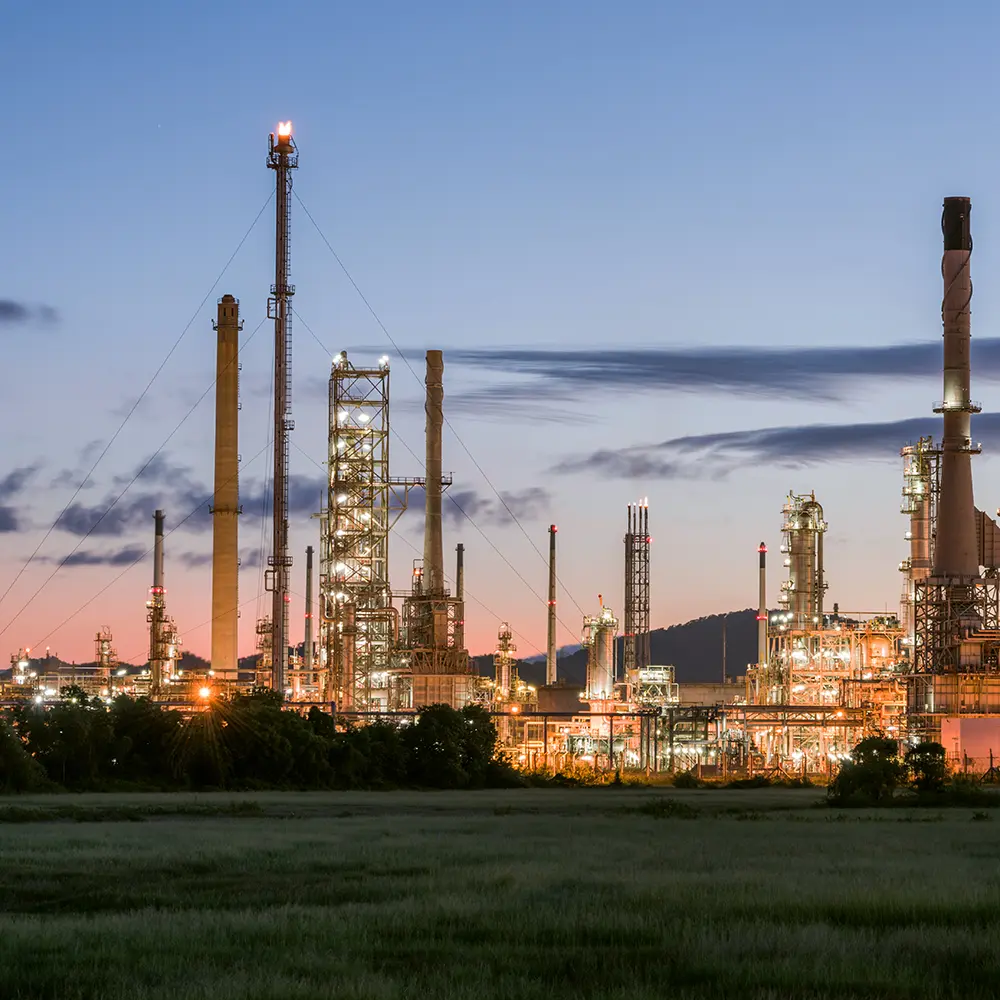
Podcast Overview
Presenters



Video Language
As the global energy system continues to seek ways to reduce carbon emissions, the chemical industry is increasingly playing a role in the energy transition — whether that is by adopting cleaner, more sustainable production processes, or as a critical enabler of clean technologies. But this transition comes with a cost, something that is challenging all but the most cost-advantaged producers. So will we continue to see investments into cleaner commodities, or will the sheer cost be too much of a headwind?
Shaheen Chohan (00:50):
Welcome to Navigating the Currents of Change. My name is Shaheen Chohan and I lead Global Analytics here at Industrial Info Resources. For over 40 years, we have been providing market intelligence, data analytics and geospatial solutions to those companies involved in the design, construction and maintenance of plants and facilities across energy, mining and heavy industrial sectors across the world. Now, to help me unpack some of these trends we are seeing, I am delighted to be joined by two of our industry experts. We have Trey Hamblet, who is our global head of chemical processing research, and Baptiste Mauduit, who leads our European research for alternative fuels and chemical processing. Welcome, gentlemen.
Now, Trey, before we sort of delve into the details of the active spending that you are seeing around the world, perhaps you could explain to folks who've joined the discussion what commodities we are tracking.
Trey Hamblet (01:49):
Yes. So predominantly we're talking about methanol, ammonia and hydrogen. And these are all building block commodities. The discussion around energy transition and moving the chemical industry to producing commodities that have an ESG flag or lower carbon footprint are predominantly centred around those commodities. And as I mentioned, these are building block commodities — they are commodities that are used in the chemical industry or even in other industries to produce other commodities, and help carry that ESG flag through to end markets and consumers and other production processes. So those are really the key stakeholders, if you will, in this energy transition — the large-scale production of ammonia, hydrogen and methanol with a lower carbon footprint.
Shaheen Chohan (02:40):
Now, obviously the big pathway to decarbonizing the energy markets is through, as you said, the use of these cleaner commodities — both as a transportation fuel as well as energy carriers. And I guess the two flavors, to coin a phrase, of this being blue versus green commodities — would it be correct to state that we are now potentially seeing two diverging trends between the green market and the blue market?
Trey Hamblet (03:12):
Yes. You know, is it a diverging trend? Well, the commodities are produced with very different technologies between green and blue. The green originates from renewable power — which is a very specific power-to-X electrolysis of water technology — where the blue commodities use very traditional technology where we're using traditional feedstocks, natural gas and others, and pulling and capturing the carbon. So while the molecules are the same in the end, the green or blue designation is very much technology-based. And so they are very much two different trends. You have different consumption markets — you alluded to energy carriers, you alluded to transportation fuels. And so the uses of the commodity are actually a little bit different. Because to carry that green flag, it can't go into a traditional transportation storage system — it has to be kept separate, consumed in that dedicated environment, if you will. So yes, there has been a divergence — not all hydrogen is the same. It's the same molecule, but we get there by different means, different technology. And there are different drivers, different incentives and motivations for those two paths.
Shaheen Chohan (04:30):
Bearing in mind the sheer supply at the moment of gas on the market, would it be right in assuming that you kind of expect to see more momentum associated with announced CapEx specific to the blue hydrogen side, bearing in mind the green technologies tend to be a little newer? We currently have a lot of gas out there which is used as the feedstock for the blue hydrogen side. So do you see more momentum on blue versus green?
Trey Hamblet (05:01):
Yeah, it's an interesting question. When we talk about momentum, when you look at pure project counts and dollar values, we have significantly more planned and proposed in the green space than we do in the blue. So on the blue hydrogen piece, again, this comes from traditional feedstocks. And you've got the world's largest companies — Air Products, Dow, Exxon and others — planning and proposing these projects. And there are much larger volumes, so they're world-scale capacity additions. There's a far fewer of the projects — there's a few dozen of those here in the US, even with the incentives that we have in place. But again, they're going to very traditional markets — global export markets, into installed infrastructure, hydrogen pipelines that go from the East Coast all the way to the Gulf Coast. So there's a very traditional, established market for that blue hydrogen, and that's certainly going to help propel those at a speed greater than the green commodities, which have many headwinds.
You look at the renewable power that's required to fuel those — it's enormous. And you look at the power demand that we have for data centers and the traditional power demand load growth that Britt and some other colleagues have talked about. There's a tremendous headwind on the green commodities. And circling back to the comment I made earlier about the use of green hydrogen — yes, we're using green hydrogen in fuel cells, in material lifting equipment and forklifts and such. But it's got to grow to something more substantial than that in our domestic market. There's a long list of constraints in doing that — you have to be able to carry that green flag and consume it as a green commodity. You've got to transport it, store it, and have a place to consume it. And we've got this renewable power constraint. So there's just a lot of headwinds for it.
But if you look at the installed base at this moment for green hydrogen, there's roughly ten operational green hydrogen units across all of the United States. And we've been talking about green hydrogen now for almost a decade. This is not a subject that came around just because of the IRA incentives or revisions from the Big Beautiful Bill recently — these are items that have been discussed for a very, very long time. And still we only have ten of those. And it's a lot of new companies that are looking for that opportunistic advantage in the market.
Shaheen Chohan (07:37):
Well, I want to come back to that theme of how do you incentivize new technologies and new emerging markets. All technologies, typically the cost is always one major consideration. And I guess to get the momentum going in scaling up production capacity and attracting additional investment, subsidies and tax incentives are typically required. In your opinion, does the current stance on decarbonization under the recently announced Big Beautiful Bill still provide enough of an incentive for US production to continue to scale?
Trey Hamblet (08:17):
Yes. I mean, some of the changes that were made kind of level the playing field in some respects — it increased the rate available in some regards for carbon capture, and it's certainly increased the incentive dramatically for direct air capture. And so there are foundational things in that that I think will help propel it. We have some other constraints specific to global demand — we're in this period right now where there's been a lot of activity that's been paused, worried about global consumption and global demand. When you look at the chemical industry as a whole and you look out to 2030, 2035, etc., the demand for the chemical commodity space is very strong. But we're in that window right now between here and there that has a lot of question marks.
But to answer your question — yes, I think there are adequate incentives to push this. But also go back to the comment I made earlier: we were pursuing blue hydrogen and carbon capture well before all these incentives. Twenty years ago, Praxair and others were developing very large projects — we just deemed they were cost-prohibitive at that point in time. Roll that forward to 7 or 8 years ago before all these tax incentives and ESG strategies were top of the agenda for corporate America and consumers alike — these incentives certainly provide something of an advantage. But this is not something that came about as a result of the incentives. The incentives are just hoped to propel the speed of these projects.
Shaheen Chohan (09:52):
Actually, Trey, thanks for that — a good point. And that provides a perfect segue to you, Baptiste, if I could bring you into the discussion. The energy transition is a big component of active capital spending across Europe right now, both in terms of new-build renewable power and also the decarbonization of the transportation sector — two very big themes that are happening in your market. And also a lot of investment going into some of those energy-intensive sectors such as steel and cement. What does the outlook for Europe appear to be? Are you also seeing diverging spending trends occurring between the blue and the green?
Jean-Baptiste Mauduit (10:36):
Hello. In Europe, the Repower EU plan is really shaping the outlook. It was launched after the Ukraine crisis to cut out Russian fossil fuels by 2027 and accelerate the clean energy transition — backed by around €300 billion. It raises renewable targets for 2030 and sets ambitious goals for green hydrogen and biomethane. We already see that reflected in spending. IIR is tracking roughly $120 billion in CapEx tied to more than 800 related hydrogen projects across Europe, and over 300 biomethane projects worth $6 to $7 billion. So the pull is very clearly to green projects, while more traditional energy-intensive investments are lagging.
Shaheen Chohan (11:20):
Thanks, Baptiste. If I could just stay with you a little longer — Europe is obviously still embarking on a major renewable power build-out. Is this providing the necessary infrastructure being put in place to really support the development of green hydrogen in Europe?
Jean-Baptiste Mauduit (11:37):
Renewables are expanding fast, and that's giving hydrogen a good start. But the support infrastructure isn't fully there yet. Grid bottlenecks and slow permits hold projects back, and the biggest hurdle right now is electrolysis — the very large units we need are only just reaching the market and European factories are still catching up. That's why we've already seen some delays and cancellations. We currently have 38 green hydrogen units operational — most of them small scale — and over 700 planned or under construction, but the vast majority being planned. A market correction is likely due in the next year or two, and only the strongest projects will move forward. To turn the European vision into reality, we need a major scale-up of investment, infrastructure and political backing.
Shaheen Chohan (12:30):
So, Trey, if I could come back to you — you named a few players and producers who are operating in the market, both on the blue and the green side, in terms of bringing these new technologies to market. Are we seeing new entrants starting to emerge in this space, or is it still largely being driven by what we could call the incumbent traditional chemical producers?
Trey Hamblet (12:54):
So on the blue side, it is largely those that we know — I named a few earlier: Air Products with their large project in Louisiana, Exxon with numerous projects in between Texas and Louisiana. So on the blue side, it's predominantly those that we know and have seen. We do have a handful of grassroots methanol, ammonia and blue commodity projects being planned and proposed — these are largely by companies that surfaced out of, or were created out of, a demand opportunity matched with that incentive. But those opportunities that I talked about earlier that predate a lot of these incentives are again those traditional firms.
When you look at it on the green hydrogen side, it's overwhelmingly new entrants — overwhelmingly companies that were created to pursue those opportunities. There are some small exceptions. CF Industries is operating one of those very few limited green hydrogen units already operational here in the United States, over in Louisiana. There's a handful of green hydrogen units being planned and proposed within the fence of an existing chemical operation. But that's a very, very small part of the future spend — predominantly the new companies. And Baptiste, back to you — is this also the case, a similar trend that you're seeing in Europe?
Jean-Baptiste Mauduit (14:09):
In Europe, it's really both new entrants and the traditional majors. On the new side, companies like Lhyfe and HY2GEN that have not even existed ten years ago are now planning large-scale green hydrogen projects. You also have kvb, a relatively young player, rolling out small-scale biomethane plants across France. On the other side, the established groups are adapting — like Engie with a 200 megawatt electrolyzer green hydrogen project in Normandy that will supply the refinery cluster, and TotalEnergies building some of the largest biomethane units in Europe, like the Bio Burn plant in the southwest of France and the Bio Nova unit in Normandy. So you can clearly see both innovative newcomers and big industrials pushing hard in this space.
Shaheen Chohan (15:03):
Now, Trey, coming back to the US — your home market. Is this a market that is really in a very strong position to be a major producer, certainly of the blue commodities, due to the ample supply of domestic natural gas? And obviously this supply gives your chemical producers a huge cost advantage over many other — if not all other — markets. But obviously on the blue side, there is clearly a big dependency on having sufficient, scalable carbon capture in place. Are you seeing also a kind of parallel momentum — the pace and the size of spending also going into carbon capture technologies?
Trey Hamblet (15:45):
So yes — if you look at the announcements that are regularly made for carbon capture and storage, matched with the technology to capture the CO2, there continues to be advancements in that. And we talked a little bit about the feedstock advantage — there's really no threat on the horizon that we're going to lose our feedstock advantage for producing the blue commodities here in the US. That's illustrated by our ability to continue to build LNG exports and a long list of projects to develop the natural gas supply here in the US.
Shaheen Chohan (16:28):
Now, talking about the LNG exports, Baptiste — turning specifically to blue hydrogen: obviously, the still ongoing conflict between Russia and Ukraine has really created ongoing gas supply chain challenges. A lot of that gas now is coming from the US. Does the risk or the volatility around getting sufficient gas supply present challenges towards the blue hydrogen space, and certainly the ability for Europe to add blue hydrogen to its pathway to decarbonization?
Jean-Baptiste Mauduit (17:00):
Since the Ukraine crisis, gas has become costly and volatile, and carbon capture capacity is still very limited, with only a few projects like Northern Lights and Porthos moving forward. That said, in the short term, blue projects are often more likely to advance than green because the technology is proven and can be used in existing gas infrastructure. But the bigger picture is clear — EU policy and funding are firmly geared towards green hydrogen. So while blue may play a role in certain clusters, the long-term momentum is shifting decisively to green.
Shaheen Chohan (17:37):
So, Trey, in closing — the chemical industry is clearly where most of the blue and green commodity investment and indeed production capacity is occurring. You've talked about how big the volume, the kind of wave of potential CapEx, is that is still sitting in the marketplace and kind of continuing to move forward. Big question: do you think a lot of this is aspirational, or do you actually think from a technology perspective we'll be able to get the cost down, and that will be sufficient to keep investments moving forward?
Trey Hamblet (18:13):
So I think it's the latter of what you said — I think we'll be able to see a significant portion of this, particularly on the blue side, move forward. Aspirational? Yes, probably a decade ago — 7 or 8 years ago — it very much was, as we were in the infancy of developing ESG strategies and ESG plans that were pushed at a time where we didn't have the technology as we do today, at the time where we didn't have the solution to store the CO2, or at the time that we didn't have announced projects to move it by transportation, etc. And so we're in a time where we've seen a lot of advancement and plans to move it, to store it — now matched with incentives, with that aspiration that I want to do better, I want to produce a greener or bluer product. So yes, I do see the stage set where we're going to realize some of this. Do we realize all of it? No. I mean, we do a good job of showing probabilities and fallouts and what projects get moved. And we're going to see that same trend within the space. Not everything that is planned or proposed is going to become a reality.
But again, you look at the long-term health of the industry matched with our desire to have a blue commodity put on a tanker or a pipeline — it spells that we're going to see it. Maybe the runway to getting there is a little longer than we anticipated, but we do anticipate this becoming a reality in some form or measure.
Shaheen Chohan (19:39):
Okay, that brings us to the conclusion of our discussion. A very big thanks to both of you, Trey and Baptiste — thanks for sharing your perspectives and insights today. Really enjoyed the discussion. If any of you have any further questions about any of the topics raised today, then please do reach out to myself or Trey or Baptiste via the contact details you can see here. And finally, a very big thanks to all of you who've joined us today. I really do hope that we have helped you all better navigate some of the currents of change that we are seeing.
Recent Podcast Episodes

Data Centers
Latin America Data Center Outlook 2026: Power, Hubs & Growth
Can Latin America become the next data center hub? IIR experts unpack 2026 trends across São Paulo, Querétaro, Santiago, and grid limits.
Food & Beverage
Food and Beverage CapEx Outlook 2026: Tariffs, AI, Africa
Why are food producers spending cautiously despite strong demand? IIR experts unpack 2026 CapEx trends across ROI-driven budgets, AI and automation, and emerging markets.
Refining
North America Refining 2026: New Pipelines to PADD 5
Is North America's refining system built for what's coming? IIR experts unpack 2026 trends across PADD 5 pipelines, Canadian crude, and modular refineries.
Pharmaceutical & Biotech
Biomanufacturing Onshoring 2026: GLP-1, CDMO and Reshoring
Could pharma's onshoring boom outlast the tariffs that sparked it? IIR experts unpack 2026 trends across GLP-1 manufacturing, CDMO growth, and biomanufacturing site selection.