Podcast Overview
Presenters


Video Language
The European pharma and biotech industry continues to show increasing growth, driven off an aging population, increased healthcare expenditures, and advancements in drug development. However, the industry also faces challenges such as construction cost inflation, regulatory challenges, and the prospect of disruptions from trade tariffs. If you're looking to gain more insights on some of these big themes, then this conversation will help you connect the dots.
Shaheen Chohan (00:45):
Welcome to Navigating the Currents of Change. My name is Shaheen Chohan, and I am the Vice President of Global Analytics at Industrial Info Resources, a global provider of energy and industrial infrastructure market intelligence for more than 40 years. And to help me dissect some of these themes and trends, I am delighted to be joined by Joe Apostol, who leads our European research for pharma and biotech. Welcome, Joe.
Joe Apostol (01:17):
Nice to meet you, Shaheen.
Shaheen Chohan (01:18):
Now, I would like to start off, Joe, by just giving folks who've tuned in a little explanation about the scope of the sectors and some of the segments of the pharma and biotech industry that you and your researchers cover. And broadly speaking, what is the current size of the European pharma market today?
Joe Apostol (01:36):
So we literally cover everything from A to Z — from cosmetics, laboratories, the final formulation ingredients, so-called active pharmaceutical ingredients, the warehouse, life science packaging. And we track over $100 billion worth of projects across Europe, covering more than 1,800 projects.
Shaheen Chohan (02:01):
Now, Joe, Europe is clearly a mature market, both in terms of production capacity and obviously also local and regionalized demand for pharma end products. But exports do play a large role in the prosperity and revenue share of European producers. Now, we have just seen the Trump administration release and put in place their current level of import tariffs on the European Union. What do you think some of the impact of those tariffs may be on both production but also future capital expenditure? And do you think the level of tariffs that we have in place today — do you think that will stay, or could we see it actually get worse?
Joe Apostol (02:41):
So yes, with the recent announcement, we are looking at 50% tariffs at the moment. But it's hard to say where it's going to go — it could be 150%, 250%. It's too early to say.
Shaheen Chohan (02:59):
And Joe, are there any particular countries that are probably more exposed to these tariffs, and do you expect to see any potential fallout in some of the planned projects that you're seeing?
Joe Apostol (03:06):
Absolutely. The two most exposed countries in Europe at the moment are Germany and Ireland. Ireland depends on pharmaceutical exports a lot — in 2024, the export was almost €100 billion, and we definitely see this effect happening. We have seen projects put on hold, put on cancellation, but at the moment it's very early to see what's going to happen. We could revisit this again in six months' time with another podcast.
Shaheen Chohan (03:36):
I think that's very likely, Joe. Now, I do want to also focus on — for European drug and pharma producers, do you think we may see some of their European capital spending commitments possibly shift to the US, to try and avoid the tariffs and kind of keep the Trump administration happy? Do you think that could happen?
Joe Apostol (03:58):
That could happen. And certainly we have seen an announcement already — in Switzerland, where Roche and Novartis announced that they will be moving manufacturing facilities back to US soil. But on the other hand, on the contrary, we've seen a lot of capital expenditure projects announced for Europe, from Novo Nordisk and others. It's a very vague situation at the moment — hard to say what's going to happen, but we monitor the market constantly.
Shaheen Chohan (04:27):
A pretty fluid outlook then.
Joe Apostol (04:27):
Absolutely right.
Shaheen Chohan (04:30):
Turning to some of those growth markets that you and your researchers are currently tracking and monitoring — are there any faster-growing, I guess, sectors or segments across the industry which you are seeing either an uptick in new production capacity, or indeed are attracting higher levels of capital investment?
Joe Apostol (04:52):
I mean, absolutely, due to our diligent research, what we do — we cover the whole sector, but there are sectors that are growing faster than others and trending. In 2025, the CMO and CDMO market is experiencing massive continuous growth, expecting over 8% growth in 2025. One would be obviously the GLP-1 products, and where they're turning from, or moving to, oral formulation production to reach more patients across the line. And we cover over $15 billion worth of projects across Europe. Companies investing: Novo Nordisk, Eli Lilly, Sanofi and Corden Pharma. We try to verify projects from the early planning stage, involving architects, EPC and engineering.
Shaheen Chohan (05:38):
Could you just share a little bit about why the CMO and CDMO market is actually growing? What are the advantages for Big Pharma in adopting this as a production kind of path or option?
Joe Apostol (05:51):
CMO and CDMO market, as I mentioned earlier, is riding the wave. Companies are sourcing out manufacturing capabilities to achieve a larger market share and achieve larger production capabilities.
Shaheen Chohan (06:12):
So I guess it's a lot about, you know, scaling up your production by outsourcing it, and that allows you to, I guess, probably — Big Pharma focuses more on the R&D, puts more and more capital dollars towards that side of the supply chain, so to speak. So really it's about cost savings, right — opportunities, getting more margin on your end product. That's one of the growth sectors. What else are you starting to see that's certainly trending?
Joe Apostol (06:35):
The other thing popping up at the moment is the oncology and ADC, the antibody-drug conjugate market in Europe. We have seen this trend so much — AstraZeneca, Daiichi Sankyo and others investing so much in capital expenditure because they want to reach patients with other treatments. We follow projects from Lonza in Visp, in the Ibex facility, or a new project in Stein called the Dolphin. We track them from the early stages I mentioned earlier through engineering, construction, up until the commissioning of the whole project.
And if I can talk about the other trend that's happening — it's the mRNA technology. In 2025, Europe is seeing a significant trend in mRNA development, building on the COVID-19 success, and they are shifting towards broader applications in areas like cancer immunotherapy, genetic diseases and protein replacement. BioNTech is leading the way, certainly, to develop and test these new therapies.
Shaheen Chohan (07:40):
Now, with, I guess, more pressure on inpatient drug costs, Big Pharma is obviously, you know, having to continuously seek out ways to make R&D more cost-efficient, make their production more efficient, and obviously focus on, you know, increasing production margin. What are some of the big themes that you are seeing associated with that, to really help support Big Pharma achieve those goals? What are you currently seeing at the moment?
Joe Apostol (08:08):
We identify in our projects the need for technologies — smart technologies, the manufacturing execution system, the distributed control system, quality management system and executions, and PLC. These systems are absolutely necessary for day-to-day operation of the factories, to be as efficient as possible.
Shaheen Chohan (08:31):
Joe, you mentioned AI as part of that process optimization and improvement. How does AI now play a role in drug discovery and development?
Joe Apostol (08:45):
Basically, target identification — AI analyzes vast databases from preclinical development trials, to reach a broader audience, and for time reduction. Traditional drug development can take up to 10–15 years and cost up to $3 billion. This is now reduced with AI help to 4 to 7 years, and reduces the cost by 20 to 30%.
Shaheen Chohan (09:11):
Now, Joe, I guess like any other industry, building more sustainability into drug production and also across the operational running of plants and facilities — that's a key consideration that sits very, very much at the front of most corporate agendas. What types of ESG-related spending are you seeing occurring across the different sectors and segments of the pharma and biotech industry?
Joe Apostol (09:43):
We see ESG reporting and sustainability in every company's financial report at the end of the year — whether this is from 100% renewable energy, from a power plant, to a power purchase agreement from a nearby solar farm or wind farm, or they are possibly perhaps installing their own equipment. We track all sorts of pharmaceutical ESG-related projects — photovoltaic, geothermal, biomass and heat pump installation. For example, the Takeda project in Vienna has a potential CO2 reduction of approximately 80% of the manufacturing site.
Shaheen Chohan (10:22):
So that brings us to the conclusion of our podcast. A very big thanks to you, Joe, for sharing your insights and perspectives today — very much appreciated, I really enjoyed the discussion. And also a very big thanks to all of you who've tuned in. If any of you have any further questions about any of the topics or points raised today, then please do reach out to myself or to Joe via our contact details that you can see here. Thanks again for joining us. I hope we have helped you all better navigate some of those currents of change that we are seeing.
Recent Podcast Episodes
Data Centers
Latin America Data Center Outlook 2026: Power, Hubs & Growth
Can Latin America become the next data center hub? IIR experts unpack 2026 trends across São Paulo, Querétaro, Santiago, and grid limits.
Food & Beverage
Food and Beverage CapEx Outlook 2026: Tariffs, AI, Africa
Why are food producers spending cautiously despite strong demand? IIR experts unpack 2026 CapEx trends across ROI-driven budgets, AI and automation, and emerging markets.
Refining
North America Refining 2026: New Pipelines to PADD 5
Is North America's refining system built for what's coming? IIR experts unpack 2026 trends across PADD 5 pipelines, Canadian crude, and modular refineries.
Pharmaceutical & Biotech
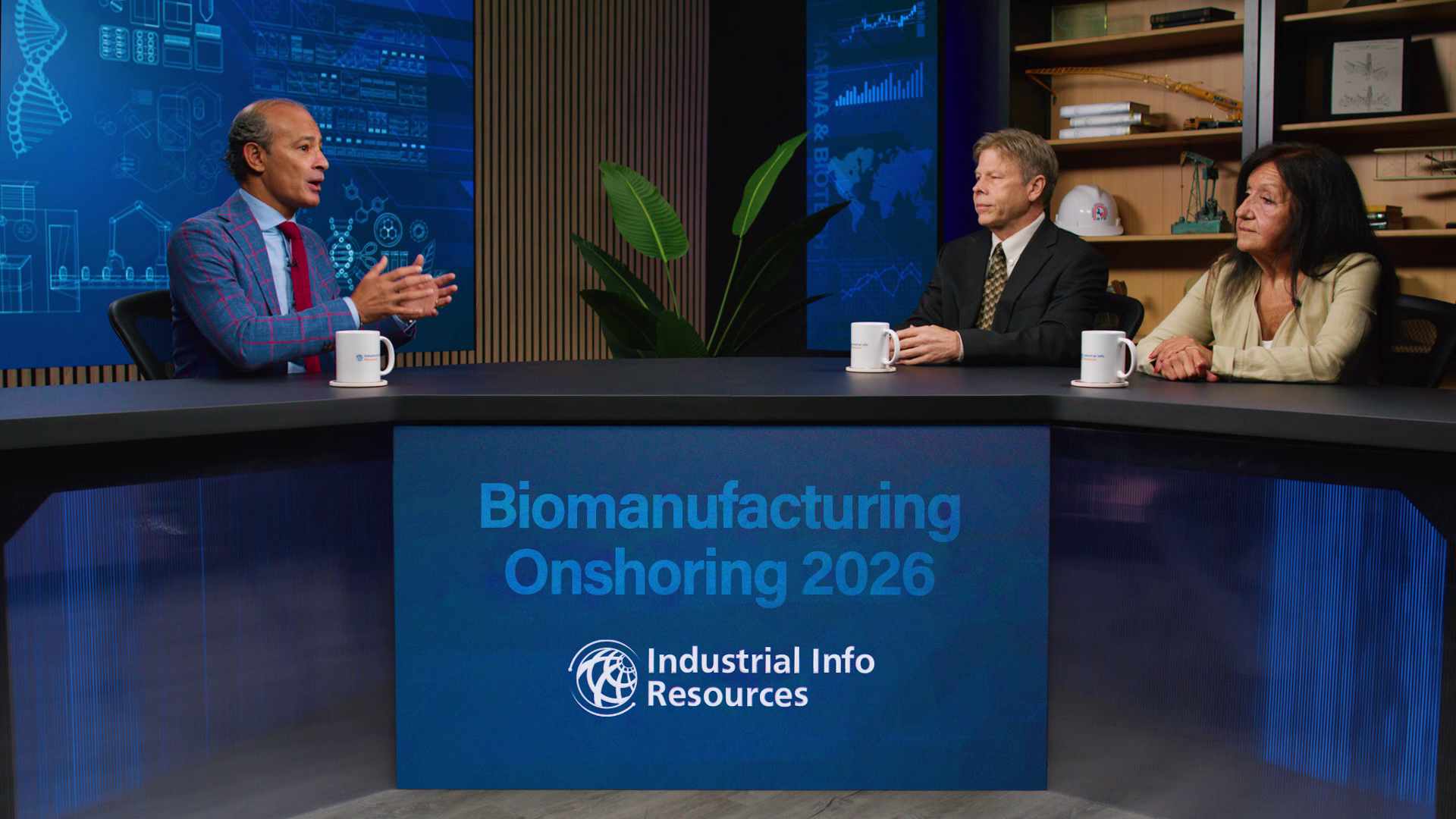
Biomanufacturing Onshoring 2026: GLP-1, CDMO and Reshoring
Could pharma's onshoring boom outlast the tariffs that sparked it? IIR experts unpack 2026 trends across GLP-1 manufacturing, CDMO growth, and biomanufacturing site selection.