Written by Aaron Studwell, Ph.D., Energy Meteorologist & Analyst (Sugar Land, Texas)
Summary
Wildfire risk expands across major U.S. energy regions as heat and dryness increase concerns from ERCOT and the southern Plains to the Pacific Northwest.August Wildfire Outlook
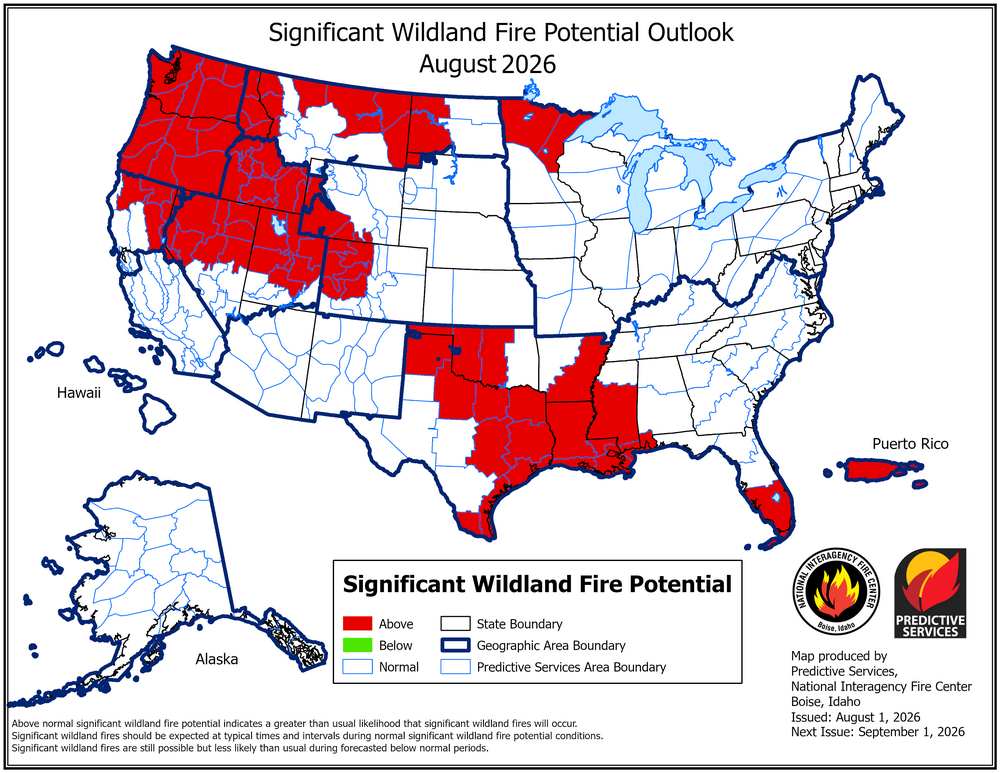
The August 2026 National Significant Wildland Fire Potential Outlook shows above-normal fire potential across a broad portion of the western and north-central United States. Additionally, a developing area of concern across the southern Plains and Lower Mississippi Valley could have important implications for the energy and industrial sectors.U.S. wildfire activity accelerated sharply during the second half of July following major lightning outbreaks in the Northwest. The National Preparedness Level increased to 5 on July 18, while more than 6 million acres had burned nationwide by July 31; this is approximately 165% of the previous 10-year average.
According to Industrial Info Resources analysis, the areas of elevated August fire potential overlap several of the nation's most important power and industrial regions. Portions of ERCOT, SPP, MISO, CAISO and the broader Western Electricity Coordinating Council footprint will face varying levels of wildfire exposure during the upcoming months.
Southern Plains Risk Takes on Greater Importance
One of the most consequential changes in the August outlook is the strengthening fire-weather signal across Texas, Oklahoma and the Lower Mississippi Valley.Above-normal significant fire potential is forecast to develop across large portions of Texas and Oklahoma, extending east into portions of Arkansas, Louisiana, Mississippi and Alabama. Extreme heat, dry air and limited rainfall could produce flash-drought conditions, rapidly reducing vegetation greenness in areas that experienced above-normal rainfall earlier this year.
This development places a significant portion of the ERCOT footprint within the emerging risk area while also impacting southern portions of SPP and MISO. Unlike many of the more sparsely populated areas experiencing elevated fire potential farther west, the southern risk zone encompasses major population centers and some of the nation's highest concentrations of energy and industrial infrastructure.
Texas alone contains extensive electric transmission and distribution systems alongside oil and natural gas production, pipelines, midstream processing facilities, refineries, petrochemical complexes, and other industrial facilities. Across the southern Plains and Lower Mississippi Valley, rapidly drying grasses could support fast-moving fires during periods of low humidity and stronger winds, potentially affecting operations and infrastructure access.
The outlook is particularly notable because drought conditions actually improved across much of Texas and Oklahoma during July. However, precipitation was below normal across much of the Plains outside the exceptionally wet Texas Hill Country. And August forecasts favor both above-normal temperatures and below-normal precipitation across much of the southern Plains. This combination could quickly reverse some of the earlier moisture gains.
Western Fire Potential Remains Widespread
The West remains the nation's largest area of above-normal significant fire potential. Elevated risk extends from the Pacific Northwest through portions of California, Nevada, Idaho, Utah, Wyoming, Colorado and Montana.The Pacific Northwest remains particularly vulnerable following a dramatic increase in wildfire activity during July. Two major lightning episodes generated hundreds of new fires across Oregon and Washington, while subsequent strong winds contributed to rapid fire growth. Fuels are now cured across most elevations and aspects, and Energy Release Component values are generally at or above seasonal averages.
For the power sector, fires across the West can directly threaten transmission and distribution infrastructure, force operational restrictions near active incidents, and complicate maintenance and restoration work. Smoke can also reduce solar generation over large areas, while persistent heat can simultaneously increase electricity demand.
Above-normal potential also extends into parts of the northern Plains and northern Minnesota, broadening the geographic footprint of August wildfire concerns.
Monsoon Rainfall Reduces Southwestern Risk
Not every change from the previous outlook represents increasing risk.The North American Monsoon brought substantial moisture into portions of Arizona, New Mexico and the Great Basin during the second half of July. In the Southwest, Energy Release Component values that began July near the 90th to 97th percentiles had fallen toward the 50th percentile by the end of the month.
Additional monsoon moisture is expected during August, helping keep significant fire potential closer to normal across much of Arizona and New Mexico. Portions of the Southeast also improved following beneficial July rainfall, although south Florida remains an area of above-normal potential.
Heat and Dryness Shape the August Pattern
The broader meteorological pattern favors substantial regional differences in fire potential. Nearly 48% of the United States remained in drought at the end of July, with drought persisting or intensifying across parts of the Northwest and Rockies while rapidly developing across portions of the northern Plains and Upper Midwest.Meanwhile, El Niño continues to strengthen. The August outlook notes central Pacific sea-surface temperature anomalies approaching the threshold for a strong El Niño, with additional strengthening anticipated into the fall.
For August, above-normal temperatures are favored across much of the West and central and southern Plains, while below-normal precipitation is favored across much of the southern Plains and Northwest.
That makes the southern Plains especially important to monitor. The Northwest enters August with an already established wildfire problem, but Texas and surrounding states face the potential for a rapidly developing one. If heat and rainfall deficits accelerate fuel drying as forecast, wildfire risk could increasingly overlap with high electricity demand across ERCOT and SPP, including one of North America's densest concentrations of energy and industrial infrastructure.
By September, elevated fire potential is expected to contract across the South while persisting across portions of the Northwest, northern Rockies, along with portions of North Dakota and Minnesota.
Key Takeaways
- Southern Plains risk rises -- Above-normal fire potential is developing across Texas, Oklahoma and the Lower Mississippi Valley.
- ERCOT exposure increases -- Emerging wildfire risk overlaps major population centers and extensive power, oil, gas and industrial infrastructure.
- Western threat remains widespread -- Elevated potential continues from the Pacific Northwest through portions of California, the Great Basin and northern Rockies.
- Monsoon provides Southwest relief -- Increased moisture has substantially lowered fuel dryness across Arizona and New Mexico.
- Heat accelerates fuel drying -- Above-normal temperatures and below-normal rainfall could rapidly reverse recent moisture gains across the southern Plains.
- September brings some improvement -- Elevated potential should contract across the South while lingering across portions of the Northwest and northern tier.
About Industrial Info Resources
Industrial Info Resources (IIR) is the leading provider of industrial market intelligence. Since 1983, IIR has provided comprehensive research, news and analysis on the industrial process, manufacturing and energy related industries. IIR's Global Market Intelligence (GMI) helps companies identify and pursue trends across multiple markets with access to real, qualified and validated plant and project opportunities. Across the world, Industrial Info Resources is tracking over 250,000 current and future projects worth $30.2 Trillion (USD).
/iirenergy/industry-news/article.jsp
false
Want More IIR News Intelligence?
Make us a Preferred Source on Google to see more of us when you search.
Add Us On GoogleAsk Us
Have a question for our staff?
Submit a question and one of our experts will be happy to assist you.

Explore Our EnergyLive Tools
EnergyLive Tools provide instant insight into new build, outages, maintenance, and capacity shifts across key energy sectors.
Explore Our ToolsRelated Articles
-
Europe Makes its First SMR InvestmentOctober 14, 2026
-
Fervo Starts Up 33-MW Utah Geothermal Power Plant UnitOctober 13, 2026
-
Ecuador to Cut Taxes on Imported Power Generation, Storage E...October 13, 2026

Explore Our Enery Industry Reports
Gain the competitive edge with IIR Energy’s suite of energy market reports, designed for traders, analysts, and asset managers who rely on verified, real-time data.
View ReportsIndustry Intel
-
Latin America Data Center Outlook 2026: Power, Hubs & GrowthPodcast Episode / Oct 9, 2026
-
Food and Beverage CapEx Outlook 2026: Tariffs, AI, AfricaPodcast Episode / Oct 9, 2026
-
North America Refining 2026: New Pipelines to PADD 5Podcast Episode / Oct 2, 2026
-
Biomanufacturing Onshoring 2026: GLP-1, CDMO and ReshoringPodcast Episode / Oct 2, 2026
-
2026 US Data Center Outlook: Power, Land & CoolingPodcast Episode / Sep 18, 2026