
Written by Aaron Studwell, Ph.D., Energy Meteorologist & Analyst (Sugar Land, Texas)
Summary
NOAA and Colorado State University continue to forecast a below-normal Atlantic hurricane season, citing increasing confidence that El Niño will suppress tropical development through the season's peak.CSU's Forecast
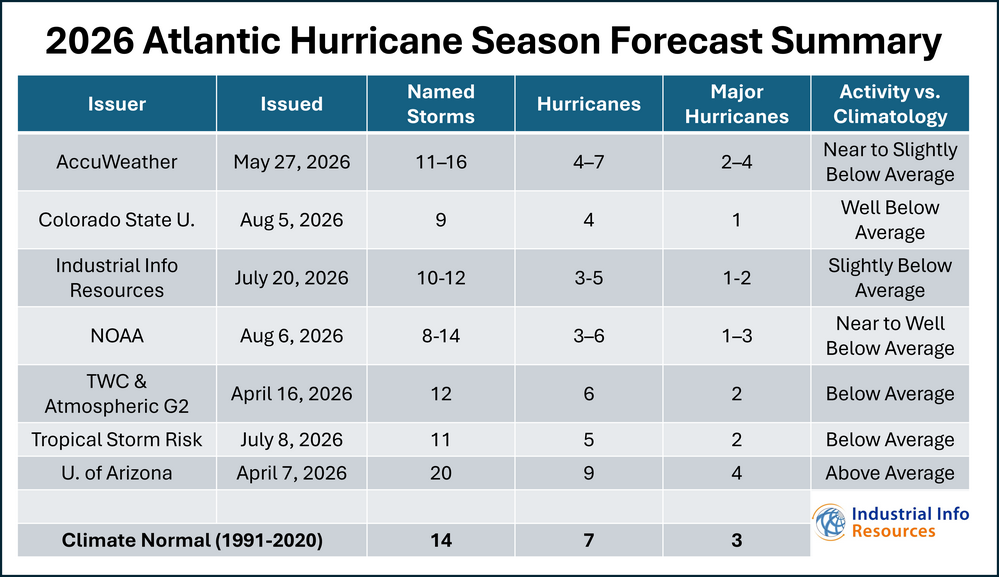
Colorado State University (CSU) has maintained its forecast for a well below-normal 2026 Atlantic hurricane season in its August outlook. The outlook continues to call for nine named storms, four hurricanes, and one major hurricane. The forecast, which includes Tropical Storms Arthur and Bertha, remains unchanged from CSU's July update. Their expectations are that a strengthening El Niño will significantly limit tropical cyclone development across the Atlantic basin.While the seasonal outlook itself remains unchanged, CSU expressed greater confidence in the forecast. Forecasters point to continued indications that El Niño will strengthen through the remainder of the summer and into the climatological peak of hurricane season.
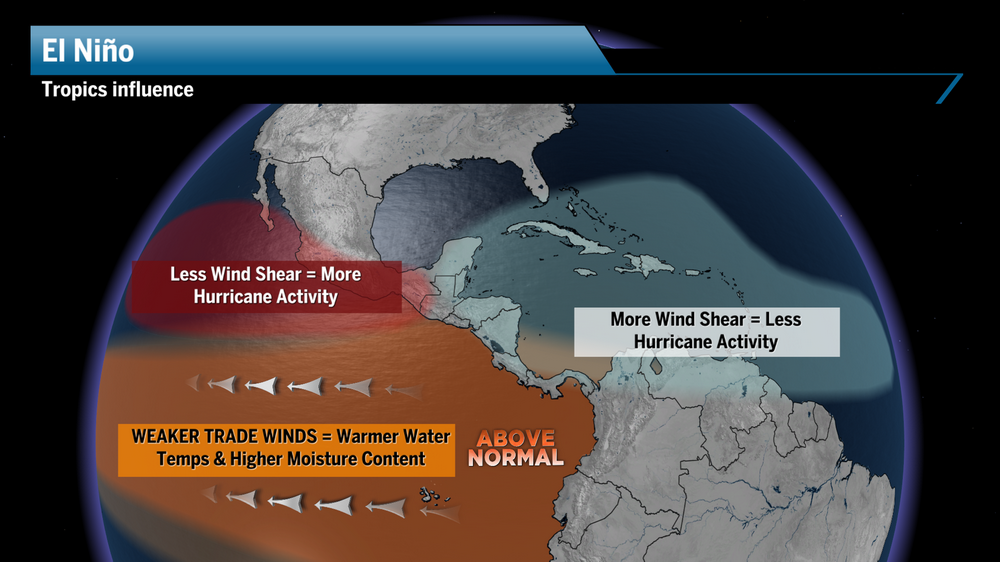
The warming sea surface temperatures across the eastern and central equatorial Pacific will produce widespread vertical wind shear across the tropical Atlantic. Both CSU's traditional statistical models and its newer artificial intelligence-based guidance indicate one of the most hostile upper-level wind environments observed in recent decades for Atlantic tropical cyclone development.
NOAA Forecast
NOAA also maintained its seasonal outlook for a below-normal Atlantic hurricane season on Thursday, citing many of the same large-scale climate signals highlighted by CSU. The agency continues to forecast 8 to 14 named storms, 3 to 6 hurricanes, and 1 to 3 major hurricanes, while assigning a 55% probability of a below-normal season, a 35% chance of a near-normal season, and just a 10% chance of above-normal activity.Although NOAA's forecast remains broader than CSU's deterministic outlook, both organizations point to a strengthening El Niño as the dominant factor expected to suppress tropical cyclone development through increased vertical wind shear.
Vertical wind shear remains the primary limiting factor in the forecast. Although portions of the Atlantic continue to exhibit above-average sea surface temperatures, stronger upper-level winds associated with El Niño are expected to disrupt the organization and intensification of tropical disturbances. This hostile wind environment is expected to have the greatest impact across the Main Development Region between the west coast of Africa and the Caribbean. Without sustained vertical alignment between the lower and upper atmosphere, many tropical waves may struggle to organize into long-lived tropical cyclones despite otherwise favorable conditions.
According to Industrial Info Resources analysis, the updated seasonal outlook continues to align with the CSU forecast and supports a lower overall risk of widespread tropical impacts to North American energy infrastructure compared with recent active seasons.
The updated outlooks reinforce growing confidence that atmospheric conditions will remain unfavorable across much of the Atlantic basin during the climatological peak of hurricane season, even as sea surface temperatures remain warmer than average.
However, seasonal forecasts do not predict where storms will form or make landfall. Even during below-average hurricane seasons, a single landfalling hurricane can produce significant disruptions to offshore energy production, refining operations, utilities, and industrial facilities along the Gulf and Atlantic coasts.
Key Takeaways
- CSU maintained its forecast of 9 named storms, 4 hurricanes, and 1 major hurricane.
- NOAA also reaffirmed its below-normal Atlantic hurricane season outlook.
- Strengthening El Niño is expected to increase vertical wind shear across the tropical Atlantic.<./li>
- Forecast confidence has increased despite continued above-average Atlantic sea surface temperatures.
- Industrial Info Resources continues to support a lower overall risk of widespread energy infrastructure impacts.
- Even below-normal seasons can produce significant disruptions from a single landfalling hurricane.
About Industrial Info Resources
Industrial Info Resources (IIR) is the leading provider of industrial market intelligence. Since 1983, IIR has provided comprehensive research, news and analysis on the industrial process, manufacturing and energy related industries. IIR's Global Market Intelligence (GMI) helps companies identify and pursue trends across multiple markets with access to real, qualified and validated plant and project opportunities. Across the world, Industrial Info Resources is tracking over 250,000 current and future projects worth $30.2 Trillion (USD).
/iirenergy/industry-news/article.jsp
false
Want More IIR News Intelligence?
Make us a Preferred Source on Google to see more of us when you search.
Add Us On GoogleAsk Us
Have a question for our staff?
Submit a question and one of our experts will be happy to assist you.

Explore Our EnergyLive Tools
EnergyLive Tools provide instant insight into new build, outages, maintenance, and capacity shifts across key energy sectors.
Explore Our ToolsRelated Articles
-
Europe Makes its First SMR InvestmentOctober 14, 2026
-
Fervo Starts Up 33-MW Utah Geothermal Power Plant UnitOctober 13, 2026
-
Ecuador to Cut Taxes on Imported Power Generation, Storage E...October 13, 2026

Explore Our Enery Industry Reports
Gain the competitive edge with IIR Energy’s suite of energy market reports, designed for traders, analysts, and asset managers who rely on verified, real-time data.
View ReportsIndustry Intel
-
Latin America Data Center Outlook 2026: Power, Hubs & GrowthPodcast Episode / Oct 9, 2026
-
Food and Beverage CapEx Outlook 2026: Tariffs, AI, AfricaPodcast Episode / Oct 9, 2026
-
North America Refining 2026: New Pipelines to PADD 5Podcast Episode / Oct 2, 2026
-
Biomanufacturing Onshoring 2026: GLP-1, CDMO and ReshoringPodcast Episode / Oct 2, 2026
-
2026 US Data Center Outlook: Power, Land & CoolingPodcast Episode / Sep 18, 2026