Written by Eric Funderburk for IIR News Intelligence (Sugar Land, Texas)
Summary
Europe leads the world for district heating construction with Germany rising to the top for both the value and number of projects.Increased Efficiencies, Lower Emissions
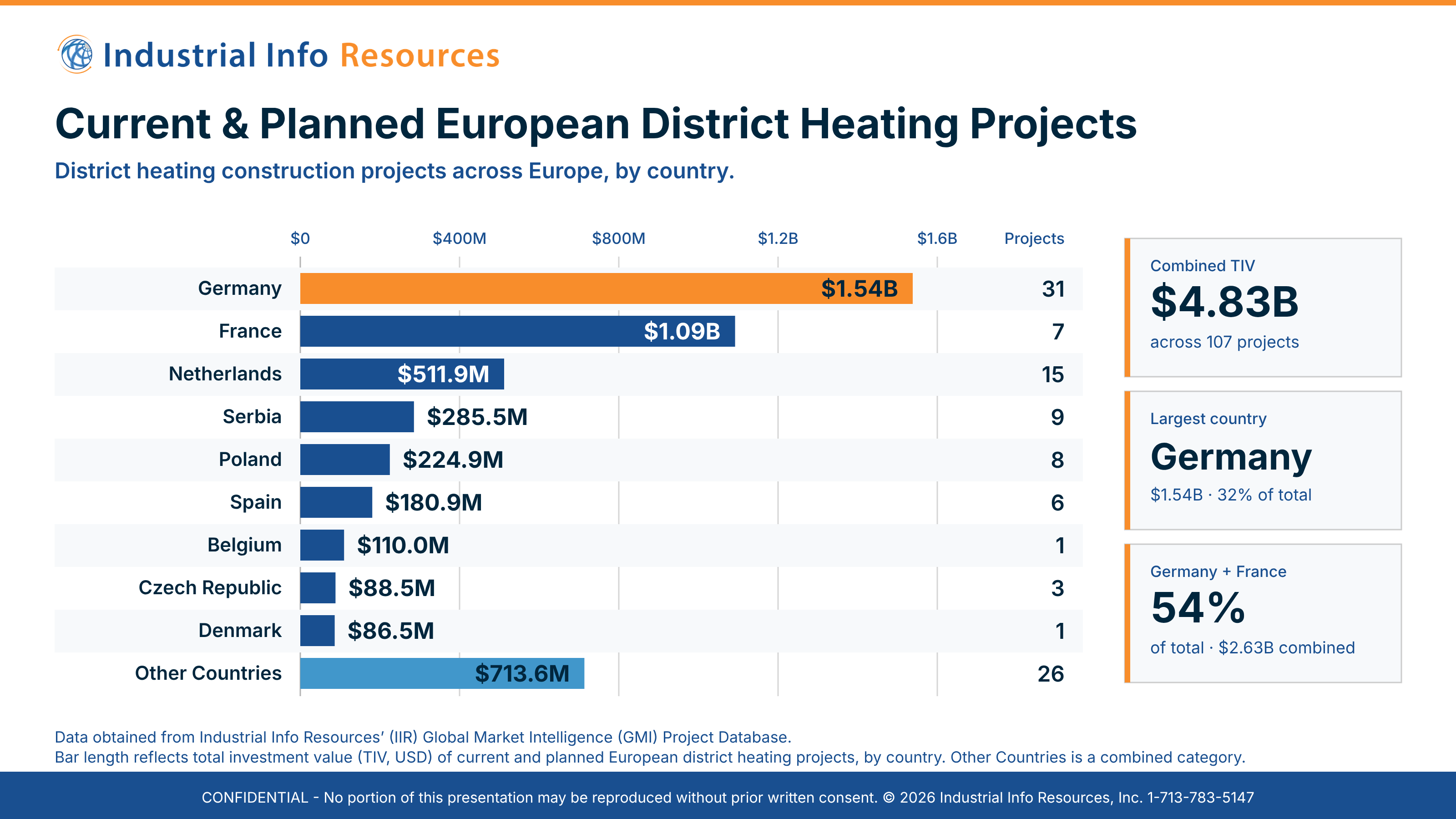
For dense urban neighborhoods, city centers and large campuses such universities, airports and hospitals, district heating represents a more efficient way to provide hot water and space heating through the distribution of hot water or steam from a centralized source to multiple buildings or households. Having a single, centralized plant to send heat can eliminate the need for hundreds or thousands of individual boilers, resulting in streamlined operations and lower emissions.According to Industrial Info Resources data, Europe is a leading destination for both current and planned district heating projects, accounting for more than US$1.3 billion worth of current construction and another US$3.5 billion worth in some form of planning or engineering. Spearheading this district heating buildout is Germany, with more than 30 projects on the books, valued at more than US$1.5 billion.
Current Construction
One current German district heating project warrants an initial discussion for both its size and type. In Mannheim (population 320,000), energy provider Grosskraftwerk Mannheim is teaming up with MVV for a river-scale heat pump to distribute heated water sourced from the Rhine River. The facility will use two 82.5-megawatt (MW) thermal units drawing energy from the existing power grid to heat distributed water to around 130 degrees Celsius for up to 40,000 households. Work on the project kicked off a few months ago, and construction is expected to last two years total. Subscribers can access details of the project, including construction timelines, key contact details, and equipment and service needs, by clicking here.Germany isn't just adding new district heating, but fundamentally reshaping the fuels used to heat the water. At the moment, Germany's district heating systems on the whole are fueled largely by natural gas or coal. Geothermal power is entering the country's district heating schemes in a big way in the future and is already being incorporated into a new system in Neuruppin, Brandenburg. There, Stadtwerke Neuruppin GmbH with drilling contractor Daldrup & Soehne AG is heading the development of a geothermal plant with wells reaching 1.8 to 2 kilometers deep, to bring up already heated water for further heating in a 12-MW thermal unit to distribute 76,000 megawatt-hours of heat each year to around 9,000 households connected to the network, or about 70% of Neuruppin's district heating demand. The returning cooler water will then be reinjected into the underground reservoir for redistribution on the closed-loop system. The wells have been completed, and the new surface-heating plant and piping infrastructure are now being built, with an anticipated completion date next year.
Future Projects
At least five other geothermal district heating projects are lined up for Germany. One of these is notable in that lead developer GeoEnergieMünchenOst aims to provide heat for four municipalities through a centralized plant in Vaterstetten, Bavaria--namely Vaterstetten, Grasbrunn, Haar and Zorneding--by tapping the Malm carbonate aquifer from two planned wells between 3,300 and 3,500 meters in depth that will use 21 MW of thermal capacity to provide 175,000 megawatt-hours (MWh) of heat annually. Tenders involving drilling site construction, equipment and services recently closed, suggesting deep drilling is on the way and putting the centralized plant on track for completion in 2028.Several other German projects incorporate river heat pumps, similar to the one in Mannheim. One of these is occurring in the Tiefstack district of Hamburg, on the Billwerder Bucht (roughly translated as "bay," on the Elbe River. Hamburger Energiewerke GmbH has operated a combined heat and power plant at the site since 1993, which currently supplies a large share of the region's district heat. Hamburger Energiewerke is shifting away from coal use at the facility with the addition of 60 MW of thermal heat output from an electric river heat pump to raise water temperatures to around 98 degrees Celsius for distribution. The facility also will incorporate waste heat from a copper facility and a district waste-treatment plant. The existing coal-fired systems will be converted to natural gas for backup generation.
Multiple other river heat pump projects are on the cards for Germany, including two separate projects in Dresden.
Key Takeaways
- Europe is a leading destination for district heating projects, with Germany taking the lead for both the number and value of these projects.
- Much of Germany's district heating buildout is meant to lessen reliance on fossil fuels used in the process through the installation of electric heat pumps or geothermal sources.
About Industrial Info Resources
Industrial Info Resources (IIR) is the leading provider of industrial market intelligence. Since 1983, IIR has provided comprehensive research, news and analysis on the industrial process, manufacturing and energy related industries. IIR's Global Market Intelligence (GMI) helps companies identify and pursue trends across multiple markets with access to real, qualified and validated plant and project opportunities. Across the world, Industrial Info Resources is tracking over 250,000 current and future projects worth $30.2 trillion (USD).
/iirenergy/industry-news/article.jsp
false
Want More IIR News Intelligence?
Make us a Preferred Source on Google to see more of us when you search.
Add Us On GoogleAsk Us
Have a question for our staff?
Submit a question and one of our experts will be happy to assist you.

Explore Our EnergyLive Tools
EnergyLive Tools provide instant insight into new build, outages, maintenance, and capacity shifts across key energy sectors.
Explore Our ToolsRelated Articles
-
Google Signs 50-MW Power Contract Supporting Advanced Geothe...November 25, 2026
-
Federal Reserve Bank of Dallas Projects Inflation Lasting We...November 25, 2026
-
Latin America Speeds Up Battery Storage: Brazil Auctions in ...November 25, 2026

Explore Our Enery Industry Reports
Gain the competitive edge with IIR Energy’s suite of energy market reports, designed for traders, analysts, and asset managers who rely on verified, real-time data.
View ReportsIndustry Intel
-
Global Chemical Industry Outlook 2026: Ethylene, Hydrogen, CapExPodcast Episode / Nov 6, 2026
-
Southern Cone Investment Radar: Argentina, Chile & UruguayPodcast Episode / Oct 30, 2026
-
Mining Capital Spending 2026: Copper, Rare Earths, AluminumPodcast Episode / Oct 23, 2026
-
Brazil Critical Minerals 2027: Rare Earths, Lithium, CopperPodcast Episode / Oct 16, 2026
-
US Craft Labor Outlook 2026: Wages, Per Diems, Data CentersPodcast Episode / Oct 16, 2026