Written by Aaron Studwell, Ph.D., Energy Meteorologist & Analyst, for IIR News Intelligence (Sugar Land, Texas)
Summary
A strengthening hurricane is threatening offshore oil and natural gas production, coastal industrial facilities and electricity networks. Damaging winds, dangerous storm surge and widespread flooding are expected across the Southeast.Isaias Grows Stronger Over Central Gulf
Hurricane Isaias continued strengthening Thursday over the central Gulf of Mexico, threatening offshore energy production, coastal industrial facilities, and regional electricity networks ahead of an expected Friday evening landfall along the northern Gulf Coast.According to Industrial Info Resources data, the hurricane's expanding wind field, dangerous storm surge and heavy rainfall could affect substantial energy infrastructure across the region. The threat will extend inland as Isaias moves through the Southeast during the weekend.
At 10 am Central Time Thursday, October 8, Isaias was approximately 380 miles south of the mouth of the Mississippi River, with maximum sustained winds of 85 miles per hour (mph). Moving east-northeast at 10 mph, the hurricane is forecast to turn northward and strengthen further, potentially reaching 110 to 115 mph Friday before weakening somewhat near landfall.
Energy Infrastructure Exposure
An assessment by Industrial Info Resources identifies substantial oil and natural gas production, refining capacity, and electricity generation within the hurricane's potential impact area. An offshore platform analysis using the 90-kilometer-per-hour (kph) (55-mph) wind exposure cone identifies 14 platforms representing approximately 552,000 barrels per day of oil production and 557 million cubic feet per day of natural gas production.These figures represent potential exposure rather than confirmed production shut-ins. Actual disruptions will depend on operator decisions, evacuations, storm conditions and subsequent facility assessments.
Based on Industrial Info Resources research and the latest forecast track, the broader regional exposure estimates are:
| Energy Sector | Potential Exposure |
|---|---|
| Crude Oil Production | 1.365 barrels per day (BBL/day) (IIR-reported units) |
| Natural Gas Production | 1.378 million cubic feet per day (MMcf/day) (IIR-reported units) |
| Refineries | Eight facilities; 894,000 BBL/day capacity |
| Natural Gas Processing | 16 facilities; 4.76 MMcf/day |
| Power Generation | 381 plants; 69.1 GW capacity; 3.52 MMcf/day natural gas consumption |
Potential Impacts from Hurricane Isaias, October 8 Outlook
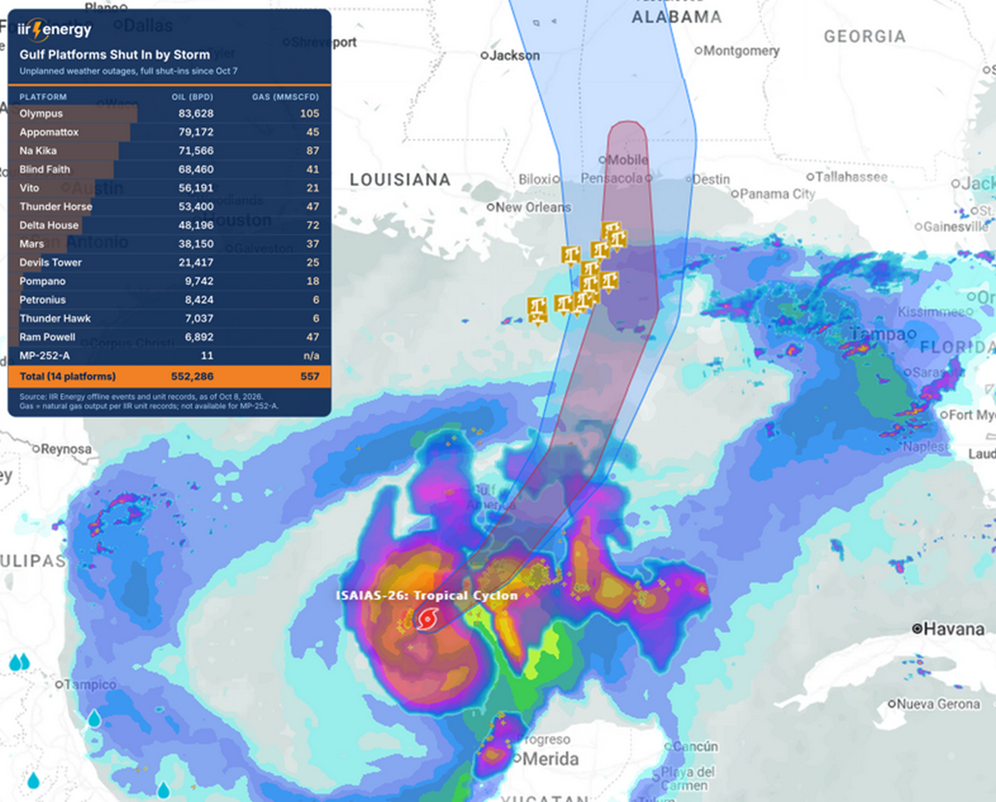
Source: Industrial Info Resources Disaster Impact Tracker, IIR Energy
Favorable Ocean Conditions Meet Increasing Wind Shear
Isaias is intensifying over very warm Gulf waters; coupled with abundant moisture, this supports continued thunderstorm development. Recent satellite observations revealed a closed ring surrounding the developing eye, a structural feature sometimes associated with rapid intensification.Although moderate vertical wind shear has disrupted the hurricane's vertical organization, Isaias continues strengthening. Increasing shear approaching landfall could produce some weakening while expanding the wind impact range, extending damaging gusts farther from the center.
Steering between a subtropical ridge extending across Florida and an approaching upper-level trough will accelerate the hurricane northward. The evolving interaction between these systems also influences the distribution of rainfall and wind impacts across the Southeast.
Energy Infrastructure Faces Multiple Hazards
Offshore oil and natural gas operations face deteriorating marine conditions, while coastal processing facilities, refineries and pipeline infrastructure are vulnerable to wind damage, flooding and electricity disruptions. Storm surge could reach 5 to 7 feet above ground level along portions of the Mississippi, Alabama and western Florida Panhandle coasts, including Mobile Bay.Electric utilities face substantial exposure as hurricane-force winds approach the coast and damaging gusts spread inland. Distribution equipment, transmission infrastructure and substations could experience damage or flooding, creating potentially prolonged outages. Strong winds may reach northern Alabama and Georgia, particularly across higher terrain.
For regional electricity markets, outages could reduce localized demand while complicating generation operations and restoration efforts. Actual disruptions will depend on the storm's track, wind-field expansion and infrastructure resilience.
Heavy Rainfall and Inland Flooding Become Major Concerns
The Weather Prediction Center forecasts 3 to 7 inches of rainfall across portions of the central Gulf Coast, with localized totals approaching 10 inches. Much of this precipitation could fall within 12 to 18 hours over already wet soils, creating conditions favorable for significant flash flooding.A moderate risk of excessive rainfall covers southern Alabama and the western Florida Panhandle Friday into early Saturday. Mobile and Pensacola are particularly vulnerable, where heavy rainfall, combined with elevated coastal water levels, could restrict drainage and prolong flooding.
Increasing wind shear should shift the heaviest precipitation east and northeast of the center. As Isaias moves inland, interactions with a frontal boundary will spread rainfall across Georgia, the Carolinas and Tennessee.
Additional flooding concerns include upslope rainfall in the southern Appalachians and coastal flooding in the Carolinas, where heavy precipitation could coincide with unusually high astronomical tides.
Post-Tropical Transition Extends the Threat
Isaias is expected to weaken inland Saturday while transitioning into a post-tropical system. Interaction with the approaching upper-level trough could redistribute its winds and rainfall across a broader area rather than immediately ending the threat.The remnants and associated tropical moisture should move northeastward, bringing additional rainfall and localized flooding potential to the Mid-Atlantic and Northeast through Sunday and possibly Monday.
For energy operators, Isaias represents a multiday infrastructure threat, beginning with offshore and coastal exposure before shifting toward inland electricity networks, transportation corridors and flood-sensitive facilities across the eastern United States.
Key Takeaways
- Hurricane Isaias continues to strengthen as it moves across the central Gulf of Mexico.
- Isaias is expected to make landfall on the U.S. Gulf Coast this weekend.
- Fourteen offshore oil and gas production platforms are in the potential path of the storm.
About Industrial Info Resources
Industrial Info Resources (IIR) is the leading provider of industrial market intelligence. Since 1983, IIR has provided comprehensive research, news and analysis on the industrial process, manufacturing and energy related industries. IIR's Global Market Intelligence (GMI) helps companies identify and pursue trends across multiple markets with access to real, qualified and validated plant and project opportunities. Across the world, Industrial Info Resources is tracking over 250,000 current and future projects worth $30.2 Trillion (USD).
/iirenergy/industry-news/article.jsp
false
Want More IIR News Intelligence?
Make us a Preferred Source on Google to see more of us when you search.
Add Us On GoogleAsk Us
Have a question for our staff?
Submit a question and one of our experts will be happy to assist you.

Explore Our EnergyLive Tools
EnergyLive Tools provide instant insight into new build, outages, maintenance, and capacity shifts across key energy sectors.
Explore Our ToolsRelated Articles
-
Maryland Backs Two BESS Projects Amid PJM Capacity PushOctober 08, 2026
-
LS Power Raises $6 Billion in FundingOctober 08, 2026
-
Bolsonaro vs. Lula: What are their Energy, Mining Policies?October 08, 2026

Explore Our Enery Industry Reports
Gain the competitive edge with IIR Energy’s suite of energy market reports, designed for traders, analysts, and asset managers who rely on verified, real-time data.
View ReportsIndustry Intel
-
North America Refining 2026: New Pipelines to PADD 5Podcast Episode / Oct 2, 2026
-
Biomanufacturing Onshoring 2026: GLP-1 Drives CapexPodcast Episode / Oct 2, 2026
-
2026 US Data Center Outlook: Power, Land & CoolingPodcast Episode / Sep 18, 2026
-
2026 Global Power Demand Outlook: Gas, Nuclear & RenewablesPodcast Episode / Sep 18, 2026
-
2026 Oil & Gas CapEx Outlook: Middle East, LNG & PermianPodcast Episode / Sep 4, 2026