
Reports related to this article:
Plant(s): View 1 related plant in Energy Live
Written by Abhishek Choudhary for IIR News Intelligence (Sugar Land, Texas)
Summary
A growing list of expansions is breathing new life into India's Petroleum Refining Industry.More Capacity on the Way
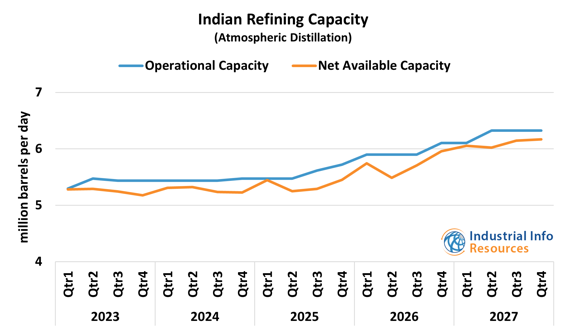
India, the fourth-largest refiner in the world and the second-largest in Asia, is investing heavily in its refining sector to meet rising domestic demand and to sustain its position as a major exporter of transportation fuels.The commissioning of the grassroot, 180,000-barrel-per-day (BBL/d) Barmer Refinery, operated by HPCL Rajasthan Refinery Limited (HRRL), and its integrated petrochemical complex has increased India's total crude processing capacity from 5.72 million to 5.9 million BBL/d.
At present, Barmer Refinery's lone crude unit is operating at about 50% capacity, while downstream units are undergoing testing and phased commissioning; these units are expected to be brought online in April, May and June.
Subscribers to Industrial Info's Global Market Intelligence (GMI) Petroleum Refining Plant Database can learn more about Barmer--including unit details--from a plant profile.
The Barmer Refinery is designed to process a blend of domestic and imported crude. It will process 1.5 million metric tons per annum (MMTPA) of Mangala crude from Rajasthan, along with 7.5 MMTPA of Arab Mix crude (Arab Heavy and Arab Light) during the first eight years, and thereafter operate entirely on Arab Mix crude.
Subscribers to Industrial Info's GMI Petroleum Refining Project Database can learn more about individual projects at Barmer from a detailed list of project reports.
The facility is designed to produce about 13,000 kiloliters per day (KL/d) of ultra-low sulfur diesel, and 2,678 KL/d each of 95 RON and 91 RON BS-VI gasoline. On the petrochemical side, the complex will produce 2,935 metric tons per day (MT/d) of polypropylene, 668 MT/d of butadiene, 1,161 MT/d each of LLDPE and HDPE, 276 MT/d of benzene and 129 MT/day of toluene.
Three More Refineries Add Units
Looking ahead, India's refining capacity could reach 6.32 million BBL/d by the end of 2027, supported by an additional capacity at new units. Most of this growth will come from expansions at public-sector undertaking (PSU) refineries.Major projects include a new, 180,000-BBL/d crude unit at Barauni Refinery; a 120,000-BBL/d expansion at Numaligarh Refinery; and a 200,000-BBL/d expansion at Panipat Refinery. These upgrades will enhance the ability to process a broader slate of high-sulfur crude oils, while increasing the production of BS-VI (Euro 6) compliant fuels and petrochemicals.
Subscribers can learn more about individual projects at these refineries from a detailed list of project reports.
In parallel, Barauni Refinery plans to decommission three older crude units with a combined capacity of 120,000 BBL/d, with the units scheduled to be closed in 2027 once the new crude unit becomes operational. Additional incremental expansions totaling 47,000 BBL/d include increases at the Digboi and Kochi refineries.
Subscribers can learn more about individual projects at the Digboi and Kochi refineries from a detailed list of project reports.
India's refining system remains highly reliable, with average capacity availability exceeding 96% in 2025, according to Industrial Info. Strong macroeconomic growth, coupled with a rapidly expanding middle class, is expected to drive demand for transportation fuels such as jet fuel, gasoline and diesel, while boosting petrochemical consumption.
However, structural shifts in the energy landscape may moderate long-term demand growth. Government initiatives promoting 20% ethanol blending, along with the increasing adoption of electric vehicles--particularly in the two and three-wheeler segments--are expected to moderate longer-term gasoline demand growth in India.
Key Takeaways
- The new Barmer Refinery is a major step forward for India's industry.
- The Barauni, Numaligarh and Panipat refineries also are adding new units.
- Barauni plans to decommission three older crude units
About IIR News Intelligence
IIR News Intelligence is a trusted source of news for the industrial process and energy markets, powered by Industrial Info Resources' Global Market Intelligence (GMI).
About Industrial Info Resources
Industrial Info Resources (IIR News Intelligence) is the leading provider of industrial market intelligence. Since 1983, IIR has provided comprehensive research, news and analysis on the industrial process, manufacturing and energy related industries. IIR's Global Market Intelligence (GMI) helps companies identify and pursue trends across multiple markets with access to real, qualified and validated plant and project opportunities. Across the world, IIR is tracking more than 250,000 current and future projects worth $30.2 trillion (USD).
/iirenergy/industry-news/article.jsp
false
Want More IIR News Intelligence?
Make us a Preferred Source on Google to see more of us when you search.
Add Us On GoogleAsk Us
Have a question for our staff?
Submit a question and one of our experts will be happy to assist you.

Explore Our EnergyLive Tools
EnergyLive Tools provide instant insight into new build, outages, maintenance, and capacity shifts across key energy sectors.
Explore Our ToolsRelated Articles
-
EIA: India Surpasses China as Top Nation in Oil Consumption ...December 31, 2024
-
India's Refiners to Boost FCCU CapacityNovember 08, 2022
-
India's HPCL Moves Ahead With Refined Products PipelineJanuary 26, 2022

Explore Our Enery Industry Reports
Gain the competitive edge with IIR Energy’s suite of energy market reports, designed for traders, analysts, and asset managers who rely on verified, real-time data.
View ReportsIndustry Intel
-
Latin America Data Center Outlook 2026: Power, Hubs & GrowthPodcast Episode / Oct 9, 2026
-
Food and Beverage CapEx Outlook 2026: Tariffs, AI, AfricaPodcast Episode / Oct 9, 2026
-
North America Refining 2026: New Pipelines to PADD 5Podcast Episode / Oct 2, 2026
-
Biomanufacturing Onshoring 2026: GLP-1, CDMO and ReshoringPodcast Episode / Oct 2, 2026
-
2026 US Data Center Outlook: Power, Land & CoolingPodcast Episode / Sep 18, 2026