Written by John Egan for IIR News Intelligence (Sugar Land, Texas)
Summary
U.S. deployments of battery energy storage systems (BESS) continued growing in the first quarter of this year, but trade and tariff fights could limit the growth trajectory.BESS Deployments Continue Growing in U.S.
Approximately 9.7 gigawatt-hours (GWh) of battery energy storage systems (BESS) were deployed in the U.S. in the January-March 2026 period, a 32% increase over the comparable year-earlier quarter and the strongest first quarter in the sector's history, according to the "U.S. Energy Storage Market Outlook" produced by the Solar Energy Industries Association (SEIA) and Benchmark Mineral Intelligence Limited. This surge took place despite the Trump administration's targeting of clean energy projects, the organizations said in a statement accompanying the release of the report May 21.According to Industrial Info Resources data, developers plan to begin construction on approximately 914 BESS projects across the U.S. over the April 2026 through March 2028 period.
"Energy storage's remarkable first quarter only underscores the fundamental values of this technology: It's insulated from fuel price shocks, keeps electricity costs down and strengthens grid reliability," said Darren Van't Hof, SEIA's interim president and chief executive. "While long-term forecasts are validating that the demand for this technology is rising as off-takers seek energy security, actions in Washington to stall permitting are threatening to slow that progress.
"Storage can help America meet rising energy demand and strengthen American energy independence," he continued, "but only if Washington lets the solar and storage industry build."
Although first-quarter deployments were up compared to the first quarter of 2025, deployments in the January-March 2026 period suffered from the effects of trade and tariff fights between the U.S. and China, which had the effect of pulling Q1 demand into the fourth quarter of 2025, the report said. First-quarter 2026 deployments fell 45% compared to fourth-quarter 2025 deployments, the report said.
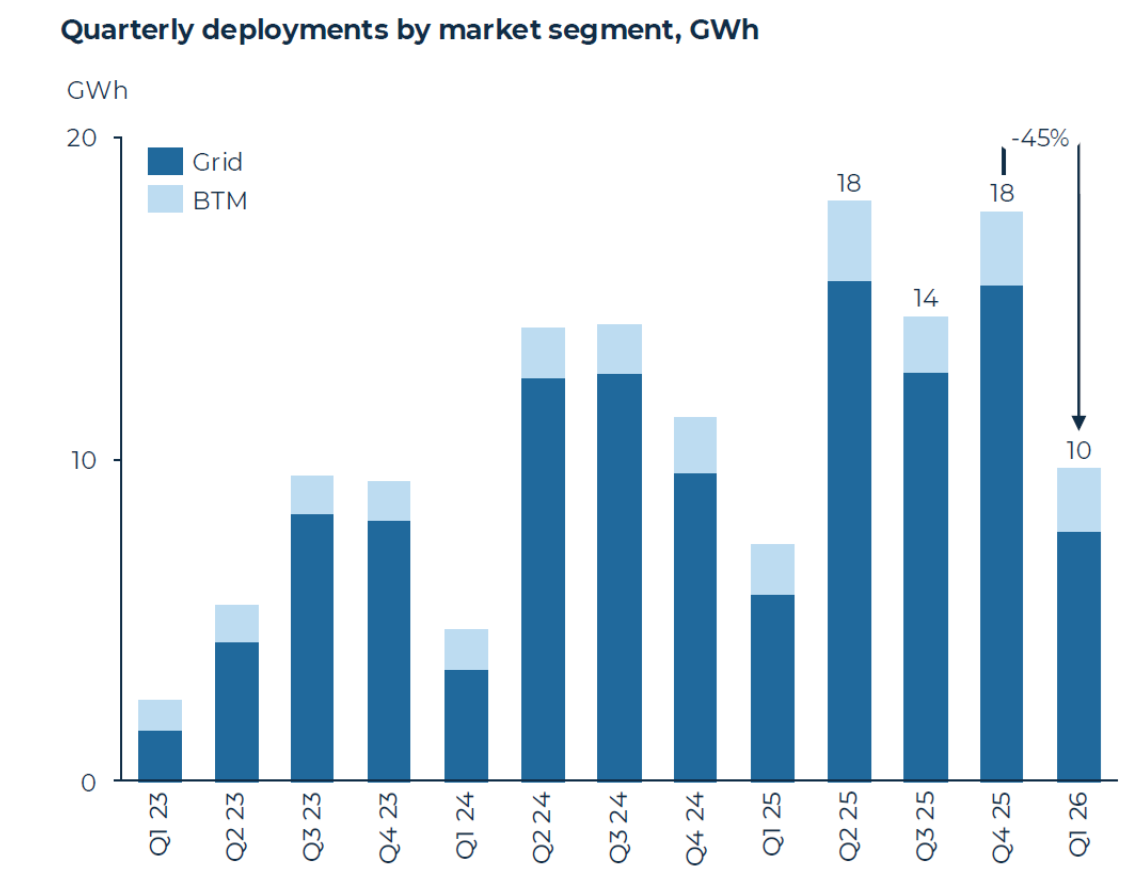 Source: SEIA and Benchmark Minerals Intelligence
Texas, Arizona and California led the nation in new BESS deployments in the first quarter of this year, the report said, adding that those three states accounted for the "vast majority" of energy storage capacity added. The domestic utility-scale market continued to drive growth, accounting for about 7.8 GWh of storage during the January-March 2026 period. "Behind the meter" (BTM) deployments accounted for about 1.9 GWh.
In the just-completed quarter, commercial & industrial (C&I) deployments of energy storage grew significantly: They rose about 55% from comparable year-earlier deployments, to about 648 megawatt-hours (MWh) from 419 MWh in the first quarter of 2025. The report said data center demand for energy storage continues to drive C&I demand for energy storage.
"In addition to the previously-seen Lithium Iron Phosphate BESS deployments for peak shaving use," the report noted, "Google and Meta are deploying ultra-long-duration energy storage (LDES) to secure 24/7 carbon-free power for their data centers."
Overall, the organizations forecast that more than 610 GWh of energy storage will be installed in the U.S. by 2030, up from previous projections. "As investors, developers and grid operators respond to energy price volatility tied to disrupted global natural gas turbine supplies, solar + storage is becoming increasingly attractive because it is insulated from fuel price swings," the groups said in a statement.
Permitting, Trade Disputes Cloud BESS' Future in the U.S.
Trade and tariff disputes with China hang over the outlook for future deployments of BESS in the U.S., the report noted. Most energy storage systems are manufactured in China, and the U.S. is one of the largest end markets, along with China.The report noted that "the tariffs applied to imported BESS cells and systems continued to evolve in the first quarter, following the Section 301 (of the Trade Act of 1974) increase from 7.5% to 25% that came into force in January (2026). The previous tariffs, enacted under the International Economic Emergency Powers Act of 1977 were ruled unlawful by the Supreme Court in early March. President Donald Trump subsequently enacted 10% tariffs on all nations under Section tariffs, which can be in place for a maximum of 150 days (or through roughly July 2026)."
The president's ability to use that law to support across-the-board tariffs on all nations is currently under litigation.
In March, the report said, the U.S. Trade Representative (USTR) announced two new Section 301 investigations targeting 60 different U.S. trading partners. Imports from these trading partners comprised more than 99% of U.S. imports in 2025. Section 301 tariffs have no statutory time limit and can last indefinitely. However, the USTR is required to review them every four years.
Officials from the U.S. and China disclosed few details about President Trump's recent summit with Chinese leader Xi Jinping.
In addition, the groups said, there remains federal permitting bottlenecks around solar + storage projects, which could slow deployment and cause electricity prices to rise further. SEIA's analysis shows that 467 solar + storage projects have permits pending and are vulnerable to politically motivated delays or cancellations.
"Energy storage is no longer just for backup, it's critical energy security infrastructure," said Shan Tomouk, BESS and Energy Lead at Benchmark Minerals. "A supportive policy landscape for BESS will be crucial to enabling the rollout of AI and data centers, while mitigating adverse cost impacts to regular consumers."
IIR Sees a Robust U.S. BESS Market
Of the approximately 914 BESS projects across the U.S. over the April 2026 through March 2028 period. The total investment value (TIV) of these projects is about $379 billion. However, Industrial Info Resources believes most of those projects have a low probability (less than 69%) chance of beginning construction on time.But according to Industrial Info Resources' assessment, about 195 of the 914 planned BESS projects, valued at roughly $96.2 billion, have a medium (70% to 80%) or high (81% to 99%) probability of starting construction according to their respective schedules. The states with the greatest level of medium and high scheduled BESS project kickoffs over the next two years are Texas, Nevada, Oregon and Colorado.
"For various reasons, energy storage makes a lot of sense if you generate, transmit or use electricity--which is to say everyone. But realizing that bright future is not a gimme," commented Britt Burt, senior vice president of research for the Global Electric Power industry. "I expect there is a lot of lobbying right now at the White House, the Department of Energy and the Department of the Interior to ease the policy bottlenecks. Winning the race for artificial intelligence (AI) may depend on accelerating the deployment of energy storage."
By the Numbers
- 9.7 GWh: The amount of battery energy storage systems deployed in the U.S. during the first quarter.
- More than 610 GWh: Amount of energy storage projects that are projected to be will be deployed in the U.S. by the end of 2030.
- $96.2 billion: The value of U.S. BESS projects being tracked by IIR with a medium or high probability of beginning construction according to their respective schedules over the next two years.
- The U.S. battery energy storage market continued growing sharply in the first quarter.
- However, future growth trajectories could depend on the U.S. and China settling their trade and tariff disputed and the U.S. clearing out the backlog of unpermitted solar + storage projects.
About Industrial Info Resources
Industrial Info Resources (IIR) is the leading provider of industrial market intelligence. Since 1983, IIR has provided comprehensive research, news and analysis on the industrial process, manufacturing and energy related industries. IIR's Global Market Intelligence (GMI) helps companies identify and pursue trends across multiple markets with access to real, qualified and validated plant and project opportunities. Across the world, Industrial Info Resources is tracking over 250,000 current and future projects worth $30.2 trillion (USD).
/iirenergy/industry-news/article.jsp
false
Want More IIR News Intelligence?
Make us a Preferred Source on Google to see more of us when you search.
Add Us On GoogleAsk Us
Have a question for our staff?
Submit a question and one of our experts will be happy to assist you.

Explore Our EnergyLive Tools
EnergyLive Tools provide instant insight into new build, outages, maintenance, and capacity shifts across key energy sectors.
Explore Our Tools
Explore Our Enery Industry Reports
Gain the competitive edge with IIR Energy’s suite of energy market reports, designed for traders, analysts, and asset managers who rely on verified, real-time data.
View ReportsIndustry Intel
-
2026-2027 Investment Radar for Mexico, Central America & the CaribbeanPodcast Episode / May 29, 2026
-
Innovations Shaping the Next Era of Power GenerationPodcast Episode / May 22, 2026
-
The Role of Contract Manufacturing in Global Pharma GrowthPodcast Episode / May 8, 2026
-
2026 North American Labor OutlookPodcast Episode / Apr 24, 2026
-
2026 European Metals & Minerals Project Spending OutlookPodcast Episode / Apr 7, 2026