Power
Artificial Intelligence & Hurricane Forecasting: Better Decisions Begin with Better Partnerships
Artificial intelligence is reshaping hurricane forecasting, but its greatest value comes from strengthening human expertise and improving operational decision-making.
Released Monday, July 20, 2026

Written by Aaron Studwell, Ph.D., Energy Meteorologist & Analyst, for IIR News Intelligence
Summary
Artificial intelligence is reshaping hurricane forecasting, but its greatest value comes from strengthening human expertise and improving operational decision-making.AI for Weather Forecasting
Artificial intelligence (AI) has become one of the fastest-growing topics in weather forecasting. That conversation has accelerated and garnered more attention this hurricane season.New AI-based forecast models have demonstrated impressive skill in predicting tropical cyclone tracks, sometimes rivaling or even outperforming traditional numerical weather prediction models. While those achievements have fueled headlines about the future of forecasting, they tell only part of the story.
The real value of AI is not that it replaces meteorologists. Rather, it provides another source of ever-improving guidance that allows forecasters to make informed decisions. For industries whose operations depend on weather, from energy and utilities to transportation and emergency management, that partnership ultimately leads to improved actionable information.
More Than Faster Forecast Models
Traditional weather models remain the backbone of hurricane forecasting. They solve millions of atmospheric equations that describe how the atmosphere evolves over time. However, they also require enormous computing power and years of scientific refinement.Artificial intelligence approaches the problem differently. Rather than explicitly solving the governing physics equations, AI models learn atmospheric patterns from decades of historical observations and model output. That allows them to generate forecasts in a fraction of the time required by conventional models while identifying patterns that might otherwise be overlooked.
By itself, speed is an advantage. AI model output is available hours before deterministic models complete their computations. This allows meteorologists to evaluate additional scenarios, produce more ensemble guidance, and examine potential changes in a storm's evolution much earlier than was previously possible.
Yet faster does not automatically mean better. Every forecast contains uncertainty, particularly when dealing with rapidly changing tropical systems. AI represents another highly valuable piece of guidance, but it is not the final answer.
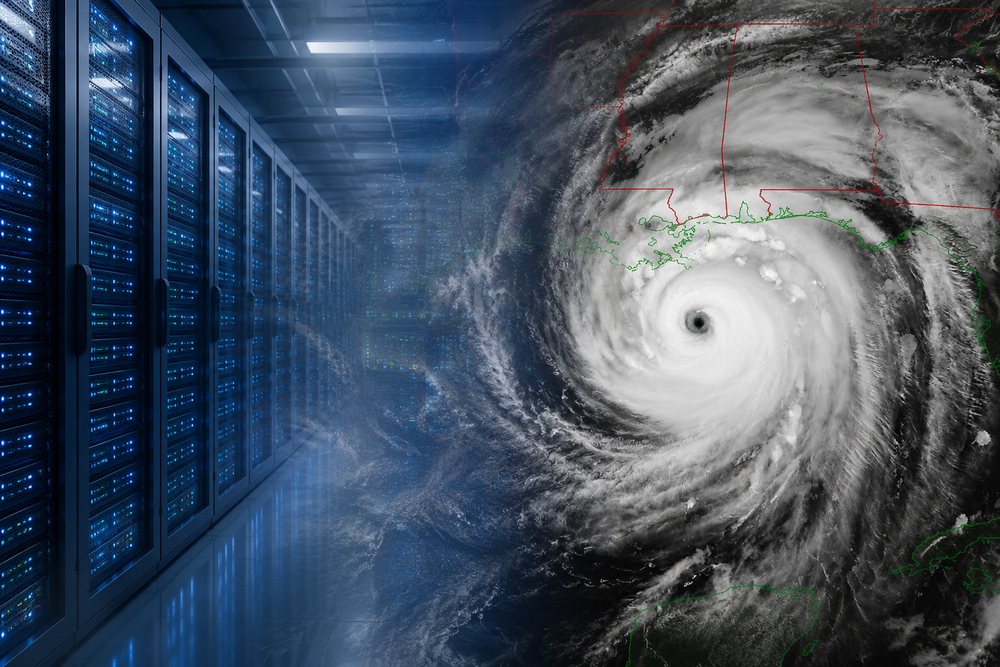 Advances in AI will improve risk communications
The Human Element Remains Essential
Despite advances in machine learning, hurricane forecasting remains a discipline built on interpretation.Experienced forecasters routinely compare multiple numerical models, satellite imagery, aircraft reconnaissance, radar observations, ocean conditions and real-time environmental changes before issuing a forecast. AI guidance is now another arrow in the meteorologist's quiver.
Perhaps more importantly, meteorologists understand the strengths and weaknesses of each forecasting system. They know that some models perform exceptionally well with track forecasting but struggle with rapid changes in intensity. Others excel at identifying environmental conditions but overreact to short-term fluctuations. AI models are no different.
Determining which guidance deserves greater weight under a particular set of atmospheric conditions remains a human responsibility.
Rather than replacing expertise, artificial intelligence places an even greater premium on experienced meteorologists. These forecasters recognize when the guidance is consistent, when it conflicts, and when the atmosphere may be evolving in ways that no single model fully captures.
From Forecasts to Actionable Insight
For most organizations, the forecast itself is only the beginning.Utilities decide when and where to stage restoration crews. Energy companies evaluate refinery and offshore operations. Airlines adjust flight plans, while emergency managers coordinate evacuation messaging. Businesses assess supply chains and employee safety.
None of those decisions are made because an AI model produced a forecast.
They are made because trusted meteorologists interpret the available guidance, communicate the associated uncertainty, and translate complex atmospheric information into practical recommendations.
This is where the partnership between artificial intelligence and human expertise delivers its greatest benefit. AI helps improve the quality and timeliness of available guidance, while experienced forecasters transform that information into actionable insight.
Better data ultimately supports better decisions.
The Intersection of Science, Technology & Communication
If hurricane forecasting were illustrated as a Venn diagram, three circles would naturally emerge.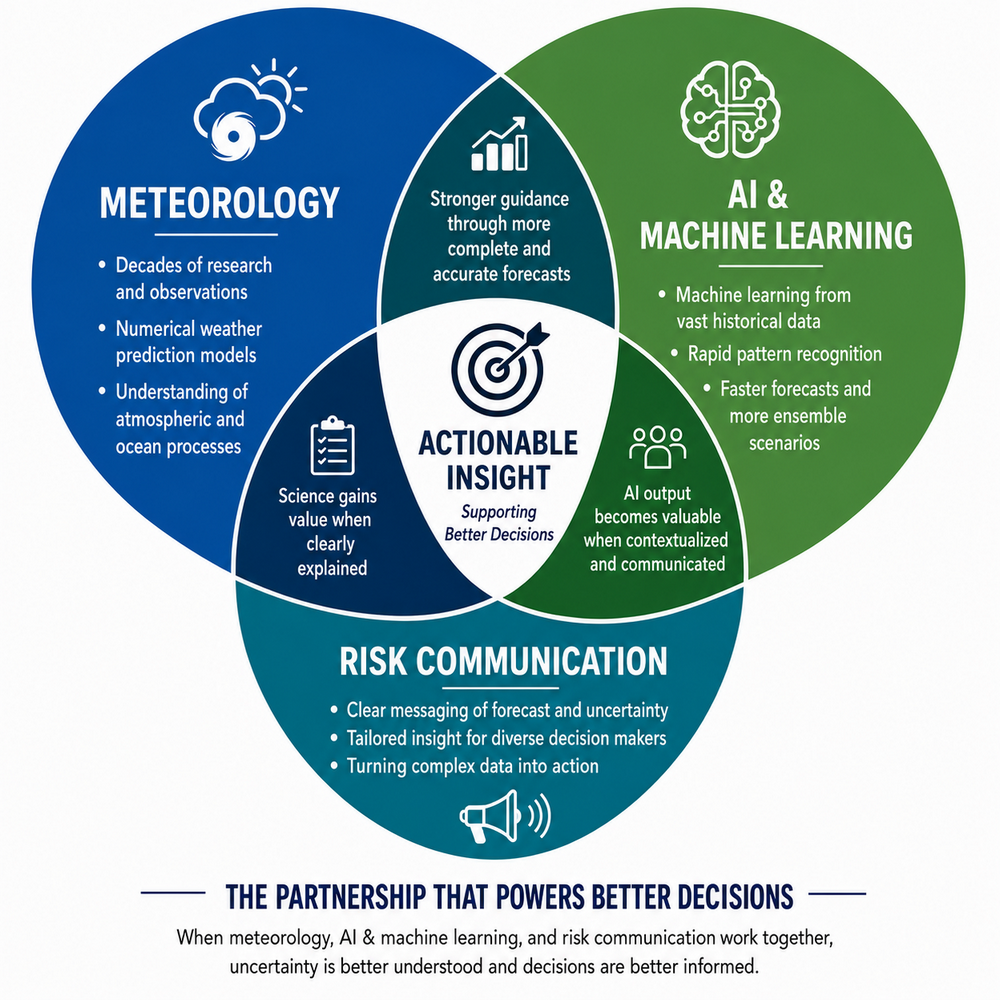 Actionable insight emerges where meteorology, AI, and risk communication intersect.
The first represents atmospheric science, built upon decades of research, observations, and numerical modeling. The second reflects artificial intelligence and machine learning; this brings unprecedented computational efficiency and pattern recognition to forecasting. The third involves communication--a forecaster's ability to explain not only what is expected to happen, but also what remains uncertain. Businesses, local government and the general populace will evaluate what actions should be considered.
The greatest value lies at the intersection of all three.
Accurate forecasts have limited value if decision-makers cannot understand them. Similarly, clear communication is ineffective if the underlying science is flawed. Artificial intelligence strengthens the forecasting process, but only when paired with sound judgment and effective communication.
That intersection is where actionable insight is created.
Looking Ahead
The role of AI in hurricane forecasting will expand as research continues and operational systems mature. Models will become faster and more sophisticated. These improvements will allow the meteorologists and emergency management to be increasingly capable of identifying potential risks earlier in a storm's lifecycle.Even so, hurricane forecasting is unlikely to become a contest between humans and machines. Instead, its future will be defined by collaboration.
Artificial intelligence will continue providing meteorologists with additional perspectives, faster analyses and increasingly refined guidance. Human forecasters will continue evaluating that information within the broader meteorological context, communicating uncertainty and helping decision-makers understand the operational implications.
For the industries and communities that rely on weather information every day, this partnership offers the greatest opportunity to improve preparedness, reduce risk, and support better decisions before, during and after the next hurricane.
Key Takeaways
- AI enhances--not replaces--human hurricane forecasting.
- Faster guidance supports earlier operational decisions.
- Human expertise remains essential for interpreting uncertainty.
- Risk communication transforms forecasts into actionable insight.
- Better forecasts lead to better business preparedness.
- AI and meteorologists deliver the strongest results together.
About Industrial Info Resources
Industrial Info Resources (IIR) is the leading provider of industrial market intelligence. Since 1983, IIR has provided comprehensive research, news and analysis on the industrial process, manufacturing and energy related industries. IIR's Global Market Intelligence (GMI) helps companies identify and pursue trends across multiple markets with access to real, qualified and validated plant and project opportunities. Across the world, Industrial Info Resources is tracking over 250,000 current and future projects worth $30.2 trillion (USD).
/news/article.jsp
false
Want More IIR News Intelligence?
Make us a Preferred Source on Google to see more of us when you search.
Add Us On GoogleAsk Us
Have a question for our staff?
Submit a question and one of our experts will be happy to assist you.

Forecasts & Analytical Solutions
Where global project and asset data meets advanced analytics for smarter market sizing and forecasting.
Explore Our SolutionsRelated Articles
-
U.S. Battery-Power Kickoffs Hit $3.2 Billion in SeptemberOctober 05, 2026
-
Zambia's Solar Expansion Builds Resilience Against Hydropowe...October 05, 2026
-
Ameren Plots Natural Gas-Fired Growth through 2045October 02, 2026
-
Solar Leads All U.S. Power Sectors for September KickoffsOctober 02, 2026
-
Key Australian Wind Farm Moves ForwardOctober 02, 2026

PECWeb Global Market Intelligence Platform
Identify opportunities, anticipate change, and execute with confidence. PECWeb connects the industrial intelligence you need, from projects and assets to operational events, all in one platform.
Discover PecwebIndustry Intel
-
North America Refining 2026: New Pipelines to PADD 5Podcast Episode / Oct 2, 2026
-
Biomanufacturing Onshoring 2026: GLP-1 Drives CapexPodcast Episode / Oct 2, 2026
-
2026 US Data Center Outlook: Power, Land & CoolingPodcast Episode / Sep 18, 2026
-
2026 Global Power Demand Outlook: Gas, Nuclear & RenewablesPodcast Episode / Sep 18, 2026
-
2026 Oil & Gas CapEx Outlook: Middle East, LNG & PermianPodcast Episode / Sep 4, 2026