Petroleum Refining
EU: Europe Needs More Oil Refining Capacity
European Commission Says Middle East Conflict is a Wake-Up Call to Increase Refining
Released Thursday, November 05, 2026
Written by Martin Lynch, European News Editor for IIR News Intelligence (Sugar Land, Texas)
Summary
The European Commission (EC) has met with the region's leading oil and gas refiners to figure out a way to boost fuel production at existing facilities in the wake of the ongoing global fuel crisis.Refiners Get a Voice
The meeting, which took place on Oct. 28, addressed the short-term response to the ongoing disruptions caused by the conflict in the Middle East as well as the medium-term outlook for the competitiveness and transformation of European refineries. Chaired by Energy Commissioner Dan Jørgensen it included representatives from the oil refining sector, European refiners, emerging fuel producers, engineering companies, technology providers, relevant industry associations and the North Atlantic Treaty Organization (NATO).
European Union (EU) refineries supply about 70% of jet fuel and 85% of diesel consumed in Europe but the sector's refining capacity is falling. According to Industrial Info Resources data there are more than 1,200 refining projects in Europe worth US$34.4 billion in investment.
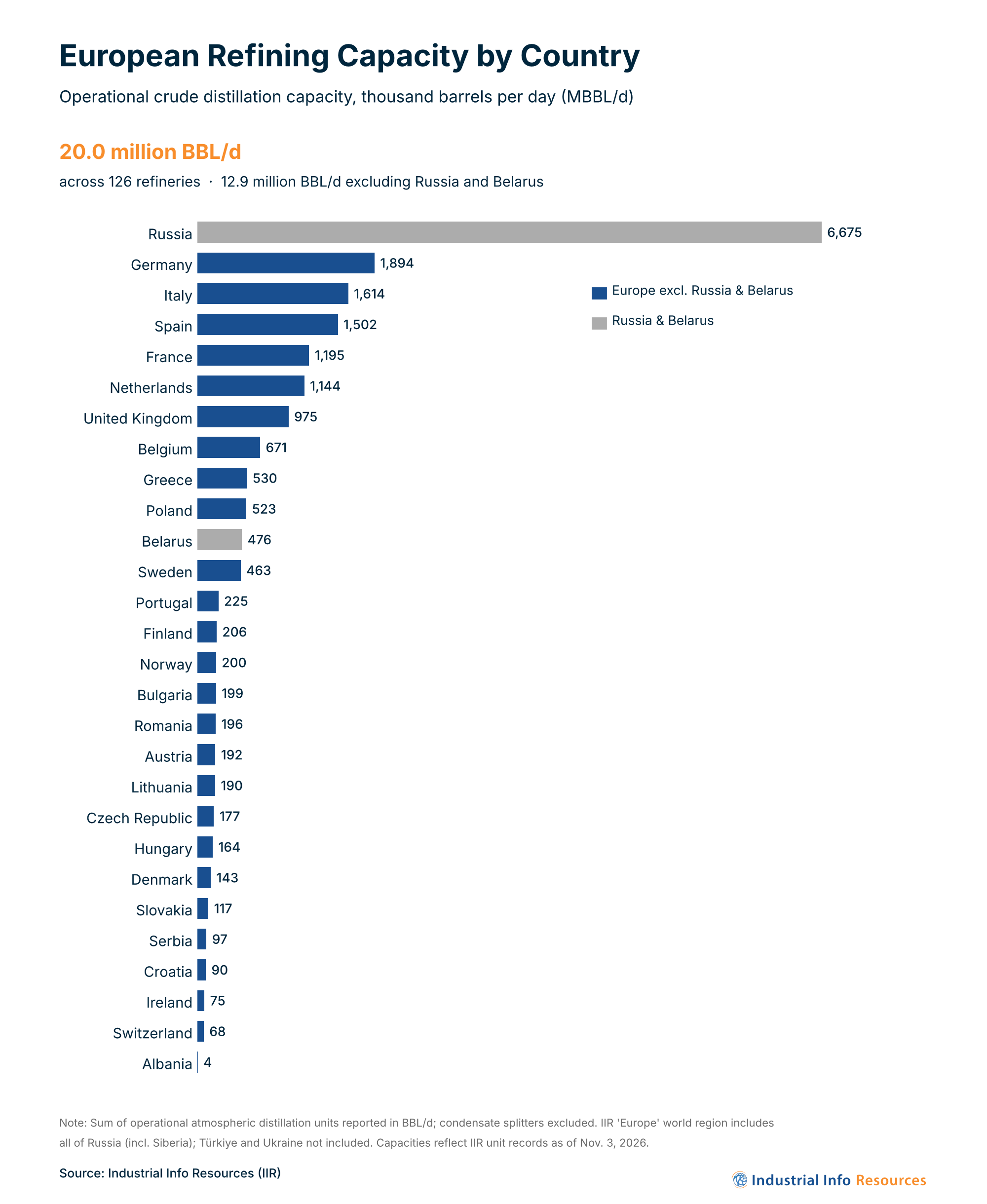
IIR also tracks European refineries at presently operating 20 million bpd across 126 refineries. That capacity drops to 12.9 million bpd when excluding Russia and Belarus. Capacities and ranking are providing the following chart, with data current as of Nov. 3 from IIR.
Wake-Up Call
"Over the last two decades, around a quarter of EU refineries were shut down, decreasing domestic refining capacities by around 10%," Jørgensen said. "Divestments have accelerated in Europe but this crisis is a wake-up call. We need to counter this trend and ensure that we have adequate and flexible refining capacity in Europe. Today and for the future. This is not just a matter of economic competitiveness. It is also a matter of security." He added: "Today's dialogue has been very fruitful, but it has been a first step. We will work to increase outputs from refining assets in Europe, because ultimately, we need to bring fuel prices down. But the work does not stop in the "here and now" of the crisis. Crises are also opportunities. We need to create an environment that supports sufficient domestic fuel production in Europe as well as long-term viability of European refining as the EU decarbonises. This is why, together with the sector, we will work on a joint roadmap on its transformation and contribution to the EU's security objectives and in line with our climate ambition"
Defence Needs Fuel
The EC's meeting with refiners over the challenges facing Europe also highlighted the growing defence concerns in the region. The vital role of the region's refining sector was touched on by Andrius Kubilius, Commissioner for Defence and Space: "I am always quoting a very famous American historical figure, General John Pershing, who was leading American troops on the European continent during the First World War, who said a very simple truth: the battles are won by infantries, the wars are won by logistics. And fuel supplies are the biggest part of what we can call logistics. Proper fuel supplies to our militaries are crucial in our defence readiness. So definitely it is an obvious truth that defence without fuel is impossible."
Declining Refining Capacity
Europe, including the EU-27, Switzerland, the U.K. and Norway, has seen its refining capacity fall by 20% since 2009 according to Euronews, citing data from Concawe, the scientific division of industry body, FuelsEurope, which represents the refining sector. At the end of 2025, there were 72 mainstream refineries with 625.4 million tonnes (MT) a year of primary refining capacity - 167.6 MT less than in 2009. The EU-27 accounts for most of that - 567.4 MT - with the U.K., Norway and Switzerland adding 58 MT. Germany is the largest refining nation with 98.7 MT of capacity, followed by Italy (78.6 MT), Spain (70.6 MT) the Netherlands (59.7 MT) and France at (57.4 MT).There were two mainstream refinery closures in 2025, Grangemouth and the Lindsey Oil Refinery - both in the U.K.. FuelsEurope lists high energy costs, global competition and investment needs for biofuels and e-fuels as the main pressures on Europe's refining sector.
IEA Warning
The International Energy Agency (IEA) warned that wholesale diesel prices in Europe may rise again despite a recovery in Gulf oil output in recent weeks and that tight supply will continue well into 2027. In its October report, it noted that global oil supply rose by 2.5 million barrels a day (Bpd) to 102.3 million in September, led by Saudi Arabia, but fell short of demand of roughly 103.5 million Bpd. Diesel prices have fallen slightly from record highs of more than US$200 per barrel in September but as the IEA noted "remain almost double the price of crude and their pre-crisis levels".
Positive Industry Reaction
FuelsEurope welcomed the EC's Strategic Dialogue on European refineries, and "the recognition of refining as a strategic sector for Europe's citizens, economy, energy security and defence". Liana Gouta, Director General FuelsEurope, said: "Today was a strong and constructive start. Europe has recognised that refining is not an industry of the past. It is strategic to EU citizens, our economy, our security, our defence, and our transition. Our industry is ready to contribute immediately to strengthening Europe's resilience. But we must look beyond the immediate pressures. European refining is a sector at risk, and without competitive refineries today, there can be no transformation into the renewable and low-carbon production hubs Europe needs tomorrow."
Key Takeaways
- Europe needs more refining capacity and the EC has held its first ever strategic meeting with Europe's top refiners to deal with the fuel crisis.
- Including the EU-27, Switzerland, the U.K. and Norway, Europe has seen its refining capacity fall by 20% since 2009.
- Industrial Info Resources is tracking more than 1,200 refining projects in Europe worth US$34.4 billion in investment.
Want More IIR News Intelligence?
Make us a Preferred Source on Google to see more of us when you search.
Add Us On GoogleAsk Us
Have a question for our staff?
Submit a question and one of our experts will be happy to assist you.

Forecasts & Analytical Solutions
Where global project and asset data meets advanced analytics for smarter market sizing and forecasting.
Explore Our SolutionsRelated Articles
-
Petrobras Sets Quarterly Oil & Gas Production Record on FPSO...November 04, 2026
-
Petrobras Advances SAF Production and DevelopmentNovember 03, 2026
-
Petrobras avanza en la producción y el desarrollo de combust...November 03, 2026

PECWeb Global Market Intelligence Platform
Identify opportunities, anticipate change, and execute with confidence. PECWeb connects the industrial intelligence you need, from projects and assets to operational events, all in one platform.
Discover PecwebIndustry Intel
-
Southern Cone Investment Radar: Argentina, Chile & UruguayPodcast Episode / Oct 30, 2026
-
Mining Capital Spending 2026: Copper, Rare Earths, AluminumPodcast Episode / Oct 23, 2026
-
Brazil Critical Minerals 2027: Rare Earths, Lithium, CopperPodcast Episode / Oct 16, 2026
-
US Craft Labor Outlook 2026: Wages, Per Diems, Data CentersPodcast Episode / Oct 16, 2026
-
Latin America Data Center Outlook 2026: Power, Hubs & GrowthPodcast Episode / Oct 9, 2026