Power
Gulf Coast Industries Brace for Hurricane Isaias
Category 3 Hurricane Isaias approaches the northern Gulf Coast, threatening energy infrastructure with destructive winds, storm surge and widespread inland flooding.
Released Friday, October 09, 2026
Written by Jesse Broehl, Editor-in-Chief, Breaking Energy News (BEN) and Aaron Studwell, Ph.D., Energy Meteorologist & Analyst for IIR News Intelligence (Sugar Land, Texas)
Summary
Category 3 Hurricane Isaias is approaching the northern Gulf Coast, threatening energy infrastructure with destructive winds, storm surge and widespread inland flooding.U.S. Power Plants, Oil & Gas, Refineries in Hurricane's Path
Packing winds as strong as 115 miles per hour, Hurricane Isaias is expected to make landfall Friday night along the coast of the western Florida Panhandle.Isaias has placed 3,475 industrial plants in its potential impact zone along the Gulf Coast, according to the Industrial Info Resources Disaster Impact Tracker. Industrial manufacturing (959 plants) and power generation (846 plants) account for the largest shares. Metals and minerals follows with 470 plants, then food and beverage with 416, oil and gas production with 175 and pulp, paper and wood with 120. Eight petroleum refining plants are also in the zone.
To be expected, offshore oil and gas production carries the largest capacity exposure in the tracker. Eighty-seven offshore plants, with a combined 1.34 million barrels per day (bpd) of crude oil and 1,360 million standard cubic feet per day (MMSCFD) of natural gas capacity, fall within the potential impact area.
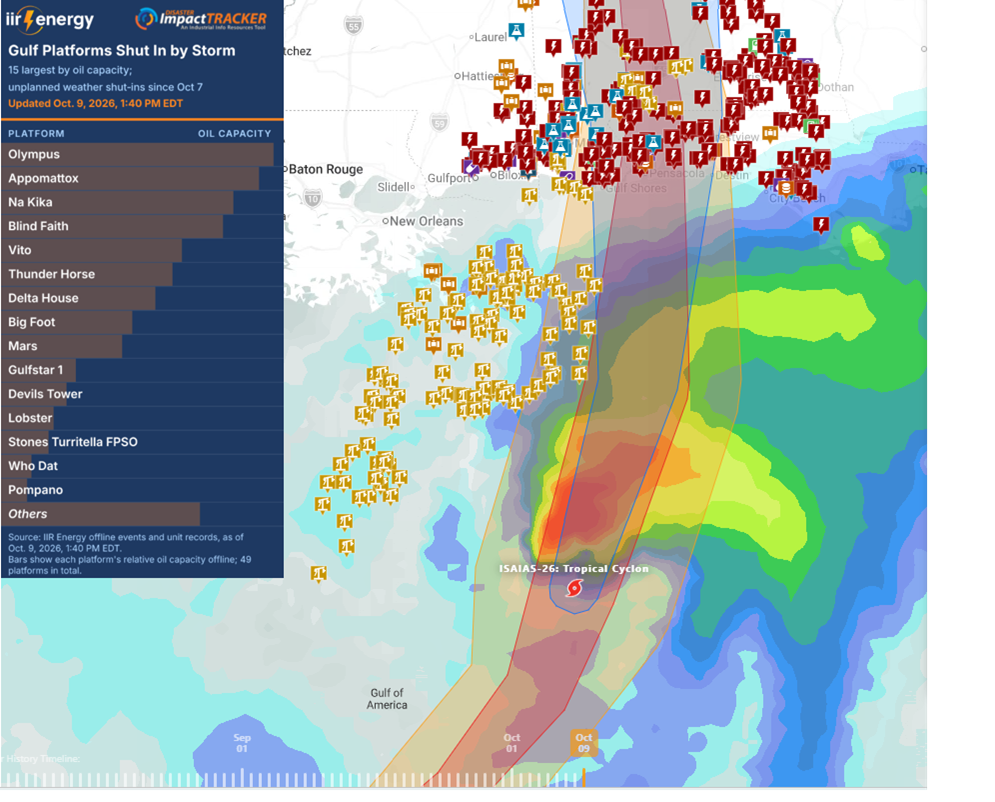
Potential vs. Confirmed Actual Platform and Plant Shutdowns
Forty-nine offshore platforms have confirmed shut in of about 702,000 bpd of oil and 763 MMSCFD of gas, and one refinery, one gas processing plant and 41 power plants are also offline. IIR will update the tracker as the storm moves through the region and operators report restarts.Refining exposure is concentrated in six plants with 812,100 bpd of crude capacity. In power, 338 plants representing 61,698 megawatts (MW) of generating capacity are potentially affected. The gas market has 22 plants in the zone, with 5,152 MMSCFD of gas processing capacity and 113,905 bpd of fractionation capacity. The tracker shows no petrochemical plants with potential exposure.
As of 4 PM Central Time Friday, Isaias was a Category 3 major hurricane. Moving north at nearly 17 mph toward the northern Gulf Coast.
Although its maximum winds appear to have stabilized, conditions remain capable of sustaining a dangerous hurricane.
According to Industrial Info Resources analysis, Isaias presents significant risks to offshore energy production, coastal industrial facilities, and electrical transmission and distribution infrastructure. Damaging winds extending well inland, combined with flooding rainfall and tornadoes, could disrupt energy operations across the Southeast.
Why Isaias Intensified So Rapidly
Exceptionally warm Gulf of Mexico waters have provided the heat and moisture needed to strengthen Isaias. Relatively light upper-level winds initially allowed the hurricane to become better organized, developing a distinct eye and intense thunderstorms surrounding its center. Together, these conditions fueled rapid intensification.
The vertical wind shear increased substantially and would normally disrupt a hurricane's organization. However, upper-level winds are blowing in nearly the same direction as Isaias' movement, limiting their impact. These same upper-level winds help maintain its circulation, allowing for efficient outflow.
Atmospheric Pattern Drives Isaias Toward the Coast
A developing weather system over the northwestern Gulf Coast and a ridge of high pressure over the western Atlantic are steering Isaias northward. Their interaction should accelerate the hurricane toward the coast while expanding its wind field, extending damaging winds beyond the center.Landfall is expected along the western Florida Panhandle later this evening. Isaias is the forecast to move northward through Alabama before turning northeastward across the Tennessee and Ohio Valleys during the weekend.
Weakening is expected after landfall, with Isaias likely losing its tropical characteristics over northern Alabama by Saturday evening. However, its expanding wind field will expose a much broader region to dangerous conditions.
Winds Threaten Inland Electrical Infrastructure
Hurricane-force winds could extend as far as 100 miles inland along Isaias' track into southern Alabama. Hurricane-force gusts could reach central Alabama, with damaging winds affecting portions of Mississippi, Georgia and southern Tennessee.These conditions threaten electric transmission and distribution systems through downed power lines, damaged utility equipment, and potentially prolonged outages. Falling trees could compound these impacts, particularly where heavy rainfall saturates soils.
Coastal energy infrastructure remains exposed to destructive winds, life-threatening storm surge, and flooding. Offshore production facilities, industrial operations and transportation networks could experience additional disruptions as Isaias moves ashore.
The combination of coastal and inland hazards presents a significant operational concern for utilities, energy producers and industrial facilities throughout the region.
Heavy Rainfall and Flooding Threaten the Southeast
There was a moderate risk (Level 3 of 4) of excessive rainfall for southern Alabama, the Florida Panhandle and southwestern Georgia through Saturday morning. The greatest flooding threat will develop along and east of Isaias' track.Persistent rainbands could repeatedly impact the same locations, producing substantial accumulations and widespread flash flooding. The storm was expected to produce widespread flooding, particularly across southwestern Georgia.
On Saturday, the threat will expand northward and eastward as Isaias moves inland. A broad Slight Risk (Level 2 of 4) covers portions of the Southeast, with some locations potentially requiring an upgrade to Moderate Risk.
Heavy rainfall across Alabama, Georgia, the Tennessee Valley and southern Appalachians could produce rapid runoff, urban flooding and rising rivers. Mountainous terrain will increase the flooding potential, threatening transportation corridors and electrical infrastructure.
By Sunday, rainfall associated with Isaias' remnants will spread into the Ohio Valley, central Appalachians and Mid-Atlantic, although amounts should decrease as the storm weakens.
Key Takeaways
- Major Hurricane at Landfall: Category 3 Hurricane Isaias is expected to reach the western Florida Panhandle Friday evening, potentially maintaining major hurricane intensity.
- Rapid Intensification: Exceptionally warm Gulf waters and favorable atmospheric conditions have allowed Isaias to strengthen despite increasing wind shear.
- Inland Power Grid Threat: Sustained hurricane-force winds could extend 100 miles inland into southern Alabama, threatening electrical transmission and distribution infrastructure.
About Industrial Info Resources
Industrial Info Resources (IIR) is the leading provider of industrial market intelligence. Since 1983, IIR has provided comprehensive research, news and analysis on the industrial process, manufacturing and energy related industries. IIR's Global Market Intelligence (GMI) helps companies identify and pursue trends across multiple markets with access to real, qualified and validated plant and project opportunities. Across the world, Industrial Info Resources is tracking over 250,000 current and future projects worth $30.2 Trillion (USD).
/news/article.jsp
false
Want More IIR News Intelligence?
Make us a Preferred Source on Google to see more of us when you search.
Add Us On GoogleAsk Us
Have a question for our staff?
Submit a question and one of our experts will be happy to assist you.

Forecasts & Analytical Solutions
Where global project and asset data meets advanced analytics for smarter market sizing and forecasting.
Explore Our Solutions
PECWeb Global Market Intelligence Platform
Identify opportunities, anticipate change, and execute with confidence. PECWeb connects the industrial intelligence you need, from projects and assets to operational events, all in one platform.
Discover PecwebIndustry Intel
-
Latin America Data Center Outlook 2026: Power, Hubs & GrowthPodcast Episode / Oct 9, 2026
-
Food and Beverage CapEx Outlook 2026: Tariffs, AI, AfricaPodcast Episode / Oct 9, 2026
-
North America Refining 2026: New Pipelines to PADD 5Podcast Episode / Oct 2, 2026
-
Biomanufacturing Onshoring 2026: GLP-1, CDMO and ReshoringPodcast Episode / Oct 2, 2026
-
2026 US Data Center Outlook: Power, Land & CoolingPodcast Episode / Sep 18, 2026