Power
IEA: Global Electric Power Demand to Rise in 2026 and 2027
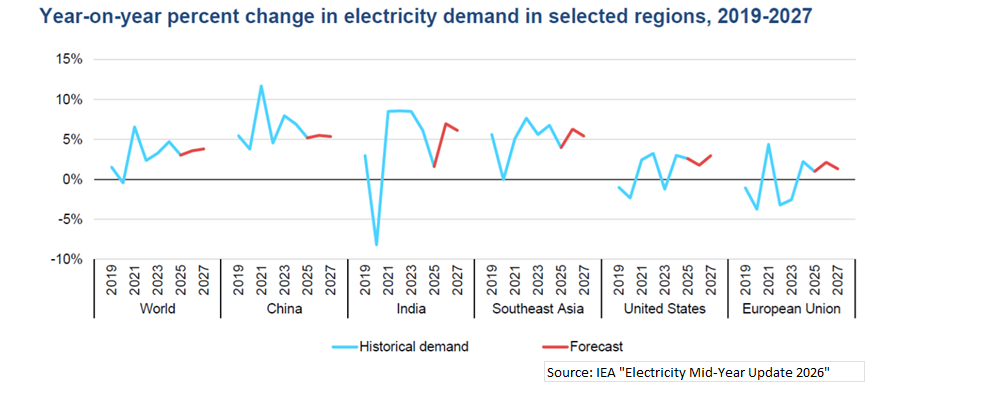
Global demand for electricity is expected to rise 3.6% this year and 3.8% in 2027, outstripping the world's 3% growth in 2025, according to a new report from the International Energy Agency.
Released Thursday, July 23, 2026
Written by John Egan for IIR News Intelligence (Sugar Land, Texas)
Summary
Global demand for electricity is expected to rise 3.6% this year and 3.8% in 2027, outstripping the world's 3% growth in 2025, according to a new report from the International Energy Agency. On a percentage basis, demand growth this year is forecast to rise much faster in China and India than in the U.S.IEA Sees Strong Global Growth in Electric Demand
The world will use about 3.6% more electricity than it did in 2025, when growth was 3%, and in 2027 growth will rise an additional 3.8%, according to the International Energy Agency (IEA), which released its "Electricity Mid-Year Update 2026" report July 23. The agency cited a number of drivers for its predicted strong demand growth, including industrial expansion; increasing appliance ownership; accelerating uptake of electric vehicles, air conditioning and heat pumps; and the rapid expansion of data centers.According to Industrial Info Resources data, companies are developing 54,740 electric generation and cogeneration projects around the world valued at about US$13 trillion. The regions with the greatest dollar value of generation and cogeneration projects under development are China (US$2.4 trillion), the U.S. (US$1.7 trillion), India (US$1 trillion) and the United Kingdon (US$635 billion). The Industrial Info Resources Global Market Intelligence (GMI) Power Project Database offers a list of detailed project reports.
On a percentage basis, India is expected to have the fastest increase in electricity use this year (7%) followed by China (5.5%), the U.K. (2.1%) and the U.S. (1.8%), the IEA said. In 2027, growth rates are expected to remain strong, with China's demand growth easing to 5.4% while the U.S. rising to 3%.
So far this year, the world's largest economies have been able to cope with the loss of LNG from the Middle East, mainly by switching to U.S.-supplied LNG and increasing purchases from other non-Middle East producers. But that has come at a price, the IEA noted: "The temporary loss of nearly 20% of global LNG supply (originating in the Middle East) has triggered significant price volatility, pushing natural gas prices in both Asia and Europe to their highest levels since the 2022-2023 energy crisis."
Gas-dependent developing nations have been hit hard by rising LNG prices, forcing them to switch to coal and impose usage restrictions, the report noted.
By the Numbers
- 3.6%: Projected global electric demand growth in 2026 over 2025, when growth was 3%, according to a new report from the International Energy Agency
- 3.8%: Expected electric demand growth in 2027
- 54,740: The number of electric generation and cogeneration projects under development around the world, valued at about US$13 trillion, according to Industrial Info Resources.
Electricity from Renewables Outstrips Coal, Gas
On a combined basis, electricity generated by all forms of renewable electric generation, including solar, wind, hydropower and others, is expected to exceed electricity produced by coal or gas plants this year, the IEA said. Renewable resources achieved near-parity with coal last year. Renewable electricity is expected to grow by more than 8% in 2026, and its share of the global electricity fuel mix is set to rise from 33% in 2025 to 37% by 2027, the agency predicted.Solar photovoltaic (PV) remains the largest contributor to electricity supply growth on a global basis. Output is forecast to increase by around 600 terawatt-hours (TWh) this year, basically matching the record annual expansion seen in 2025. The IEA said it expected a similar amount of growth for 2027. Solar PV is set to overtake wind power in 2026 to become the world's second-largest renewable source of electricity generation after hydropower, the report added.
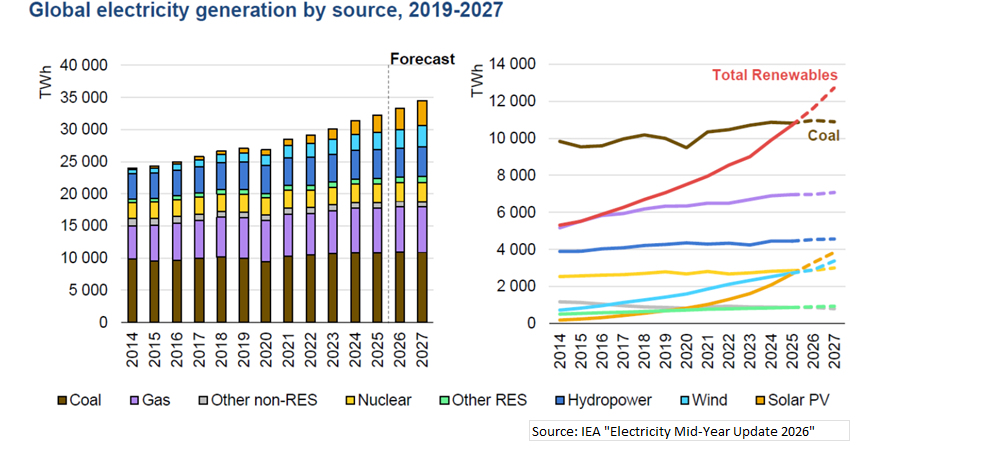
Nuclear power generation is expected to increase again in 2026, albeit at a slower pace, before accelerating strongly in 2027, the IEA said. Delays in getting new reactors online, as well as maintenance-related outages, are seen tempering growth this year. By contrast, in 2027, the addition of new reactors in China and India, continued strong output in the United States and France, and the completion of projects that have been delayed, are set to drive nuclear energy's growth of over 4%.
Negative Prices Can be Overcome with Flexible Resources
Strong electric demand growth, coupled with increased output from intermittent renewable resources, increasingly is leading to negative electric wholesale prices in several places around the world. This highlights the need for increased deployment of battery energy storage systems (BESS) and demand response programs, the IEA wrote.So far in 2026, "major markets continued to exhibit a significant number of hours with negative wholesale electricity prices, which typically signal insufficient flexibility in the system due to technical, regulatory or contractual constraints," the IEA said. Strong output from intermittent renewables, coupled with occasional periods of slack demand, have pushed up the percentage of hours with electricity prices under US$0, particularly in portions of Spain, South Australia, Southern and Central California, and West Texas.
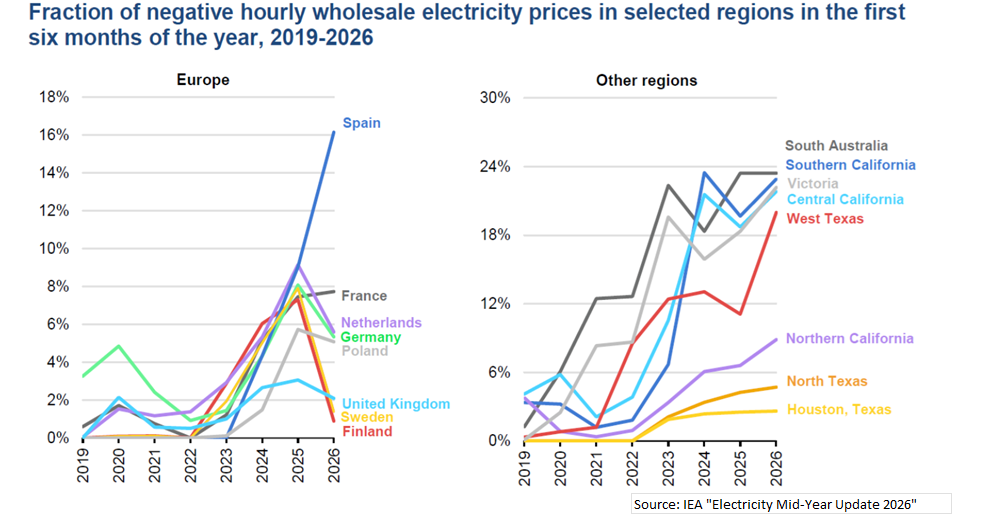
"These developments underscore the increasing value of flexibility in power systems," the IEA report concluded. "Technologies such as battery storage, demand response and other flexible resources can shift generation and consumption across hours, and capture value from widening intraday price spreads. By doing so, they can reduce curtailment of renewables and support system reliability as the share of variable renewable generation continues to expand."
Key Takeaways
- Demand for electricity is expected to rise approximately 3.6% this year and an additional 3.8% in 2027, outstripping 2025's 3% gain.
- On a combined basis, renewables are expected to produce more power than coal or gas this year.
- Several regions around the world have reported an increase in the percentage of hours when wholesale electricity prices are negative.
About Industrial Info Resources
Industrial Info Resources (IIR) is the leading provider of industrial market intelligence. Since 1983, IIR has provided comprehensive research, news and analysis on the industrial process, manufacturing and energy related industries. IIR's Global Market Intelligence (GMI) helps companies identify and pursue trends across multiple markets with access to real, qualified and validated plant and project opportunities. Across the world, Industrial Info Resources is tracking over 250,000 current and future projects worth $30.2 Trillion (USD).
/news/article.jsp
false
Want More IIR News Intelligence?
Make us a Preferred Source on Google to see more of us when you search.
Add Us On GoogleAsk Us
Have a question for our staff?
Submit a question and one of our experts will be happy to assist you.

Forecasts & Analytical Solutions
Where global project and asset data meets advanced analytics for smarter market sizing and forecasting.
Explore Our Solutions
PECWeb Global Market Intelligence Platform
Identify opportunities, anticipate change, and execute with confidence. PECWeb connects the industrial intelligence you need, from projects and assets to operational events, all in one platform.
Discover PecwebIndustry Intel
-
Latin America Data Center Outlook 2026: Power, Hubs & GrowthPodcast Episode / Oct 9, 2026
-
Food and Beverage CapEx Outlook 2026: Tariffs, AI, AfricaPodcast Episode / Oct 9, 2026
-
North America Refining 2026: New Pipelines to PADD 5Podcast Episode / Oct 2, 2026
-
Biomanufacturing Onshoring 2026: GLP-1, CDMO and ReshoringPodcast Episode / Oct 2, 2026
-
2026 US Data Center Outlook: Power, Land & CoolingPodcast Episode / Sep 18, 2026