Production
IEA Report Assesses Potential Impacts of Middle East War on Global Oil & Gas Markets
In an exhaustive new report, the International Energy Agency attempts to sketch out how global energy markets could be transformed by the current energy crisis.
Released Wednesday, November 25, 2026
Written by John Egan for IIR News Intelligence (Sugar Land, Texas)
Summary
In an exhaustive new report, the International Energy Agency attempts to sketch out how global energy markets could be transformed by the current energy crisis. The implications for the oil and gas industry could be particularly pronounced.IEA Uses Scenarios and Cases to Assess Possible Implications of Current Energy Crisis
The International Energy Agency (IEA) has long used scenarios in its annual World Energy Outlook (WEO) to assess the possible implications of global energy trends. In its newest WEO, released November 19, the agency continued to use three scenarios--Current Policies Scenario (CPS), Stated Policies Scenario (STEPS) and Net Zero Emissions to 2050 (NZE)--to measure the possible aftershocks of what it called the most significant energy crisis in history.But because that crisis is still unfolding, the new WEO report included two additional cases--Additional Response Case (APC) and Low-Hormuz Case (LHC)--which are less fully developed than the three longstanding scenarios. Those two cases represent more dramatic illustrations of what the future could look like should national governments and energy companies take significant steps to insulate themselves from future Middle East conflicts. Those steps include:
- Diversification as a "key policy preoccupation across multiple dimensions," impacting including suppliers, routes, energy mixes and technology supply chains
- A stronger preference for domestically available energy resources, which would have different implications for different countries depending on their domestic resource base, and
- An accelerated push for electrification in transportation, buildings and industry
The scope of what IEA attempts to do in the current WEO is vast, with possible implications ranging from relatively benign to fundamentally transformative. Over the course of 564 pages, the agency tries to tease out the possible implications for different nations, regions and fuels. The agency always emphasized that its WEOs were not predictions, but merely explorations of how different trends could play out over a multi-decade timeline.
"A central question for this Outlook is how the 2026 crisis might alter policy preferences, risk perceptions and the mix of fuels and technologies that the world uses to meet our energy needs," IEA said.
"The Hormuz crisis has delivered a huge shock to the system," IEA Executive Director Fatih Birol said in a statement accompanying the release of the report. "While the energy sector and the global economy have shown considerable resilience, the longer the crisis lasts, the deeper the effects will be. And I don't see any credible pathway for the energy world to return to the way it was before. This World Energy Outlook looks past the current turmoil to explore the range of energy futures that could emerge from today's upheaval."
In this first of three articles, IIR will present the WEO's assessment of how the current energy crisis could affect the global oil and gas sector. Subsequent articles will explore possible implications for the coal and electricity industries.
Three Scenarios Assess Implications for Oil & Gas Industry
Of the IEA's three fully developed scenarios, it said the Current Policies Scenario (CPS) is based on "energy policies and regulations that are already firmly in place and offers the least scope for change" to the energy crisis. One of the other fully developed scenario, Stated Policies Scenario (STEPS), considers "specific policy measures that have formally been put forward but not yet adopted." This scenario incorporates a broader range of responses to the energy crisis.Both scenarios assume a continued easing of constraints on Gulf exports and sufficient stability to allow for unimpeded transit through the Strait of Hormuz by the end of 2027. They differ chiefly in their assessment of how rapidly the world's energy system can evolve.
The third full-fledged scenario, Net Zero Emissions by 2050 (NZE) starts from 2050 and works backward to today, identifying what measures would need to be taken to achieve net zero carbon emissions by 2050. The United Nations global climate research has identified this pathway as the best opportunity to keep global temperature gain at or below 1.5° Celsius since the Industrial Revolution.
The main drivers used by IEA in its three scenarios are global population growth, economic growth, energy prices, government policies, electrification and technology changes.
The global oil and gas industry is at the center of the current energy crisis, the IEA said in WEO 2026.
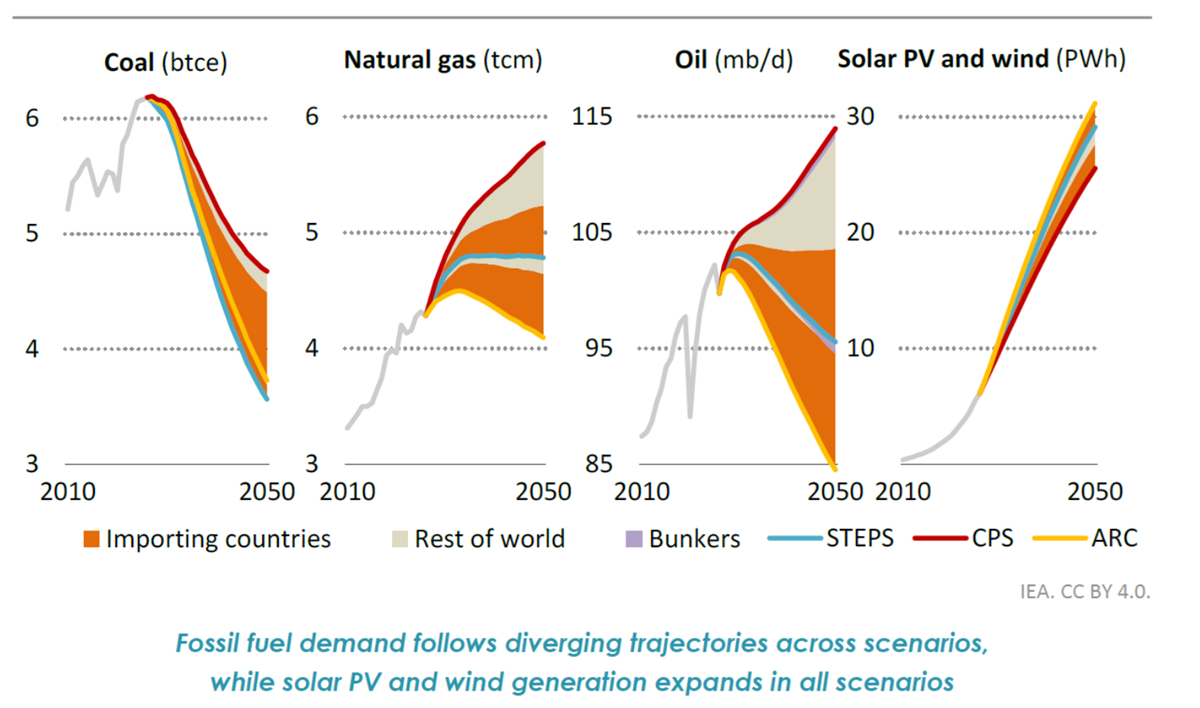
In the CPS scenario, IEA said worldwide demand for both oil and gas will continue rising to 2050. Crude oil demand reaches from its present level of approximately 102 million barrels per day (bpd) to about 114 million bpd by 2050. "While electrification, efficiency and biofuels cut passenger car oil use to 2035," the report noted, "this is more than offset by a combined increase of 5 million bpd for petrochemicals, aviation and heavy trucks. Natural gas use grows strongly, backed by a wave of new LNG supply."
Gas demand in the CPS scenario rises from its current level of about 4.3 trillion cubic meters (tcm) to just shy of 5.8 tcm by 2050.
But in STEPS, "the pace of structural change is faster," IEA said. Oil demand rises briefly by 2030 before entering a slow decline that lowers its use to approximately 95 million bpd in 2050. Natural gas demand rises for the next decade before plateauing in the mid-2030s. By 2050, demand is about 4.8 tcm.
In the third scenario, NZE, meeting stringent emissions and climate goals requires much more rapid substitution of oil and gas, putting their use into earlier and faster decline. Oil use will decline about 73%, to about 28 million bpd, in 2050 while gas demand falls even more, about 80% from current use, to about 850 billion cubic meters (bcm) by mid-century.
 By the Numbers
- Worldwide demand for crude oil, currently about 102 million bpd, could, by mid-century, be either 114 million bpd, 95 million bpd or 28 million bpd, depending on the scenario developed by the IEA. Natural gas use was seen as more resilient than the oil market in three scenarios developed by the energy agency. Current demand for gas, about 4.3 tcm, could either rise to about 5.8 tcm by 2050, or fall to as little as 850 billion cubic meters (bcm).
Two Cases Explore More Dramatic Changes for Oil and Gas
Although the three full-fledged scenarios developed by IEA show a wide divergence of possible outcomes by 2050, the agency developed two other cases, Additional Response Case (APC) and Low-Hormuz Case (LHC), which were less fully developed than the three scenarios that have long guided IEA research and reports. But both cases carry even more dramatic upending of the world energy order.In the ARC, where Middle East security risks and uncertainties are assumed to persist for longer, energy self-reliance measures currently under discussion in several countries are fully implemented. The world moves farther and faster away from Middle East crude oil and natural gas because it must. That region's war, after all, could last for years.
The Low Hormuz Case (LHC) looks at whether and over what time horizon the world could manage without energy flows through the Strait of Hormuz.
 Key Takeaways
- In its annual World Energy Outlook report, the International Energy Agency used three scenarios and two cases to frame the potential impact that the Middle East war could have on global energy markets to 2050.
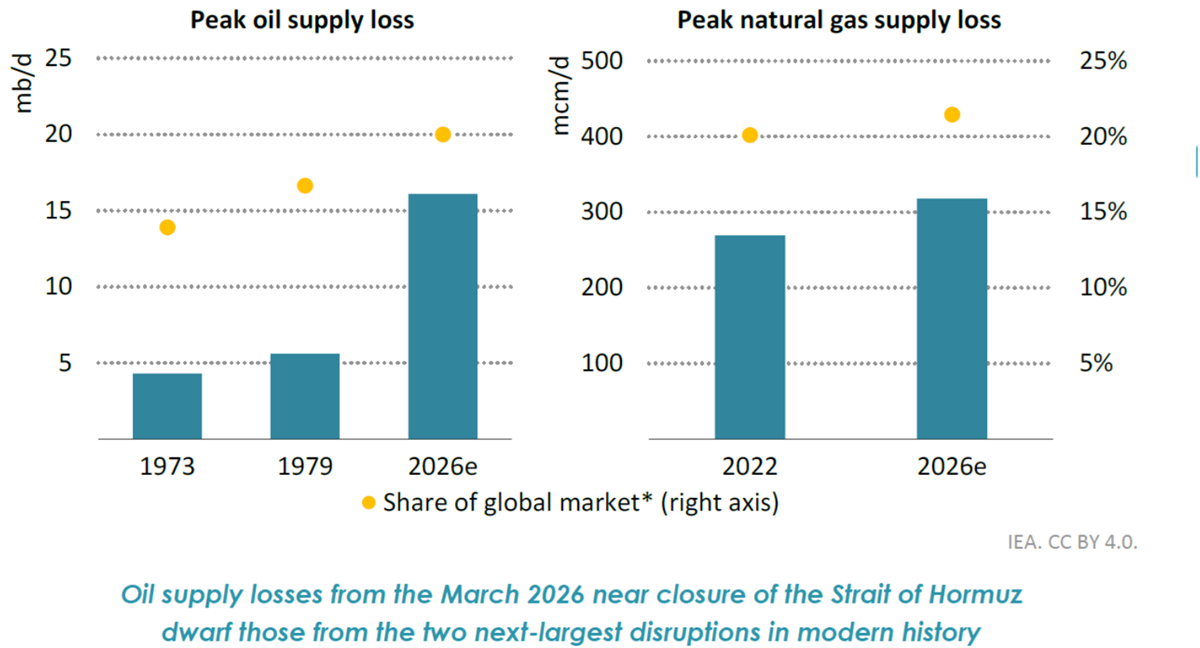
- The agency said the Middle East war has been the most disruptive one in world history.
- The war's impact on worldwide demand for oil ranged from comparatively modest to significant reductions in demand.
- IEA's outlook was more resilient for the natural gas market, though potential declines in demand were possible.
- Since the beginning of the Middle East war this past February, nations have implemented measures to insulate themselves from energy volatility and market disruptions, which could alter the long-term trajectories of demand across fuels.
- The report was not a prediction; instead, it explored a range of potential outcomes for worldwide energy markets under a variety of assumptions over the next decade.
About Industrial Info Resources
Industrial Info Resources (IIR) is the leading provider of industrial market intelligence. Since 1983, IIR has provided comprehensive research, news and analysis on the industrial process, manufacturing and energy related industries. IIR's Global Market Intelligence (GMI) helps companies identify and pursue trends across multiple markets with access to real, qualified and validated plant and project opportunities. Across the world, Industrial Info Resources is tracking over 250,000 current and future projects worth $30.2 trillion (USD).
/news/article.jsp
false
Want More IIR News Intelligence?
Make us a Preferred Source on Google to see more of us when you search.
Add Us On GoogleAsk Us
Have a question for our staff?
Submit a question and one of our experts will be happy to assist you.

Forecasts & Analytical Solutions
Where global project and asset data meets advanced analytics for smarter market sizing and forecasting.
Explore Our SolutionsRelated Articles
-
Deal in the Works for Sale Lukoil's Non-Russian Global Energ...November 23, 2026
-
Keyera Acquires, Expands NGL Capacity in Western CanadaNovember 23, 2026
-
U.S. LNG Near Record High Amid Global Supply IssuesNovember 20, 2026

PECWeb Global Market Intelligence Platform
Identify opportunities, anticipate change, and execute with confidence. PECWeb connects the industrial intelligence you need, from projects and assets to operational events, all in one platform.
Discover PecwebIndustry Intel
-
Global Chemical Industry Outlook 2026: Ethylene, Hydrogen, CapExPodcast Episode / Nov 6, 2026
-
Southern Cone Investment Radar: Argentina, Chile & UruguayPodcast Episode / Oct 30, 2026
-
Mining Capital Spending 2026: Copper, Rare Earths, AluminumPodcast Episode / Oct 23, 2026
-
Brazil Critical Minerals 2027: Rare Earths, Lithium, CopperPodcast Episode / Oct 16, 2026
-
US Craft Labor Outlook 2026: Wages, Per Diems, Data CentersPodcast Episode / Oct 16, 2026