Production
Lower Gas Prices Drag Down Full-Year Profits for Four Independent Producers
Happier days may await producers in the future, but they are not there yet
Released Monday, March 03, 2025
Written by John Egan for Industrial Info Resources (Sugar Land, Texas)--The most recent Short-Term Energy Outlook (STEO) from the U.S. Energy Information Administration (EIA) may give natural gas producers reasons for optimism about prices for 2025 and 2026. Happier days may await producers in the future, but they are not there yet. First, the industry had to get through another difficult year and quarter in which U.S. production growth outpaced demand growth, leading to lower prices, lower revenue and, generally, weaker profits.
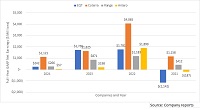
For 2024, continued low gas prices pushed down full-year earnings for four large, independent, gas-oriented producers: EQT Corporation (NYSE:EQT) (Pittsburgh, Pennsylvania), Range Resources Corporation (NYSE:RRC) (Fort Worth, Texas), Antero Resources Corporation (NYSE:AR) (Denver, Colorado) and Coterra Energy Incorporated (NYSE:CTRA) (Houston, Texas). For the fourth quarter, Antero was the exception to the rule, increasing earnings while profits at its three peers fell versus the comparable year-earlier quarter.
In its STEO, released February 11, the EIA said that gas spot prices dipped to an annual average of $2.20 per million British thermal units (MMBtu) at Henry Hub for 2024, down from $2.50 in 2023. But looking forward, the agency said it expected gas prices to rise sharply for 2025 and 2026: to an average of $3.80 this year and $4.20 next year.
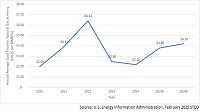
The average price forecast for 2025 contained in the February STEO was about 86 cents per MMBtu higher than EIA's January projection.
But that's a forecast, which may or may not materialize. The reality of fourth-quarter prices was bleak compared to comparable quarterly averages from prior years: $2.44 per MMBtu for the just-completed quarter, down 30 cents per MMBtu from fourth-quarter 2023, the EIA said. Prices fell $3.11 per MMBtu in the just-completed period compared to the historically high prices in the fourth quarter of 2022.
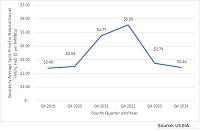
Some providers, such as EQT, had higher fourth-quarter price realizations than the Henry Hub spot price. EQT and Antero made more in last-year's fourth quarter than they did for the full year.
EQT
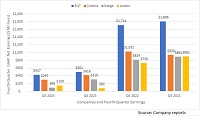
On a generally accepted accounting principles (GAAP) basis, EQT earned approximately $231 million on $5.3 billion of revenue for all of 2024, down sharply from net profits of $1.7 billion on sales of $6.9 billion for full-year 2023, the company said in a February 18 earnings statement. For the just-completed fourth quarter, the company earned $427 million on $1.6 billion of sales, down from earnings of $502 million on revenue of slightly over $2 billion for the comparable year-earlier quarter. Asset sales last year lowered year-over-year results.
Last year's acquisition of Equitrans turned EQT into one of the largest U.S. fully integrated gas companies, where price volatility in the upstream segment (Exploration & Production) could be smoothed with the addition of transmission assets, which tend to be more insulated from the vicissitudes of prices.
EQT officials estimated that 90% of the Equitrans integration tasks had been accomplished by yearend 2024.
The company also sold a stake in some of its pipelines to asset manager Blackstone Incorporated (NYSE:BX) (New York, New York) for $3.5 billion during the fourth quarter. The transaction would help EQT reduce the debt pile it accumulated after it acquired pipeline company Equitrans Midstream (Pittsburgh) in early 2024. Asset sales lowered EQT's debt to $9.1 billion at the end of 2024, down from a high of $13.7 billion after the Equitrans deal. For more on that transaction, see March 12, 2024, article - Gas Player EQT Reunited with Equitrans in $5.5 Billion Deal.
Company officials told investors the company ended 2024 with about 25.9 trillion cubic feet (Tcf) of proved reserves on a gas-equivalent basis, flat with yearend 2023 data. The company operates in the Appalachian Basin, specifically Pennsylvania, West Virginia and Ohio. Gas accounts for the majority of the company's production and proved reserves.
On the February 18 earnings call, EQT officials said the company was well-positioned to deliver sustainable growth to meet demand within the Appalachian Basin, which they expect to grow by 6 billion cubic feet per day (Bcf/d) or 7 Bcf/d by 2030, to approximately 43 Bcf/d. In contrast to the 2016-2020 period, when most demand growth came from pipelines pushing gas into their systems, EQT officials said they expected rising demand from electric generators over the 2024-2030 period to pull more gas into the region's pipeline infrastructure.
Across the U.S., rising electric demand from data centers, artificial intelligence (AI) and continued retirement of coal-fired electric generation is expected to add between 10 Bcf/d and 18 Bcf/d of new demand nation-wide by 2030, company officials said.
Coterra
Coterra reported earnings February 24. For the just-completed fourth quarter, it earned $297 million on revenue of $1.4 billion, a decline from the comparable year-earlier quarter, when profits reached $416 million on sales of slightly under $1.6 billion. For the full year, the Houston-based company, which operated in the Appalachian, Permian and Anadarko basins, earned $1.1 billion on $5.5 billion of sales in 2024, down from net profits of $1.6 billion on $5.9 billion of revenue in 2023.
During the fourth quarter, Coterra acquired certain Permian Basin assets from Franklin Mountain Energy (Denver, Colorado) and Avant Natural Resources (Denver) in a cash-and-stock deal valued at $3.95 billion. Those transactions closed in January. The acquired assets will increase Coterra's exposure to crude oil. The acquired assets, totaling about 83,000 acres, will create a new focus area in the Northern Delaware Basin, company officials said.
For 2024, the company reported that oil production, natural gas production and overall production on a barrels of oil equivalent (BOE) basis exceeded the high-end of its guidance and capital expenditures came in near the low-end of guidance.
Over the 2025-2027 period, Coterra officials said they expect capital outlays to average $2.1 billion to $2.4 billion per year. It expects production, on a BOE basis, to grow about 9% this year, driven by a sharp expected gain in oil production. Gas volumes, on the other hand, are predicted to be flat this year compared to 2024 production. This 2025 guidance includes the impact of last November's acquisitions.
Company officials told investors February 24 that annual oil production will grow approximately 5% or more per year for the 2025-2027 period.
Antero
Antero earned about $150 million on sales of $1.2 billion for last year's fourth quarter, an improvement over the comparable year-earlier quarter, where net profits were approximately $82 million on the same amount of revenue. For the full year, profits sank about 71%, to about $57 million from $198 million in 2023. The company reported earnings February 12.
Like some other gas producers, when faced with mixed financial results, Antero officials highlighted its improving capital and operating efficiencies in 2024. The Denver-based company, which operates in the Appalachian Basin, spent 8% less than expected for drilling and completion of new wells last year. Production was 2% higher than the company's initial guidance. Antero last year reduced by 29% the number of days it took to drill a 13,000-foot lateral compared to 2022.
On December 31, 2024, Antero's estimated proved reserves were 17.9 Tcf of gas equivalent. Estimated proved reserves comprised 59% natural gas, 40% natural gas liquids (NGLs) and 1% oil.
Though mainly a gas producer, Antero took advantage of higher NGL prices and a strong export market to increase its production and export of NGLs last year. Net production in 2024 averaged 3.4 billion cubic feet of gas equivalent per day (Bcfe/d), an increase of 1% from the prior year. Gas production fell 3% compared to 2023 but liquids production averaged 209,000 barrels per day (BBL/d), an increase of 8% from the prior year.
Company officials projected this year's daily net production on a gas-equivalent basis would hold steady in 2025. Capital outlays for drilling and completion in 2024 was $620 million, a 32% decline from the prior year. Company officials projected increasing their D&C spending to between $650 million and $700 million.
Range
Range Resources, another major Appalachian Basin gas producer, saw sharp declines for fourth-quarter and full-year 2024 earnings. Net quarterly earnings fell 69%, to about $95 million from $310 million for the comparable year-earlier quarter. For 2024, profits also plummeted 69%, to approximately $266 million from $871 million in 2023. Range reported results February 25.
Production averaged 2.18 Bcfe/d, approximately 68% of which was natural gas.
In its earnings announcement, Range officials said that, despite low gas prices, the company is investing to build its inventory of wells that will support its production growth plans through 2027.
The driller also said that "an exciting chapter for U.S. natural gas is materializing as (LNG) export capacity is commissioned to meet growing global gas demand. As the lowest-cost, lowest-emissions natural gas basin in the country, we expect Appalachia will play a significant role to meet global gas needs over time." Range officials predicted that the company "will see an outsized benefit" from this expected growth.
On a gas-equivalent basis, Range produced an average of approximately 2.2 billion Bcfe/d in 2024, a figure Range expects to increase to about 2.6 Bcfe/d in 2027. Over the 2025-2027 period, the Fort Worth-based company expects to make annual capital investments of between $650 million and $700 million.
Industrial Info Resources (IIR) is the leading provider of industrial market intelligence. Since 1983, IIR has provided comprehensive research, news and analysis on the industrial process, manufacturing and energy related industries. IIR's Global Market Intelligence (GMI) platform helps companies identify and pursue trends across multiple markets with access to real, qualified and validated plant and project opportunities. Across the world, IIR is tracking over 200,000 current and future projects worth $17.8 Trillion (USD).
/news/article.jsp
false
Want More IIR News Intelligence?
Make us a Preferred Source on Google to see more of us when you search.
Add Us On GoogleAsk Us
Have a question for our staff?
Submit a question and one of our experts will be happy to assist you.

Forecasts & Analytical Solutions
Where global project and asset data meets advanced analytics for smarter market sizing and forecasting.
Explore Our SolutionsRelated Articles
-
U.S. LNG Near Record High Amid Global Supply IssuesNovember 20, 2026
-
Surplus Signal Drag Oil Prices Lower, But Global Risks Remai...November 19, 2026

PECWeb Global Market Intelligence Platform
Identify opportunities, anticipate change, and execute with confidence. PECWeb connects the industrial intelligence you need, from projects and assets to operational events, all in one platform.
Discover PecwebIndustry Intel
-
Global Chemical Industry Outlook 2026: Ethylene, Hydrogen, CapExPodcast Episode / Nov 6, 2026
-
Southern Cone Investment Radar: Argentina, Chile & UruguayPodcast Episode / Oct 30, 2026
-
Mining Capital Spending 2026: Copper, Rare Earths, AluminumPodcast Episode / Oct 23, 2026
-
Brazil Critical Minerals 2027: Rare Earths, Lithium, CopperPodcast Episode / Oct 16, 2026
-
US Craft Labor Outlook 2026: Wages, Per Diems, Data CentersPodcast Episode / Oct 16, 2026