Industrial Manufacturing
Projects Under Construction Drive $58 Billion in U.S. Battery-Manufacturing Investment
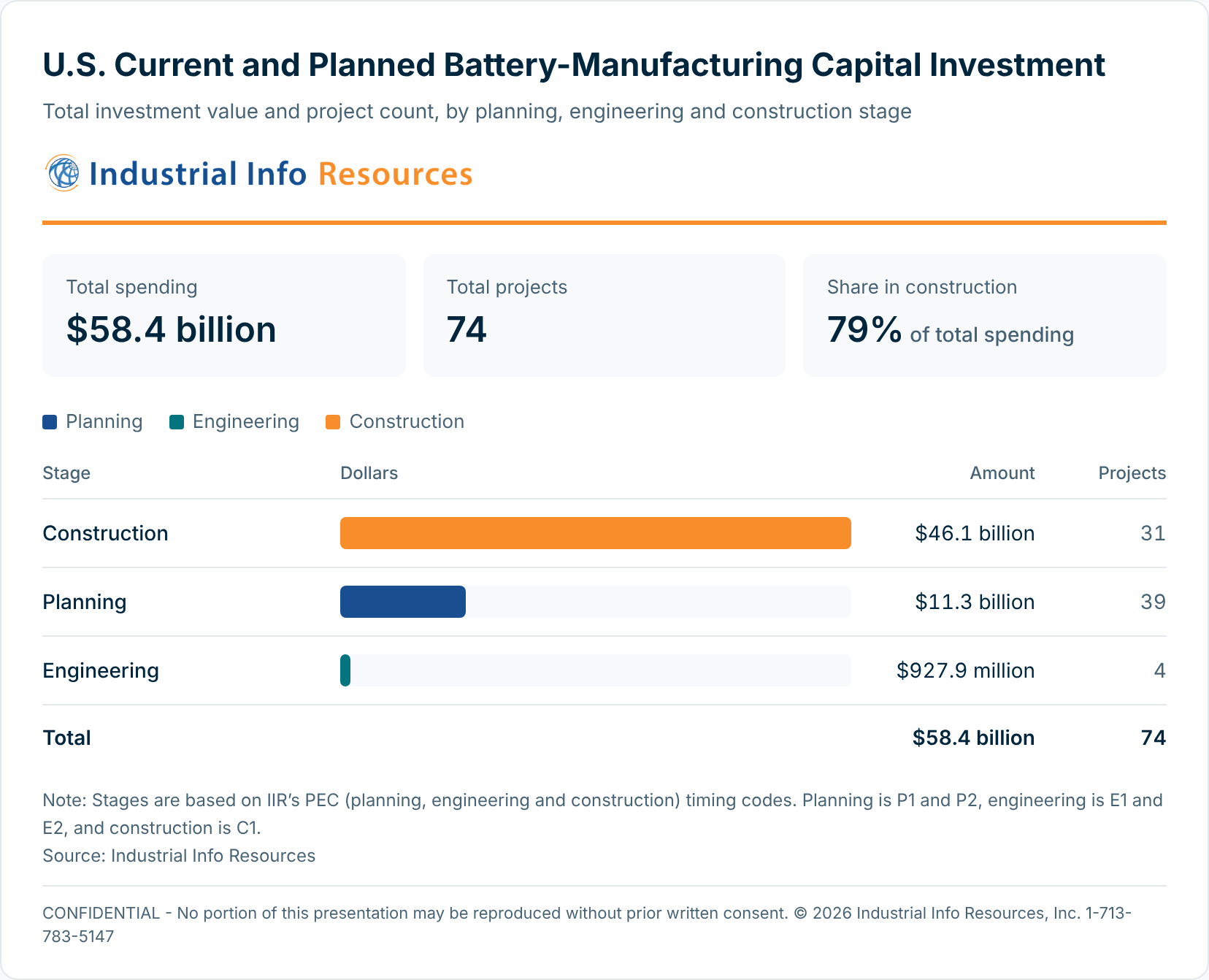
Industrial Info Resources is tracking $58 billion worth of capital battery-manufacturing investment across the U.S., with about 75% of the spend attributed to projects under construction.
Released Thursday, November 05, 2026
Reports related to this article:
Written by Danny Levin, Deputy Editor for IIR News Intelligence (Sugar Land, Texas)
Summary
Industrial Info Resources is tracking $58 billion worth of capital battery-manufacturing investment across the U.S., with about 75% of the spend attributed to projects under construction.State of U.S. Battery Manufacturing
Automakers are looking to produce batteries for energy storage as well as EVs and hybrids. Rollbacks on energy transition funding--including the expiration of the federal $7,500 consumer EV tax credit--and slower-than-expected market adoption--are causing some domestic automakers to move away from full EVs, leaving some U.S. battery-manufacturing capacity underutilized. Some of that capacity and overall energy storage market momentum has shifted from an EV focus to energy storage for the electricity grid.According to Industrial Info Resources data, there are $58 billion worth of active and planned capital battery-manufacturing projects across the U.S., with about 75% of the spend attributed to projects under construction. This includes activity aimed at supporting fully-electric and hybrid vehicles and energy-storage batteries.
Battery-energy storage system (BESS) units have mainly been used in the U.S. to store energy to supply power when solar is not generating. Increasingly, data centers are using them to reduce reliance on diesel backup during grid outages.
Policy has also been a key enabling factor. The 2022 Inflation Reduction Act (IRA) provided tax credits for standalone BESS for the first time, which before had been limited to co-located with solar. Then, when the U.S. elections in the fall of 2024 ushered in a second Trump Administration and full Republican control of Congress, wind and solar tax credits were phased out by the federal government while the credits for BESS were left intact. In its third-quarter earnings call on October 28, The Ford Motor Company highlighted its approach to battery manufacturing, through its newly formed Ford Energy division: "The investment thesis is very clear," Chief Executive Officer Jim Farley said. "Our starting point is U.S. manufactured grid-scale battery storage for companies building America's new power infrastructure and data centers. He added the automaker is building a "diverse customer base across solar, grid support and data centers, and we expect our 2028 capacity to be fully committed by Q1 of next year," while negotiations for 2029 and 2030 already are underway.
In addition, more than 80% of 2028's capacity is tied to what Farley called executed contracts and late-stage negotiations.
The automaker's current focus is a $2.3 billion plant conversion in Glendale, Kentucky, to produce lithium iron phosphate (LFP) battery cells, BESS modules and the company's DC Block product--a battery system packaged inside a 20-foot shipping container. First production is expected next year, reaching 20 gigawatt-hours (GWh) of annual capacity online by the end of next year. The output will support data centers, utilities, and large-scale commercial/industrial customers. Ford also is building a plant in Marshall, Michigan, plant under construction in Marshall, Michigan, which will manufacture smaller, residential battery units.
Readers can view related project reports and plant profiles.
GM is making a similar leap, including through its Ultium Cells joint venture with South Korea's LG Energy Solution (LGES). The venture already produces batteries for BESS units at its Ultium Cells plant in Spring Hill, Tennessee
While based in Korea, LG Energy Solution aims to be a major player in the growing U.S. energy-storage market. Announcing its third-quarter earnings on November 3, The company said it is targeting more than 70 GWh of energy-storage battery capacity in North America by the end of 2027.
For more information on GM's battery-manufacturing strategy, see June 15, 2026, article - GM on Track to Significantly Shift Battery Technologies for Energy Storage, EVs.
Tesla is wrapping up a $200 million project in Brookshire, Texas, which entails converting a former warehouse into a new BESS manufacturing facility, supporting its Megapack systems--which are in high demand. View the project report here, and see October 28, 2026, article - Tesla's Megapack Energy Storage Systems are in High Demand.
Another project aimed at supporting Tesla is underway, but not for energy storage: traditional battery manufacturer Panasonic's $4 billion expansion of its plant in De Soto, Kansas, just outside Kansas City, will increase production of battery cells for Tesla EVs. Operations are expected to begin in 2027. View more project information here.
But at an investor's event in June, Panasonic indicated it planned to convert part of the plant's operations to manufacture batteries for artificial intelligence data centers. Kazuo Tadanobu, chief executive officer of Panasonic Energy, said the company plans to invest $2.2 billion over the next three years, including investments in infrastructure at the plant. "The key to flexibility is expanding capacity in North America, where customer demand is highest, and strengthening local procurement of power components," he said.
Traditional Battery Manufacturers
After dissolving its BlueOval SK joint venture with Ford, Korea's SK On became the sole owner of a site in Stanton, Tennessee, where SK is in the middle of building a new lithium-ion battery plant to support EVs and energy storage. Mass production is expected to begin in 2028. View the project report here.In the site preparation phase is the construction of the American Battery Factory Incorporated's grassroot LFP battery plant in Pima, Arizona, part of a phased development plan. Initial capacity is expected to be 4 GWh, with production expected to begin in late 2027. The company plans 5.5 GWh through at least the first five years of production. Readers can view the related project reports, including that for Phase I.
Potential Projects
In terms of EVs, as part of a $1 billion investment, GM and LGES' Ultium Cells joint venture is evaluating a retooling of its Spring Hill, Tennessee, plant in order to diversify its battery-manufacturing capabilities, in addition to upgrading equipment to produce lower cost lithium manganese-rich (LMR) prismatic cells for upcoming models.Meanwhile, EnerSys is planning a grassroot lithium-ion battery cell manufacturing plant in Greenville, South Carolina, albeit for a different application: cells to be used in batteries for defense-related applications such as drones and missile defense. The project is armed with a U.S. Department of Energy grant totaling approximately $150 million, and EnerSys Chief Executive Officer Shawn O'Connell said in August that construction is planned to begin in the first half of fiscal-year 2028.
Readers can view more information on the Ultium Cells and EnerSys projects.
The Industrial Info Resources GMI Project and Plant databases offer a full list of detailed reports for projects mentioned in this article, and a full list of related plant profiles.
Industrial Info Resources also offers a full list of reports for active and proposed capital battery-manufacturing projects across the U.S.
Key Takeaways
- $58 billion: Total value of capital active and proposed battery-manufacturing projects across the U.S., with about 75% of the spend attributed to projects under construction.
- This includes production for EVs, energy storage and data centers.
- Ford and GM are investing in shifting some EV battery production to energy storage.
About Industrial Info Resources
Industrial Info Resources (IIR) is the leading provider of industrial market intelligence. Since 1983, IIR has provided comprehensive research, news and analysis on the industrial process, manufacturing and energy related industries. IIR's Global Market Intelligence (GMI) helps companies identify and pursue trends across multiple markets with access to real, qualified and validated plant and project opportunities. Across the world, Industrial Info Resources is tracking over 250,000 current and future projects worth $30.2 trillion (USD).
Want More IIR News Intelligence?
Make us a Preferred Source on Google to see more of us when you search.
Add Us On GoogleAsk Us
Have a question for our staff?
Submit a question and one of our experts will be happy to assist you.

Forecasts & Analytical Solutions
Where global project and asset data meets advanced analytics for smarter market sizing and forecasting.
Explore Our SolutionsRelated Articles
-
Tesla's Megapack Energy Storage Systems are in High DemandOctober 28, 2026
-
Plant Expansions Drive U.S. Automotive KickoffsSeptember 17, 2026
-
U.S. Consumers Mull EVs Amid Higher Gasoline PricesMay 15, 2026

PECWeb Global Market Intelligence Platform
Identify opportunities, anticipate change, and execute with confidence. PECWeb connects the industrial intelligence you need, from projects and assets to operational events, all in one platform.
Discover PecwebIndustry Intel
-
Southern Cone Investment Radar: Argentina, Chile & UruguayPodcast Episode / Oct 30, 2026
-
Mining Capital Spending 2026: Copper, Rare Earths, AluminumPodcast Episode / Oct 23, 2026
-
Brazil Critical Minerals 2027: Rare Earths, Lithium, CopperPodcast Episode / Oct 16, 2026
-
US Craft Labor Outlook 2026: Wages, Per Diems, Data CentersPodcast Episode / Oct 16, 2026
-
Latin America Data Center Outlook 2026: Power, Hubs & GrowthPodcast Episode / Oct 9, 2026
