Power
West Coast Leads U.S. in Hydropower Spending
While hydropower projects are scattered throughout the U.S., there is a tremendous concentration of this form of renewable energy in California and the Pacific Northwest.
Released Wednesday, January 07, 2015
Researched by Industrial Info Resources (Sugar Land, Texas)--As federal and state policies strive to lower power plant emissions, utilities across the United States are continually seeking increased sources of renewable energy, chiefly from wind, solar and hydropower. The predominant type of renewable energy often varies by region. California, Nevada, Arizona and New Mexico command most spending in the solar sector. Wind power has a more evenly distributed geographic footprint, but remains dominated by Texas, accompanied by strong regional spending in the Midwest and Great Lakes regions. While hydropower projects are scattered throughout the U.S., there is a tremendous concentration of this form of renewable energy in California and the Pacific Northwest.
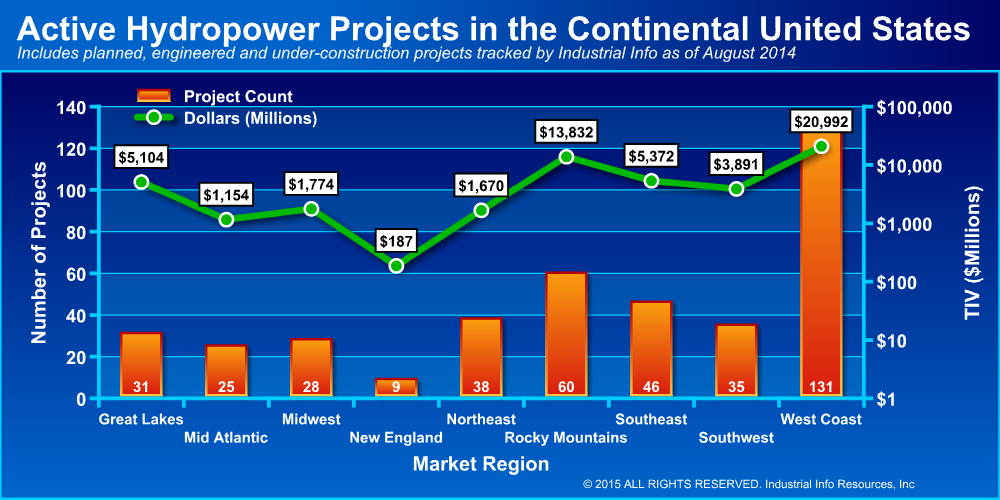 The U.S. Energy Information Administration states that more than half of U.S. hydroelectric capacity is located in the states of Washington, Oregon and California, and these states are definitely remaining on course as leaders in the sector. According to Industrial Info's North American Power Industry Database, about $21 billion of the $54 billion in active hydropower projects in the continental U.S. are in these three states. Washington and Oregon each have more than $5 billion in planned, engineered or under-construction hydropower projects, while California boasts more than $10 billion in hydropower projects.
"One of the main things that we're seeing across the U.S., but particularly along the West Coast, is an increase in the number of hydro projects that are 10 megawatts (MW) or less," says Brock Ramey, Industrial Info's manager of research for the North American Power Industry.
Ramey explains that much of this development of smaller hydropower projects stems from the enactment of the Hydropower Regulatory Efficiency Act of 2013, which frees many smaller hydropower projects from regulatory burdens.
Among other things, the Act exempts smaller, non-federally owned "conduit" facilities from licensing requirements of the Federal Power Act. A "conduit" is basically something such as an aqueduct, tunnel or ditch that moves water from one place to another without the primary purpose of generating electricity. Under the act, such conveyances that generate less than 5 megawatts of power are now easier to construct in regard to permitting and licensing. The act also increases the defined size of "small" hydroelectric projects from 5,000 MW to 10,000 MW, exempting more facilities from licensing requirements of the Federal Energy Regulatory Commission (FERC).
"Developers and utilities are still very much in the process of integrating this new legislation into their capital plans, and it's opening all kinds of new doors," says Ramey.
Many larger projects remain in the early planning stages and are tentatively planned to begin construction in the coming years. By far most of the larger new-build construction occurring within the hydropower sector is for pumped-storage hydropower projects. In these projects, water is pumped to high-elevation reservoirs during periods of low power demand and then, during periods of high demand, the water is released to a lower-elevation reservoir through turbines to generate electricity.
Most of these projects are fairly large-scale undertakings because of the tremendous amount construction and engineering involved. These projects can run upward of $2 billion and can have generating capacities of more than 1,000 MW. Such planned projects include the 1,300-MW Eagle Mountain Pumped Storage Project, located on the site of a former iron ore mine in Southern California, and the Klickitat Public Utility District's planned 1,200-MW project on the Columbia River in Washington.
Although the Hydropower Regulatory Efficiency Act of 2013 had no direct, immediate effect on these larger projects, it did call for a study for the feasibility of FERC's issuing licensing for closed-loop pumped-storage projects within a two-year time frame. While these larger projects garner much of the attention because of the large price tags and scale of construction, Ramey says that it will be several years before ground is broken on any pumped-storage hydropower project of 800 MW or more.
Much of the activity in the near term will be for smaller hydropower projects such as powerhouse additions and refurbishments at operating plants and smaller projects at existing dams. While the West Coast states of Oregon, Washington and California lead the U.S. in both the value and number of planned hydropower projects, there are hydropower projects springing up throughout the U.S., with particularly strong spending occurring where existing geographic or manmade features (such as unused mines or quarries) allow for the construction of new pumped-storage facilities.
"Hydropower has always had a strong presence in the Western U.S.," says Ramey. "What we will undoubtedly see with these new regulations is a strong surge in refurbishment projects, initially beginning in the West through the U.S. Bureau of Reclamation and the Bonneville Power Administration [government agencies that deal with water resources and hydroelectric projects in the Western U.S.], then continuing to spread throughout the U.S. as the U.S. Army Corps of Engineers begins prioritizing its potential upgrade and refurbishment projects."
With many states implementing renewable portfolio standards and increasing federal legislation to reduce power plant emissions, renewable energy sources are receiving quite a boost. While much of the recent focus has been on solar power and heavily subsidized wind projects, hydropower is undoubtedly regaining a hold in the U.S., and both new construction and improvements to existing facilities are expected to continue gaining momentum for the next several years.
Industrial Info Resources (IIR), with global headquarters in Sugar Land, Texas, three offices in North America and ten international offices, is the leading provider of global market intelligence specializing in the industrial process, heavy manufacturing and energy markets. Industrial Info's quality-assurance philosophy, the Living Forward Reporting Principle, provides up-to-the-minute intelligence on what's happening now, while constantly keeping track of future opportunities.
/news/article.jsp
false
Want More IIR News Intelligence?
Make us a Preferred Source on Google to see more of us when you search.
Add Us On GoogleAsk Us
Have a question for our staff?
Submit a question and one of our experts will be happy to assist you.
Forecasts & Analytical Solutions
Where global project and asset data meets advanced analytics for smarter market sizing and forecasting.
Learn MoreRelated Articles

Industrial Project Opportunity Database and Project Leads
Get access to verified capital and maintenance project leads to power your growth.
Learn MoreIndustry Intel
-
2026 North American Labor OutlookPodcast Episode / Apr 24, 2026
-
2026 European Metals & Minerals Project Spending OutlookPodcast Episode / Apr 7, 2026
-
The Age of Critical Minerals in the AmericasPodcast Episode / Mar 20, 2026
-
2026 Regional Chemical Processing OutlookPodcast Episode / Mar 6, 2026
-
From Data to Decisions: How IIR Energy Helps Navigate Market VolatilityPodcast Episode / Nov 21, 2025