Power
Could a Full-Blown U.S.-Canada Energy Trade War Erupt?
The U.S.-Canada trade and tariff conflict is either an elaborate game of signaling, the beginning of the end of mutually beneficial trade between the two countries that started before the Revolutionary War or something in between.
Released Thursday, August 27, 2026

Written by John Egan for IIR News Intelligence (Sugar Land, Texas)
Summary
The U.S.-Canada trade and tariff conflict is either an elaborate game of signaling, the beginning of the end of mutually beneficial trade between the two countries that started before the Revolutionary War or something in between. Cross-border energy trade might be dragged into the spat. Only time will tell.Energy's Role in U.S.-Canadian Trade
Canada is the United States' second-largest trading partner. Last year, about US$880 billion in combined goods and services crossed the border, with the U.S. importing about US$454 billion from Canada last year and exporting approximately US$426 billion of goods and services, according to the Bureau of Economic Analysis (BEA), a branch of the U.S. Department of Commerce.Tariffs announced last week by President Donald Trump, and this week by Canadian Premier Mark Carney, could, unless reversed, be applied to about 5% of that value, roughly US$40 billion, evenly split between goods each country imports from the other. Services were exempted from the latest round of tariffs. For more on that, see August 27, 2026, article -- Energy Spared in U.S.-Canadian Trade War.
There is a significant energy trade between the U.S. and Canada.
U.S.-Canadian energy trade has been widely discussed in Canada in recent days, though so far it is not on the table. Instead, food, hockey sticks, liquor, metals & minerals, cars and automobile parts have been the focus of new tariffs announced by Trump and Carney.
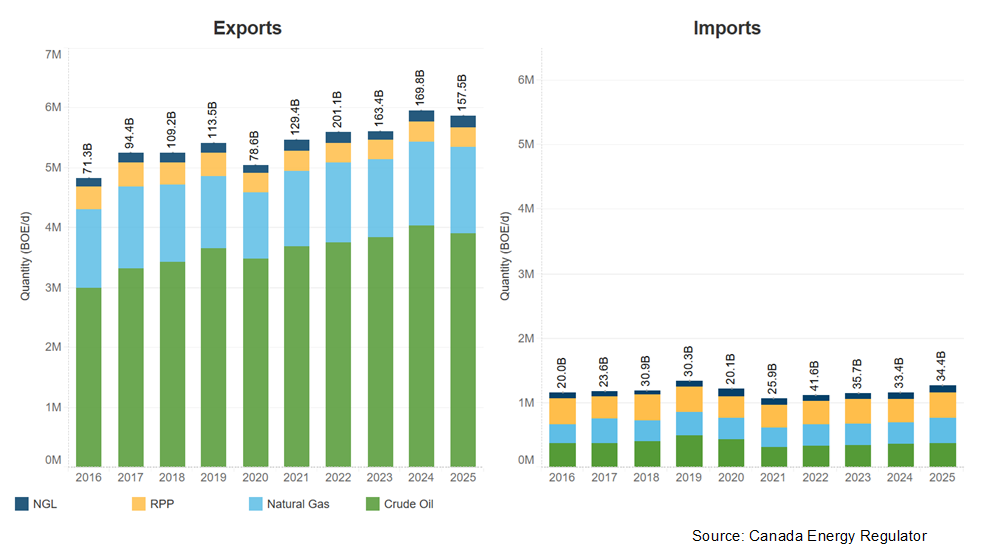
In a market snapshot from May, the Canada Energy Regulator (CER) noted a network of dozens of pipelines transport crude oil, natural gas, natural gas liquids (NGLs), and refined petroleum products (RPPs) between Canada and the U.S. along with fleets of rail, marine, and freight vehicles. Additionally, 86 international power lines move electricity between provinces and U.S. states.
At the current exchange rate (1 Canadian dollar equals about 72 U.S. cents), CER said Canada exported about C$157 billion of crude oil, refined petroleum products, natural gas and NGLs to the U.S. in 2025, or approximately 6.9 million barrels of oil equivalent per day (BOE/d). That works out to about US$113 billion. Most of that, about US$90 billion, is crude oil, according to data from the U.S. Energy Information Administration (EIA).
In return, CER said Canada imported about US$25 billion of crude oil, refined petroleum products, natural gas and LNG last year. That works out to approximately 1.3 million BOE/d the agency estimated.
But unlike Canada's hydrocarbon exports, which are refined and used across the U.S., Canada's electricity exports were concentrated in a few states, namely New York, Michigan, Minnesota, Vermont and Maine.
By the Numbers
- US$40 billion: The value of the current tariffs that the U.S. and Canada have announced on the other county's imported goods. Energy trade flows are not part of this sum
- 6.9: Million barrels per day of oil equivalent per day (BOE/d) of crude oil, refined petroleum products, natural gas and natural gas liquids that Canada sold to the U.S. in 2025
- US$113 billion: Value of Canadian crude oil imported by the U.S. in 2025
- US$13 billion: Value of U.S. refined petroleum exports sold to Canada in 2025
- US$6.5 billion: Value of U.S.-Canadian electricity trade in 2025. Slightly over two-thirds of that sum reflects U.S. imports of Canadian electricity
The Road Ahead
At this point, it seems there are three basic options for predicting how the current U.S.-Canada trade and tariff wars could unfold:- The countries could agree to call off the dispute and resume bilateral trade and tariff negotiations with no preconditions.
- The countries could continue to proportionally increase tariffs or trade restrictions, until one surrenders.
- One country, or both, could push the proverbial "nuclear" button and dramatically escalate the dispute by putting cross-border energy trade and tariffs on the table. Then, unless an off-ramp is created, a truly destructive, no-holds-barred trade war will erupt.
In the days after Trump announced his newest round of tariffs on Canada August 21, Ottawa's Premier Douglas Ford signaled a desire to put Canadian energy exports to the U.S. on the table. Then, both leaders traded insults across the border, pouring metaphorical gasoline on a fire. Predicting whether a full-blown energy trade war will erupt is dicey, owning to a number of factors. But if the Cold War is any guide, pressure is growing for cooler heads to prevail.
Key Takeaways
- Although cross-border energy tariffs and trade restrictions have not been part of the current tit-for-tat dispute between the U.S. and Canada, there is no guarantee that it will remain off the table.
- On a dollar basis, the U.S. imports more energy from Canada than Canada imports from the U.S., suggesting that the U.S. has more to lose if Canada enacts energy tariffs and trade restrictions.
About Industrial Info Resources
Industrial Info Resources (IIR) is the leading provider of industrial market intelligence. Since 1983, IIR has provided comprehensive research, news and analysis on the industrial process, manufacturing and energy related industries. IIR's Global Market Intelligence (GMI) helps companies identify and pursue trends across multiple markets with access to real, qualified and validated plant and project opportunities. Across the world, Industrial Info Resources is tracking over 250,000 current and future projects worth $30.2 Trillion (USD).
/news/article.jsp
false
Want More IIR News Intelligence?
Make us a Preferred Source on Google to see more of us when you search.
Add Us On GoogleAsk Us
Have a question for our staff?
Submit a question and one of our experts will be happy to assist you.

Forecasts & Analytical Solutions
Where global project and asset data meets advanced analytics for smarter market sizing and forecasting.
Explore Our SolutionsRelated Articles

PECWeb Global Market Intelligence Platform
Identify opportunities, anticipate change, and execute with confidence. PECWeb connects the industrial intelligence you need, from projects and assets to operational events, all in one platform.
Discover PecwebIndustry Intel
-
Latin America Data Center Outlook 2026: Power, Hubs & GrowthPodcast Episode / Oct 9, 2026
-
Food and Beverage CapEx Outlook 2026: Tariffs, AI, AfricaPodcast Episode / Oct 9, 2026
-
North America Refining 2026: New Pipelines to PADD 5Podcast Episode / Oct 2, 2026
-
Biomanufacturing Onshoring 2026: GLP-1, CDMO and ReshoringPodcast Episode / Oct 2, 2026
-
2026 US Data Center Outlook: Power, Land & CoolingPodcast Episode / Sep 18, 2026