Production
As Iran and Israel Broaden their War, IEA Sees Global Oversupply of Oil to 2030
Global demand for oil will increase by about 2.5 million barrels per day between 2024 and 2030
Released Tuesday, June 17, 2025

Written by John Egan for Industrial Info Resources (Sugar Land, Texas)--Timing, goes the old saying, is everything. As the Iran-Israel war expands to include attacks on each countries' oil infrastructure, the International Energy Agency (IEA) (Paris, France) issued its annual report on global oil production and consumption, refining and prices to 2030.
Finalized last week as the two Middle Eastern foes began ratcheting up their hostilities, the agency forecast that global demand will increase by about 2.5 million barrels per day (BBL/d) between 2024 and 2030, reaching about 105.5 million BBL/d in 2030. But liquids production is expected to grow even more, by over 5 million BBL/d to 114.7 million BBL/d in 2030.
An over-supplied global oil market is expected to keep a lid on prices--unless the Middle East war expands to include a potential blockage of the Straits of Hormuz, through which flows about one-fifth of the world's oil.
On Monday, analysts at one investment house, Deutsche Bank, predicted a blockade could briefly cause oil prices to nearly double, to over $120 per barrel. West Texas Intermediate (WTI) crude oil has been on a long, slow decline for the first five months of the year, falling from a peak of $80 per barrel in January to just over $60 per barrel at the end of May. But threats of war in the region pushed it up approximately $12 per barrel so far in June, to about $72 per barrel late Monday afternoon.
The Middle East war is flaring up at a crucial time for oil markets with the start of the summer driving season, when demand for oil, and the price of transportation fuel, typically rise.
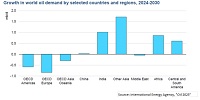
The IEA report, "Oil 2025," released today, predicted global liquids growth will "be dominated by robust gains in natural gas liquids (NGLs) and other non-crude liquids. The strategic shift towards higher non-crude capacity is driven by strong global demand for petrochemical feedstocks and the development of liquid-rich gas resources."
That is, assuming Israel and Iran don't destroy too much of each other's oil infrastructure. Iran produces about 3.3 million BBL/d of crude oil and another 1.3 million BBL/d of condensate and NGLs, making it the third-largest OPEC producer. The country also produces about 34 billion cubic feet of gas per day (Bcf/d), but that is largely consumed within its borders. Israel produces comparatively few hydrocarbons, but it does have a refinery on its coast that reportedly was damaged by Iranian missiles.
The IEA report highlighted several important trends that could considerably reshape global oil markets over the next few years, including:
- China, which has driven the growth in global oil demand for well over a decade, is expected to see its consumption peak in 2027, following a surge in electric vehicle (EV) sales and the continued deployment of high-speed rail and trucks running on natural gas.
- At the same time, U.S. oil supply is now expected to grow at a slower pace as companies scale back spending and focus on capital discipline and returning capital to shareowners. Still, the U.S. is expected to remains the single largest contributor to non-OPEC supply growth in the coming years.
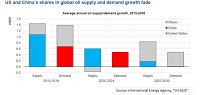
"When we look at oil market trends over the past decade, we see a remarkable double act: thanks to the shale revolution, the United States has accounted for 90% of oil supply growth worldwide, while 60% of the rise in global demand has come from China. But these dynamics are shifting," IEA Executive Director Fatih Birol said in a statement accompanying the 152-page report.
"Based on the fundamentals, oil markets look set to be well-supplied in the years ahead--but recent events sharply highlight the significant geopolitical risks to oil supply security. When it comes to energy security, there is no room for complacency," he added.
"Oil 2025" expects worldwide sales of electric vehicles to continue accelerating, despite the current U.S. administration's determination to withdraw federal funding from EVs and EV charging infrastructure. Global EV sales reached a record 17 million units in 2024, and the Paris-based energy agency sees that rising to over 20 million this year.
The rise in electric transportation has held oil demand growth in check in recent years. The IEA's current projection is that EVs will displace about 5.4 million BBL/d of global oil demand by the end of the decade. The replacement of oil with natural gas and renewables for power generation in the Middle East, particularly in Saudi Arabia, also is expected to hold down global oil demand growth in the coming years.
But the global petrochemical industry is poised "to become the dominant source of oil demand growth from 2026 onwards," the report said. By 2030, it forecast, that industry will consume one out of every six barrels of oil produced around the world. Since petrochemicals are mostly produced from non-refined products such as natural gas liquids (NGLs), these trends are set to increasingly impact the refining sector.
These strategic changes are expected to have a significant impact on the global petroleum refinery industry, the IEA said, predicting growth there will be "tepid." The report sees net refinery capacity gains far exceeding demand for refined products in 2030, which is likely to result in more capacity shutting down in the interim.
"The refining sector is set to be increasingly challenged by demand growth that is underpinned almost exclusively by petrochemicals produced from non-refined products such as NGLs," the oil report said. "Global refined products demand is projected to peak in 2027 at 86.3 million BBL/d, only 710,000 BBL/d above 2024 levels. Thereafter, accelerating declines in gasoline and diesel use outweigh growth in naphtha and jet fuel."
The IEA report estimated that about 4.2 million BBL/d of new refining capacity is expected to begin operating around the world by 2030, partly offset by approximately 1.6 million BBL/d of closures. "Net refining capacity growth is set to far exceed refined product demand, with increases in Asia, especially China and India, outpacing shutdowns in Europe and the United States," the IEA wrote. "This indicates that more capacity will have to shut, with high-cost plants in Europe and on the West Coast expected to be hardest hit."
Industrial Info Resources (IIR) is the leading provider of industrial market intelligence. Since 1983, IIR has provided comprehensive research, news and analysis on the industrial process, manufacturing and energy related industries. IIR's Global Market Intelligence (GMI) platform helps companies identify and pursue trends across multiple markets with access to real, qualified and validated plant and project opportunities. Across the world, IIR is tracking over 200,000 current and future projects worth $17.8 Trillion (USD).
/news/article.jsp
false
Want More IIR News Intelligence?
Make us a Preferred Source on Google to see more of us when you search.
Add Us On GoogleAsk Us
Have a question for our staff?
Submit a question and one of our experts will be happy to assist you.

Forecasts & Analytical Solutions
Where global project and asset data meets advanced analytics for smarter market sizing and forecasting.
Explore Our SolutionsRelated Articles
-
Cenovus Eyes Athabasca in Major Canadian Oil Sands ShakeupOctober 06, 2026
-
Louisiana Gets Hot with LNG Offtake DealsOctober 06, 2026
-
Europe To Keep Arctic Ban on Oil & Gas DrillingOctober 05, 2026
-
LNG Supports U.S. Energy Dominance, Army Corps SaysOctober 01, 2026
-
Trump Administration at Work to Offset Higher Commodity Pric...October 01, 2026

PECWeb Global Market Intelligence Platform
Identify opportunities, anticipate change, and execute with confidence. PECWeb connects the industrial intelligence you need, from projects and assets to operational events, all in one platform.
Discover PecwebIndustry Intel
-
North America Refining 2026: New Pipelines to PADD 5Podcast Episode / Oct 2, 2026
-
Biomanufacturing Onshoring 2026: GLP-1 Drives CapexPodcast Episode / Oct 2, 2026
-
2026 US Data Center Outlook: Power, Land & CoolingPodcast Episode / Sep 18, 2026
-
2026 Global Power Demand Outlook: Gas, Nuclear & RenewablesPodcast Episode / Sep 18, 2026
-
2026 Oil & Gas CapEx Outlook: Middle East, LNG & PermianPodcast Episode / Sep 4, 2026
