Industrial Manufacturing
California, China Face Different Odds Advancing Offshore Wind Manufacturing
California is gearing for one the world's biggest wind turbine component manufacturing and assembly projects in the world, while China leads in current, on-the-ground construction in the area.
Released Wednesday, November 04, 2026
Reports related to this article:
Written by Eric Funderburk for IIR News Intelligence (Sugar Land, Texas)
Summary
Despite the systematic dismantlement of the U.S. offshore wind industry, California's Port of Long Beach says it will proceed with a multibillion-dollar project to develop floating wind turbines, while current turbine-manufacturing construction is strongest in Asia and Europe.The Larger Picture
The global wind power sector has seen mixed success depending on geography. In the U.S., onshore wind is giving way to cheaper solar power, while the offshore wind sector has been subject to repeated headwinds from the second Trump administration, including billions of dollars' worth of lease buyouts and withdrawing permissions for offshore projects in all stages of development, including attempts to rescind permits from projects nearing the end of full construction.In contrast, Europe has supported and nurtured its wind sector much more, with sea-facing countries holding multiple competitive offshore auctions and the European Union funding (EU) various support schemes, such as its Innovation Fund that has supported wind manufacturing projects.
Globally, China very much takes the lead when it comes to wind power deployment, guided by national energy targets, state-directed planning and government investments. The Chinese government's support of its wind-manufacturing sector at one point prompted the EU to launch an investigation into the subsidies received by Chinese suppliers of turbines for potential unfair trade practices.
The Monster Project
Despite the ailing state of the U.S. offshore wind sector, one of the largest offshore turbine-manufacturing projects in the world is gearing up to take up place in a state that has repeatedly been at loggerheads with the Trump administration: California.That manufacturing project comes at the Port of Long Beach, where plans are taking shape to invest around $4.7 billion in both the manufacturing of offshore turbines as well as the deep-water berths, heavy-lift wharves and other port infrastructure needed to move massive turbine components out of the port to facilitate deployment.
This forward movement comes despite a chill that has been cast over the prospect of offshore wind in the U.S. after the repeated attempts by the Trump administration to delay or halt the offshore wind market. Many companies have taken a view that they cannot risk multibillion-dollar investments in 10+ year timeline projects that can be derailed on four-year U.S. presidential election cycles.
If it advanced, the Pier Wind Terminal project will manufacture components such as towers, blades and floating foundations, and will house areas for final assembly and deployment. A May 2026 article in the Los Angeles Times clearly points to the project moving forward with plans to roll out one to two turbines per week, each capable of generating 20 to 25 megawatts (MW).
The manufacturing of floating foundations is key to the facility, as offshore areas in California suitable for wind deployment are much deeper than in the Atlantic and must float rather than be fixed to the bottom. While the offshore wind sector on the West Coast of the U.S. hasn't attained the achievements seen in the Atlantic, California is playing a long game, with the state putting forward funding toward design and preconstruction work for the project, and other contributions coming from the port itself as arrangements for further financing are made. The long game view is that California is a large enough and relentless growing electricity market with limited energy sources and offshore wind will eventually be a commercially viable option if investors eventually shake-off concerns about federal roadblocks.
According to Industrial Info Resources data, the Pier Wind Terminal would be built in two phases, potentially kicking off construction in 2027 with an aim for the plant to begin full operations around 2035. Subscribers can access details of the project, including construction timelines, key contact details, and equipment and service needs, by clicking here.
Other Future Construction
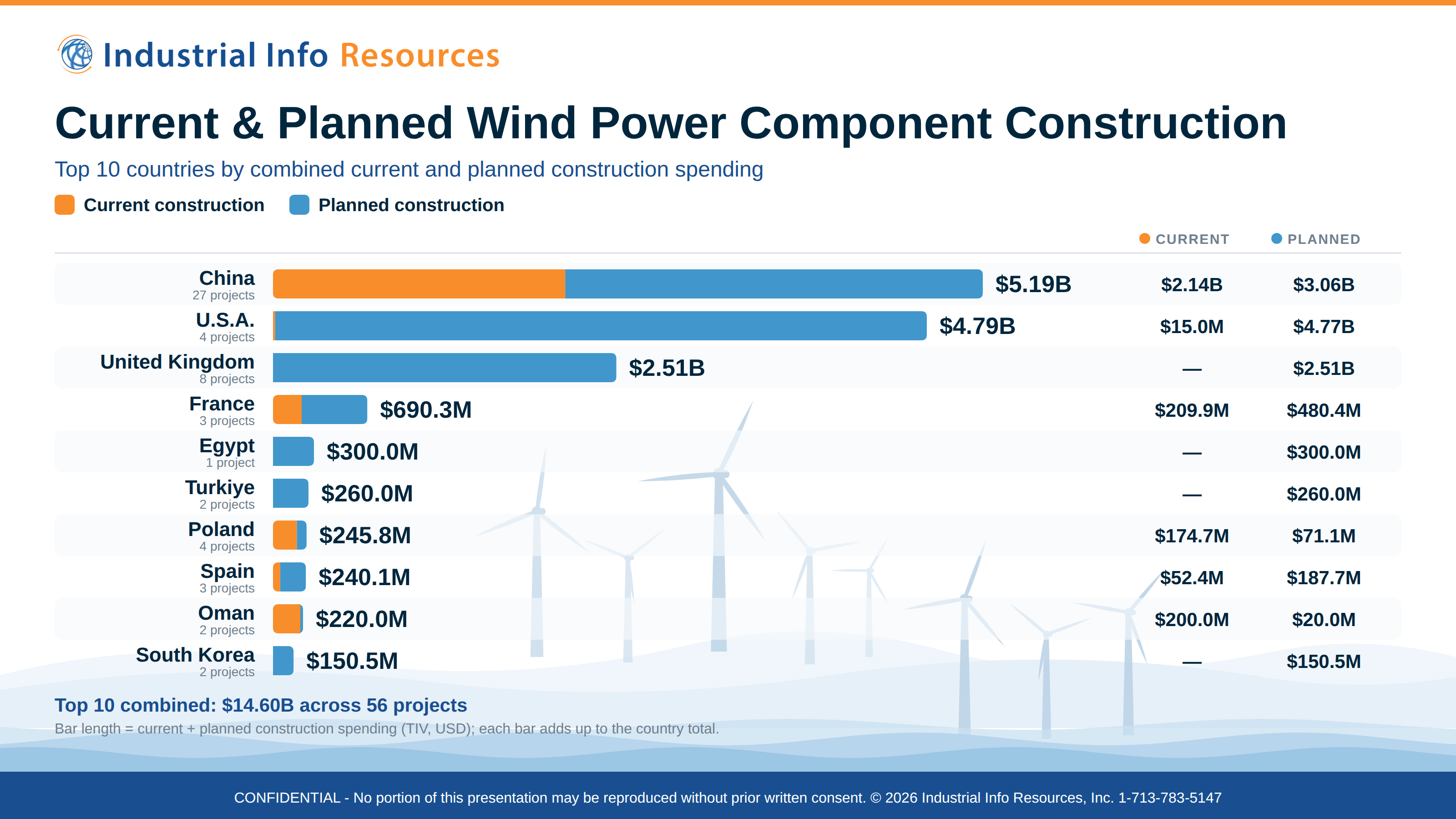
China ranks second in planned wind component manufacturing, with a particularly notable development taking shape at a port on the Tawain Strait in the Fujian province, where Tianshun Marine Engineering Equipment wants to manufacture and deploy heavy offshore wind equipment, including the steel lattice jacket foundations that support offshore turbines as well as offshore substations.A manufacturing project planned for the U.K. is facing major headwinds as it is being developed by a Chinese company, which is raising red flags over national security and trade issues from the national government.
A more likely European project candidate to move forward comes from the Grand Port Maritime de Marseille (Marseille Fos Port Authority) in the industrial-port zone of Fos-Sur-Mer, a project that has received considerable government support throughout its development. The Fos-Sur-Mer project has been narrowed in scope since its original inception and now is intended to focus on the manufacture of the foundations for floating wind turbines. The floating structures are necessary for wind deployment off France's Mediterranean coast, where the sea gets very deep relatively close to shore. The French government agreed to more than 82 million euros (US$91.8 million) in state support for the project.
Current Wind Manufacturing Buildout
Current wind power component manufacturing construction is dominated by China, particularly in the Zhejiang province on the East China Sea, where the first phase of a potential US$1.8 billion components-manufacturing project kicked off earlier this year.Within Europe, some of the strongest wind-component spending comes from Poland, which is actively trying to reduce the dominance of coal in its power mix, with wind very much part of the planning process. A recent report from the Paris-based International Energy Agency states Poland is aiming for between 15.8 and 16.5 gigawatts (GW) of onshore wind by 2030, up from around 11.2 GW currently. Offshore wind ambitions are even larger, targeting 5.9 GW of offshore production, up from nil in 2025.
The largest wind manufacturing project underway in the country comes from Spain's Windar Renovables, which is developing a 17-acre site at Szczecin, which provides port access to the Baltic Sea. After more than two years of construction, developers plan on the plant entering the commissioning phase in March 2027, when it will begin production of offshore towers up to 450 tons that can accommodate 14- to 16-MW turbines.
Key Takeaways
- Despite federal headwinds toward the wind industry, the Port of Long Beach in California is gearing up for a multibillion-dollar offshore wind manufacturing, assembly and deployment facility.
- China dominates the world for the value of current wind component construction, while Poland and France give Europe a notable position in wind manufacturing.
About Industrial Info Resources
Industrial Info Resources (IIR) is the leading provider of industrial market intelligence. Since 1983, IIR has provided comprehensive research, news and analysis on the industrial process, manufacturing and energy related industries. IIR's Global Market Intelligence (GMI) helps companies identify and pursue trends across multiple markets with access to real, qualified and validated plant and project opportunities. Across the world, Industrial Info Resources is tracking over 250,000 current and future projects worth $30.2 trillion (USD).
Want More IIR News Intelligence?
Make us a Preferred Source on Google to see more of us when you search.
Add Us On GoogleAsk Us
Have a question for our staff?
Submit a question and one of our experts will be happy to assist you.

Forecasts & Analytical Solutions
Where global project and asset data meets advanced analytics for smarter market sizing and forecasting.
Explore Our SolutionsRelated Articles
-
Major California Ports See Shift Away From China ExportsFebruary 20, 2026
-
Tariffs Hit Major California Port Cargo ActivityOctober 23, 2025
-
U.S. Wind Turbine-Manufacturing Projects Gain GroundMarch 22, 2024
-
Expansions Lead $5 Billion in U.S. Port Projects Under Const...December 07, 2023
-
Grassroot, Expansion Projects Lead $25.5 Billion in Active U...August 28, 2023

PECWeb Global Market Intelligence Platform
Identify opportunities, anticipate change, and execute with confidence. PECWeb connects the industrial intelligence you need, from projects and assets to operational events, all in one platform.
Discover PecwebIndustry Intel
-
Southern Cone Investment Radar: Argentina, Chile & UruguayPodcast Episode / Oct 30, 2026
-
Mining Capital Spending 2026: Copper, Rare Earths, AluminumPodcast Episode / Oct 23, 2026
-
Brazil Critical Minerals 2027: Rare Earths, Lithium, CopperPodcast Episode / Oct 16, 2026
-
US Craft Labor Outlook 2026: Wages, Per Diems, Data CentersPodcast Episode / Oct 16, 2026
-
Latin America Data Center Outlook 2026: Power, Hubs & GrowthPodcast Episode / Oct 9, 2026