Industrial Manufacturing
Data Centers Face 'Arc of Outrage,' But Consultant Has a Plan
Industrial Info Resources is tracking about $3 trillion of investment in 3,146 data center projects across the U.S., set to begin construction between January 2026 and December 2030
Released Monday, July 20, 2026
Editor's note: Paragraph 19 of this article has been corrected to reflect that New York Governor Kathy Hochul signed an executive order, not state legislation, pausing construction of data centers.
Written by John Egan for IIR News Intelligence (Sugar Land, Texas)
Summary
Popular resistance to data centers will get worse before it gets better, according to a consultant drawing on her years spent navigating Colorado's oil & gas "fracking wars." There are specific steps data center developers and Big Tech companies could do shorten and flatten what she calls the "arc of outrage," but so far, few data center enthusiasts appear to be listening.The Fracking Wars and Today's 'Arc of Outrage'
A decade ago, Colorado was convulsed by a long-running conflict over hydraulic fracturing and expanded oil & gas project activity. Energy industry plans to expand drilling using hydraulic fracturing were opposed by worried parents, agitated community activists, media-savvy environmental organizations, regulators and, in some cases, elected officials at the city, county and state levels. Lawsuits proliferated. For a while, each election had ballot initiatives, pro and con, on oil and gas drilling.Eventually a truce was reached. How the industry ended hostilities with its opponents in Colorado is highly applicable to today's fight over building data centers, Tisha Schuller, founder and president of consulting firm Adamantine Energy, told Industrial Info in an interview.
For five and a half years, from December 2009 through May 2015, Schuller had a front-row seat at the Centennial State's "fracking wars" as president and chief executive at the Colorado Oil & Gas Association (COGA), which represented oil & gas interests across the state. She distilled her lessons from that conflict into two books, "The Gamechanger's Playbook" and "Accidentally Adamant."
In a series of LinkedIn posts this summer, Schuller further distilled and applied her hard-learned lessons to the growing conflict over constructing data centers.
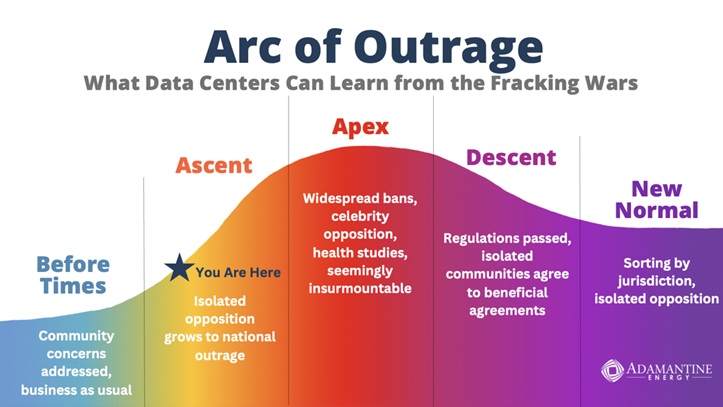
From personal observation, and from closely following energy projects around the country that triggered local opposition, she created the "Arc of Outrage" idea and graphic to show the steps an industry goes through when it is trying to build something new and unfamiliar to the public.
Fear Drives the 'Arc of Outrage'
The "Arc of Outrage" shows the predictable, distinct stages a conflict moves through. She said she has observed similar trajectories over construction of various types of energy projects, such as carbon dioxide pipelines; carbon capture, utilization & storage (CCUS) projects; windfarms; and other energy projects in Colorado and across the U.S.Resistance to proposed data centers has morphed from isolated local opposition to national outrage, she said. That puts the data center industry in the "Ascent" stage. The next stage will feature widespread bans and celebrity opposition.
Writing to data center developers, Big Tech companies and electric utilities, one post said, "If you don't know how to navigate the Arc, your projects are more likely to stall, shrink, relocate or die. And your company's reputation with them." The problem, she said, is that business leaders' likely will be betrayed by their instincts.
"Board members and executives should not assume those who oppose them are irrational or professional," she told Industrial Info Resources. "They need to reorient their thinking to understand the authenticity and fear driving opponents. You can't sit in a three-hour community meeting on data centers and not have your thinking changed. Moms and schoolteachers are genuinely freaked out by data centers."
Often, business leaders try to "out-fact" their critics, but Schuller said that facts, while important, have to come later. First, there needs to be more listening. "Go to community meetings and listen, really listen, to what is being said. Listen for the purpose of understanding." She did that when she led COGA, traveling across Colorado to sit in public meetings and engage in dialogue with concerned attendees.
Data center advocates need to develop facts to support their proposed projects, but facts will fail to make the desired impression until advocates find a way to build a relationship with those who oppose data centers, she cautioned.
Sector Still Vibrant, but Cancellations and Delays Rise
While the pace of proposed data center construction is extraordinary, even unprecedented, some cracks have started to appear in the form of project cancellations or delays.According to Industrial Info Resources data, Big Tech companies and data center developers plan to invest about $3 trillion to begin construction on 3,146 data center projects across the U.S. between January 2026 and December 2030. The states with the greatest dollar value of proposed data center construction over this five-year period are Texas, Virginia, Ohio and Georgia. For more on that, see July 7, 2026, article - Money, Votes and Data Centers: Will Political Spending Overcome Rising Public Opposition to Data Centers?
Over that same five-year timeframe, 353 proposed U.S. data center projects, valued at about $205 billion, have been canceled or placed on hold. The states with largest number of delayed or canceled projects are Virginia, Georgia, Minnesota and Illinois. Most of these projects--286 valued at an estimated $152 billion--have been canceled outright.
Texas, the nation's leader in scheduled data center construction, has canceled 12 projects and placed two on hold. Industrial Info Resources is tracking all 353 projects canceled or placed on hold; readers can learn more from a detailed list of project reports.
Industrial Info Resources does not believe that all 3,146 proposed data center projects will begin construction as planned. Neither do we believe that all of the project cancellations or delays were caused solely by public opposition. There remains a long and still-kinked supply chain for critical equipment, including turbines, for utilities as well as data centers that wish to self-generate their electricity.
Plus, the arms race to build data centers has caused a runup in chip prices, which could undermine the economic viability of some projects. Awarding a local project to one firm could cause competitors to pull out. Some of the project cancellations and delays are an expected shakeout as an industry moves through the "gold rush" phase of development.
But popular resistance to data centers is mounting. More than a dozen states, and more than 100 cities and counties, are considering pauses of varying lengths on construction of new data scenters, according to organizations that track data-center construction plans. In states led by Republicans and Democrats alike, the public has turned on plans to build data centers, with an estimated 70% opposing building them in their communities. A year ago, opposition was about half that.
"The fight will get worse before it gets better," Schuller predicted in her interview with Industrial Info. The day after the interview, New York State Governor Kathy Hochul (D) signed a first-in-the-nation executive order pausing construction of data centers exceeding 50 megawatts (MW) for up to one year while the state's regulatory bodies work through various energy, water, environmental and other issues surrounding data centers. Her executive order was actually less stringent than a bill passed by the state legislature last month, which would have paused construction of data centers larger than 20 MW. The governor has until the end of the year to sign or veto the bill. For more information, see June 6, 2026, article - New York Lawmakers Pass One-Year Permitting Ban for New Data Centers.
By the Numbers
- 3,146: Number of proposed U.S. data centers, valued at about $3 trillion, that are scheduled to be built between January 2026 and December 2030.
- 351: Number of proposed data centers in the U.S. that have been canceled or postponed that were scheduled to be constructed during that five-year period. The value of those projects is about $250 billion.
- 70%: The percentage of people surveyed who opposed construction of a data center in their community, according to one poll, a level that had nearly doubled in one year.
A Way to Shorten and Flatten the Arc of Outrage
How can companies keep their data center projects alive? Schuller pointed to the July 13 announcement from Facebook parent Meta that the tech giant and Richland Parish, Louisiana, reached an agreement under which Meta will double the size of its planned hyperscale data center, to about 5,000 megawatts, and schoolteachers will receive a 400% increase in bonuses, up to $50,000.The statement from Meta also said the Richland Parish Data Center has awarded more than $1.6 billion in work to local contractors since first breaking ground in December 2024. The data center expansion will result in more than $1 billion of new investment in local infrastructure improvements, including roads, water and wastewater systems. In a community of 20,000 people, the data center will provide more than 1,000 roles once it is operational.
"That approach, creating shared value with the community, creates goodwill and can turn opponents into proponents--and that, in turn, can give local elected officials cover for approving data centers," Schuller told Industrial Info. "Elected officials need to be able to point to a tangible sharing of benefits with the community that can be defended in the public sphere before they will approve plans to build large data center campuses."
"It takes political courage to defend data centers because there can be consequences," she continued. "It does not take political courage to oppose them."
There are a variety of ways to shorten and dampen the "Arc of Outrage," and she doesn't necessarily think Meta's example is the only one worth following. But the essence of it, authentically engaging with stakeholders and find ways to share the benefits with affected stakeholders, should constitute a foundation.
"There are no cookie-cutter solutions, but time is short," she said. "Local elected officials across the country stand for election in four months. There's no time to waste."
Key Takeaways
- Data center development is caught up in a popular "Arc of Outage" that threatens to stall scheduled construction.
- A growing number of data center projects have been delayed or canceled, not all of which can be traced to local opposition.
- Companies can keep their projects alive by earnestly listening to the concerns of opponents and find a way to share the benefits of a proposed data center with the affected stakeholders.
About Industrial Info Resources
Industrial Info Resources (IIR) is the leading provider of industrial market intelligence. Since 1983, IIR has provided comprehensive research, news, and analysis on the industrial process, manufacturing, and energy-related industries. IIR's Global Market Intelligence (GMI) helps companies identify and pursue trends across multiple markets with access to real, qualified, and verified plant and project opportunities. Across the world, Industrial Info Resources is tracking over 250,000 current and future projects worth $30.2 trillion (USD).
/news/article.jsp
false
Want More IIR News Intelligence?
Make us a Preferred Source on Google to see more of us when you search.
Add Us On GoogleAsk Us
Have a question for our staff?
Submit a question and one of our experts will be happy to assist you.

Forecasts & Analytical Solutions
Where global project and asset data meets advanced analytics for smarter market sizing and forecasting.
Explore Our SolutionsRelated Articles
-
Blackstone Upbeat on Long-Term Outlook for U.S. Data CentersOctober 23, 2026
-
Roofing Materials Production Drives Multiple U.S. Constructi...October 22, 2026
-
ABB Builds Backlog with Canadian Mining, U.S. Tech WorkOctober 21, 2026
-
Argentina y Brasil lideran los cinco principales proyectos d...October 21, 2026
-
U.S. Data Center Construction Starts Still Soaring Despite S...October 20, 2026

PECWeb Global Market Intelligence Platform
Identify opportunities, anticipate change, and execute with confidence. PECWeb connects the industrial intelligence you need, from projects and assets to operational events, all in one platform.
Discover PecwebIndustry Intel
-
Brazil Critical Minerals 2027: Rare Earths, Lithium, CopperPodcast Episode / Oct 16, 2026
-
US Craft Labor Outlook 2026: Wages, Per Diems, Data CentersPodcast Episode / Oct 16, 2026
-
Latin America Data Center Outlook 2026: Power, Hubs & GrowthPodcast Episode / Oct 9, 2026
-
Food and Beverage CapEx Outlook 2026: Tariffs, AI, AfricaPodcast Episode / Oct 9, 2026
-
North America Refining 2026: New Pipelines to PADD 5Podcast Episode / Oct 2, 2026