Industrial Manufacturing
Investment in U.S. Solar Manufacturing is Alive and Well
Industrial Info Resources is tracking $19 billion worth of capital-spending projects across the U.S. related to manufacturing solar panels and their components, which comes as the newly elected Democratic majority in Congress could boost solar development.
Released Thursday, November 12, 2026

Reports related to this article:
Written by Danny Levin, Deputy Editor for IIR News Intelligence (Sugar Land, Texas)
Summary
Industrial Info Resources is tracking $19 billion worth of capital-spending projects across the U.S. related to the manufacturing of solar panels and their components, which comes as the newly elected Democratic majority in Congress could boost solar development.State of U.S. Solar Development Post-Midterm Elections
Industrial Info Resources data show 34 active and planned capital-spending projects, worth $19 billion, across the U.S. related to the manufacturing of solar panels (also known as solar modules) and their components. The activity, which is buoyed by projects in Texas, comes as a new Democratic majority in Congress could streamline and speed permitting to boost the development of solar power.This includes protecting tax credits from being repealed and accelerating utility-scale projects. But Democratic lawmakers and industry trade groups have differing opinions on a piece of bipartisan legislation--introduced in September--that could have an impact: Although the Bipartisan American Affordability and Jobs Act (BAAJA) would not directly provide funds for the construction of solar-power plants, it includes, but is not limited to:
- Reforming and shortening federal permitting and environmental review timelines for a wide swath of energy-related projects, including solar power
- Shielding approved projects from losing their permits
- Speeding up the construction of power lines
It also would require regional grid operators to offer an option for fixed-fee interconnection, which could ease queues that have a backlog of solar projects. It also would require data centers to pay for their own grid infrastructure, such as transmission.
The first vote on November 9 passed a key hurdle in the U.S. Senate. There is not yet a companion piece of legislation in the House--although that can be accomplished quickly if the House takes up the identical bill.
Although some lawmakers believe a better deal can be reached once the Democratic majority is in session, the architects have said they would not postpone the bill.
"This is the closest we have come to actually finding something that can get signed into law," Senator Martin Heinrich (D) of New Mexico said in a statement to Reuters. House Minority Leader Hakeem Jeffries on November 5 said he would oppose the bill in its current form, although the authors have since amended the legislation to seemingly address some concerns.
Although it supports permitting reform, Jeffries said the bill "falls short in several areas, including the manner in which NEPA [National Environmental Policy Act] reform is undertaken and the failure to adequately protect tribal sovereignty."
Trade group The Solar Energy Industries Association (SEIA) has applauded the bill, estimating it would provide more net solar capacity additions from 2028 to 2035 when compared with current law, and increase solar's share of electricity generation to 18.1% by 2035.
For more information on the state of U.S. solar development, see October 26, 2026, article--U.S. Solar Power Development has Soared in Trump 2.0, But Wind Has Fallen Off.
According to the SEIA, operational U.S. solar module manufacturing capacity sits at 75.3 GWdc (gigawatts of direct current), covering approximately 176% of projected 2026 demand. And manufacturers are looking to build more capacity.
GWdc refers to the maximum potential output of a solar system.
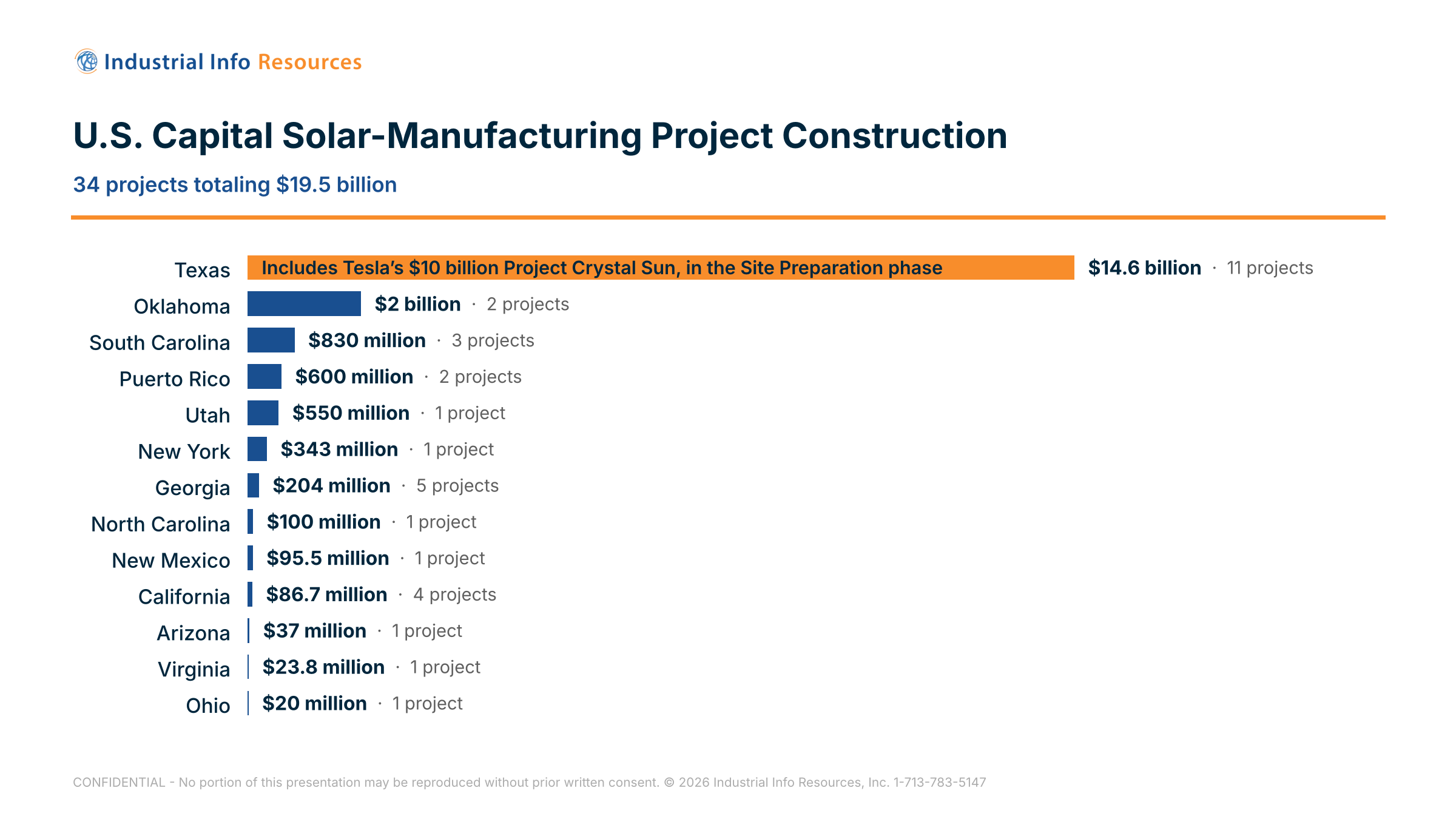
U.S. Solar Manufacturing
One factor that could affect the market environment for solar panels is the White House's August executive order placing 15% tariffs and import price floors on imported polysilicon derivative products (ingots, wafers, cells and modules). This supports crystalline silicon solar panels, which, according to the U.S. Environmental Protection Agency, account for more than 95% of all U.S.-sold panels.This is an effort to reduce overreliance on foreign countries, notably China, although raw polysilicon is exempt from the tariff and is subject strictly to minimum import prices; the White House notes domestic share of global production capacity sits at less than 2%.
Skeptics note the efforts would drive higher costs, which could reduce demand for solar.
For more information, see August 10, 2026, article - Trump Places Tariffs on Key Material for Solar Panels, Semiconductors.
But the largest U.S.-based solar manufacturer--First Solar--does not use crystalline silicon in its panels and does not depend on China's solar supply chains. Still, in the company's October 29 third-quarter earnings call, Chief Executive Officer Mark Widmar said the Section 232 tariff "represents a meaningful shift for U.S. solar manufacturing."
Industrial Info Resources is tracking about 140 solar power projects across the U.S. that are scheduled to use First Solar's technology, valued collectively at about $46 billion.
Widmar expects nearly 80% of the company's global solar module manufacturing will be in the U.S. by 2027: "Long-term demand fundamentals also remain strong. AI-related infrastructure, electrification, and the onshoring of U.S. manufacturing are driving significant load growth."
"Customers are focused on advancing mid- and late-stage projects where modules have already been secured, while deferring procurement on early-stage projects requiring delivery later in the decade," due to several factors, including data center pushback from residents and state and local governments.
Capital Projects on the Rise, especially in Texas
Widmar said the company is bringing its Series 6 module-manufacturing plant in Gaffney, South Carolina, online in two phases. The first phase started production in the third quarter, while the second phase is expected to reach "commercial launch" in mid-2027. The plant has a planned yearly production capacity of 3.4 gigawatts (GW) once fully operational. Subscribers can learn more from a detailed project report.But Texas leads all states in the total investment value for solar manufacturing. This includes construction of fully integrated plants, as well as those producing specific components. This includes solar cells--an upstream component that serves as the final component of solar modules. Solar modules and solar panels often are used interchangeably, referring to a pre-assembled unit of cells used to provide power.
The project activity is buoyed by "Project Crystal Sun," which is Tesla's grassroot, $10 billion integrated solar cell and panel manufacturing plant in Fort Bend County, Texas, outside of Houston, where preliminary site work is underway. Commercial operations are targeted for 2029. View the project report here.
In late October, SEG Solar said it secured land for its planned 4-GW heterojunction technology (HJT) module plant in Tomball, also in the Greater Houston area. The plant is planned to come online in two, 2-GW phases, targeted for 2028 and 2029; see project reports for Phase I and Phase II.
The plant is adjacent to the company's 4-GW HJT module-manufacturing plant, which is under construction and targeted for completion next year.
HJT solar cells combine two different technologies into one cell: a crystalline silicon cell sandwiched between two layers of amorphous "thin-film" silicon. This results in a couple of layers of thin-film solar that absorb extra photons, not typically captured by the middle crystalline silicon wafer of more traditional solar panels. They can be cheaper to produce and more flexible in design, often with a higher efficiency than typical panels.
Also underway is construction of T1 Energy's "G2 Austin," an estimated $850 million, multi-phase solar cell manufacturing plant in Rockdale, in Milam County. Construction kicked off in December 2025, with the first phase (2.1 GW) expected to begin production in first-quarter 2027; a subsequent expansion would follow.
The full project is designed for roughly 5 GW of capacity. Subscribers can view more information on the initial construction and expansion.
The GMI Project and Plant databases offer a full list of detailed reports for projects mentioned in this article, and a full list of related plant profiles.
View a full list of active and planned capital-spending projects across the U.S. aimed at manufacturing solar panels and their components.
Key Takeaways
- $19 billion: Total value of projects across the U.S. aimed at manufacturing solar panels and their components, most of which is in the pre-construction stages and located in Texas.
- The newly elected Democratic majority in Congress could boost solar development.
About Industrial Info Resources
Industrial Info Resources (IIR) is the leading provider of industrial market intelligence. Since 1983, IIR has provided comprehensive research, news and analysis on the industrial process, manufacturing and energy related industries. IIR's Global Market Intelligence (GMI) helps companies identify and pursue trends across multiple markets with access to real, qualified and validated plant and project opportunities. Across the world, Industrial Info Resources is tracking over 250,000 current and future projects worth $30.2 trillion (USD).
Want More IIR News Intelligence?
Make us a Preferred Source on Google to see more of us when you search.
Add Us On GoogleAsk Us
Have a question for our staff?
Submit a question and one of our experts will be happy to assist you.

Forecasts & Analytical Solutions
Where global project and asset data meets advanced analytics for smarter market sizing and forecasting.
Explore Our SolutionsRelated Articles
-
Projects Under Construction Drive $58 Billion in U.S. Batter...November 05, 2026
-
Austin, Texas, Area Dominates U.S. Robotics-Manufacturing Co...November 03, 2026
-
U.S. Reaches Historic Solar Module Production CapacityOctober 31, 2025
-
U.S. Forms Nuclear Strategic Partnership with Private SectorOctober 30, 2025
-
Major U.S. Solar Cell Plant to Start Construction This YearAugust 25, 2025

PECWeb Global Market Intelligence Platform
Identify opportunities, anticipate change, and execute with confidence. PECWeb connects the industrial intelligence you need, from projects and assets to operational events, all in one platform.
Discover PecwebIndustry Intel
-
Global Chemical Industry Outlook 2026: Ethylene, Hydrogen, CapExPodcast Episode / Nov 6, 2026
-
Southern Cone Investment Radar: Argentina, Chile & UruguayPodcast Episode / Oct 30, 2026
-
Mining Capital Spending 2026: Copper, Rare Earths, AluminumPodcast Episode / Oct 23, 2026
-
Brazil Critical Minerals 2027: Rare Earths, Lithium, CopperPodcast Episode / Oct 16, 2026
-
US Craft Labor Outlook 2026: Wages, Per Diems, Data CentersPodcast Episode / Oct 16, 2026