Industrial Manufacturing
Europe Leads Global Spending for Railcar Production, Maintenance Facilities
Capital construction investments for railcar maintenance and repair facilities help propel Europe to the top of the list when it comes to railcar-related spending.
Released Wednesday, October 28, 2026
Reports related to this article:
Project(s): View 5 related projects in PECWeb
Plant(s): View 4 related plants in PECWeb
Written by Eric Funderburk for IIR News Intelligence (Sugar Land, Texas)
Summary
Europe takes a leading spending role for railcar plant construction, with three of the biggest construction projects related to railcar maintenance and repair facilities.European Strength
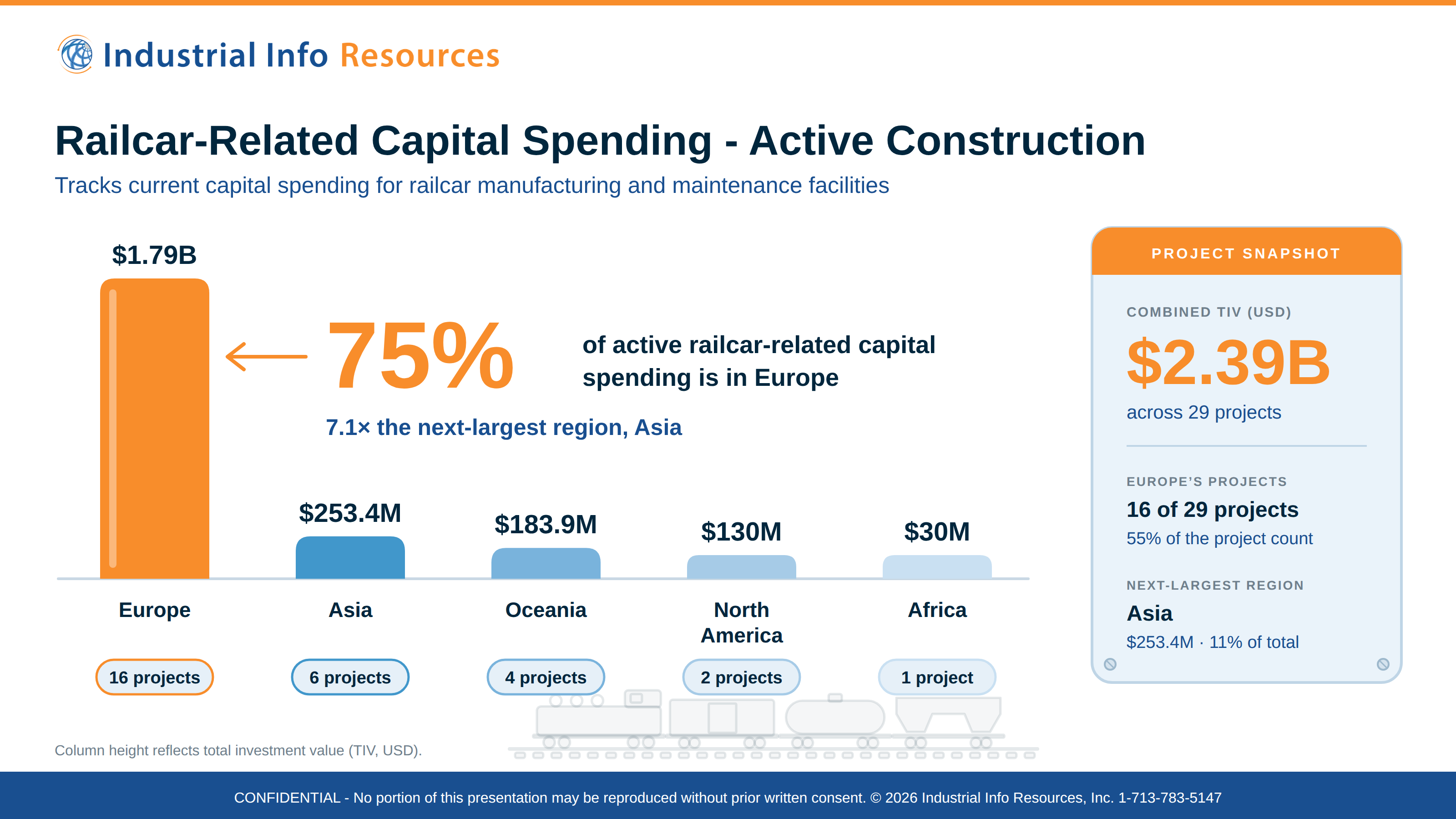
Europe's rail sector is big. Very big, and very important for millions of European residents and visitors as well as substantial movement of freight. A May 2026 report from Eurostat, the statistical arm of the European Union (EU), states that EU rail passengers made 8.7 billion trips in 2024, accounting for 444.5 billion passenger kilometers (276.2 billion passenger miles). Other European countries outside of the EU, including Britain, have their own rail networks, netting more European trips and miles. And that's not taking into account freight transport by rail, which Eurostat recently pegged at 368.2 billion tonne-kilometers (228.8 billion tonne-miles) traversed within the EU in 2025.And backing this up, of course, is Europe's rail fleet itself, accounting for around 835,000 rolling stock vehicles in mid-2024, comprising 635,000 freight wagons, 45,000 passenger coaches as well as other traction and special vehicles, according to EU statistics. It's no wonder that of the US$2.4 billion worth of current railcar-related construction that Industrial Info Resources data show, about 75% of this is occurring in Europe for both railcar manufacturing and maintenance facilities.
Maintenance Facilities
With such a big fleet to maintain, it's perhaps not a surprise that Europe's largest railcar-related construction projects are geared toward railcar maintenance facilities. Germany and Switzerland feature particularly prominently for their current spending in this sector.The Swiss Railways Federation is heading up a major grassroot construction project in the form of a new maintenance facility in Ticino for the country's electric train fleet and locomotives. The new facility will replace an existing maintenance, repair and overhaul (MRO) facility in Bellinzona with a modern plant to maintain the updated electric fleet. In a scope of the some of the project's specifications, the Swiss Railways Federation said the plant will be able to maintain 110 electric train sets and 40 locomotives at any one time. Contractors plan to wrap up construction by mid-2028. Subscribers can access details of the project, including construction timelines, key contact details, and equipment and service needs, by clicking here.
Germany's state-owned national railway group Deutsche Bahn is heading up two substantial projects for maintenance facilities to service the country's Intercity-Express (ICE) high speed electric passenger train fleet--one project a new facility on a brownfield site and the other an expansion of a heavily utilized existing facility in Cottbus that includes a new maintenance hall expected to enter service in the near future.
Together, Industrial Info Resources pegs the combined total investment value of construction of the three German and Swiss maintenance facilities at slightly less than US$1.5 billion.
Railcar Manufacturing
Railcar manufacturing is less prominent in EU construction; however, EU-adjacent Turkey and the United Kingdom are home to substantial railcar-manufacturing investments. Turkey is hoping to reduce its reliance on imported railcars with the substantial expansion of a state-owned manufacturing facility in Sakarya. The expanded plant will target the manufacture, assembly and testing of a more advanced electric train fleet that will be reportedly be able to reach speeds of up to 225 kilometers per hour (km/h) (140 miles per hour (mph)), versus the plant's current capability of trainsets that top out around 160 km/h (100 mph).While the Turkish, German and Swiss projects all come under the auspices of state-owned rail companies and groups, the U.K. provides a somewhat different picture as private Germany-based manufacturer Siemens Mobility enters the picture with the ongoing phased construction of its manufacturing campus in Goole, East Yorkshire. The complex, which has been producing trains for a few years now, is especially focused on car production for the London Underground's Piccadilly Line, and at the moment Siemens is just wrapping up final work extending the plant's capacity and offerings, with the aim of producing three to four trainsets per month. Industrial Info Resources has been reporting on plans and development of the site since 2018, and currently pegs the fourth and final phase of construction as wrapping up by the end of this year.
Other railcar-manufacturing projects are dotted throughout the world, with Australia gearing up for a new grassroot manufacturing plant in Queensland as well as substantial expansions and renovations to a diesel locomotive and railcar plant in Bryansk, Russia, that are expected to last into 2028, according to the project report updated last month in Industrial Info Resources' Global Market Intelligence (GMI) Industrial Manufacturing Project Database.
Key Takeaways
- Europe leads the world head and shoulders when it comes to current construction investments in railcar-related facilities.
- Substantial spending for railcar maintenance facilities is led by Germany and Switzerland.
- Spending for manufacturing plays a lesser role in EU construction, but is notable in EU-adjacent Turkey and the U.K. as well as Russia.
About Industrial Info Resources
Industrial Info Resources (IIR) is the leading provider of industrial market intelligence. Since 1983, IIR has provided comprehensive research, news and analysis on the industrial process, manufacturing and energy related industries. IIR's Global Market Intelligence (GMI) helps companies identify and pursue trends across multiple markets with access to real, qualified and validated plant and project opportunities. Across the world, Industrial Info Resources is tracking over 250,000 current and future projects worth $30.2 trillion (USD).
/news/article.jsp
false
Want More IIR News Intelligence?
Make us a Preferred Source on Google to see more of us when you search.
Add Us On GoogleAsk Us
Have a question for our staff?
Submit a question and one of our experts will be happy to assist you.

Forecasts & Analytical Solutions
Where global project and asset data meets advanced analytics for smarter market sizing and forecasting.
Explore Our SolutionsRelated Articles
-
Genex's Kidston Project in Australia Awaits Final Investment...September 08, 2020
-
New Dynamics Unfold for Australia's Renewable Energy Generat...February 11, 2019
-
Springsure Creek Coal Mine Project Receives Green Light from...December 05, 2013

PECWeb Global Market Intelligence Platform
Identify opportunities, anticipate change, and execute with confidence. PECWeb connects the industrial intelligence you need, from projects and assets to operational events, all in one platform.
Discover PecwebIndustry Intel
-
Mining Capital Spending 2026: Copper, Rare Earths, AluminumPodcast Episode / Oct 23, 2026
-
Brazil Critical Minerals 2027: Rare Earths, Lithium, CopperPodcast Episode / Oct 16, 2026
-
US Craft Labor Outlook 2026: Wages, Per Diems, Data CentersPodcast Episode / Oct 16, 2026
-
Latin America Data Center Outlook 2026: Power, Hubs & GrowthPodcast Episode / Oct 9, 2026
-
Food and Beverage CapEx Outlook 2026: Tariffs, AI, AfricaPodcast Episode / Oct 9, 2026