Power
Global Renewable Electric Capacity Additions Dip in 2026, Expected to Surge Over 2027-2031
The world is projected to add about 4,770 gigawatts of renewable electric generating capacity over 2026-2031, about 57% more than was added over the 2020-2025 period.
Released Friday, November 13, 2026
Written by John Egan for IIR News Intelligence (Sugar Land, Texas)
Summary
The world is projected to add about 4,770 gigawatts of renewable electric generating capacity over 2026-2031, about 57% more than was added over the 2020-2025 period, according to a new report on renewables from the International Energy Agency (IEA).Global Outlook for Renewables
Around the world, nearly 4,800 gigawatts (GW) of new renewable electric generation is expected to come online over the 2026-2031 period, bringing global installed capacity to over 9,710 GW by 2031, according to a new report from the International Energy Agency (IEA). Solar photovoltaic (PV) is expected to account for over 75% of this growth.The IEA report, Renewables 2026: Analysis and Forecasts to 2031, released November 6 in advance of the United Nations annual climate summit, projected that global annual renewable electric capacity additions will average nearly 800 GW per year over the six-year forecast period. That's 57% higher that the agency's 2020-2025 average.
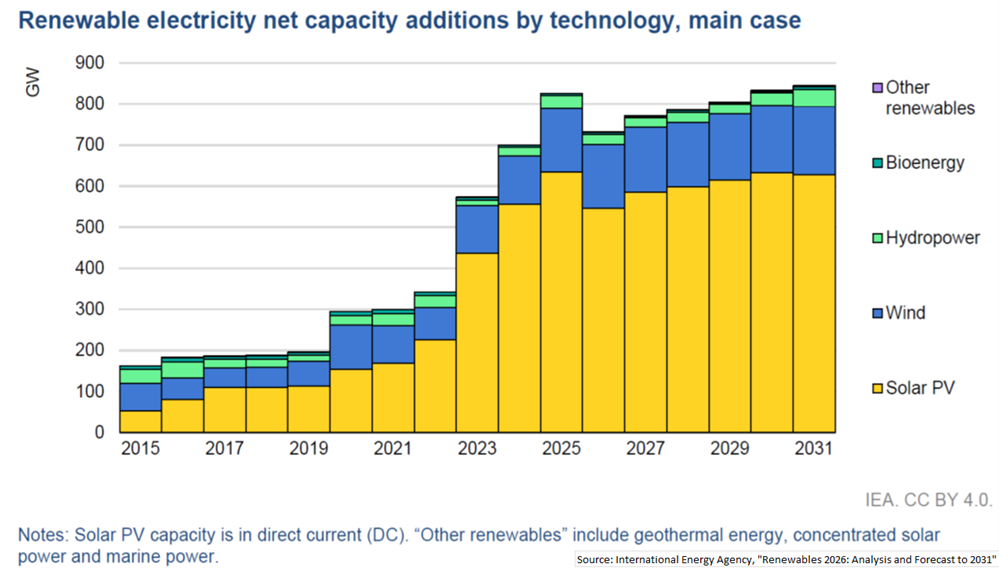 This long-term global outlook includes an 11% decline in renewable capacity additions in 2026, which would end 21 consecutive years of record additions, the IEA said. Adverse changes in the China market significantly cut that country's capacity additions this year, but declines in that country were partly offset by strong growth elsewhere. Going forward, China's growth is expected to slow markedly from prior years. Changes that took place in 2026 will lead to slower growth going forward in the world's largest renewables market.
The energy agency predicted that growth in emerging and developing economies (EMDEs) outside China will equal growth in advanced economies for the first time. In the U.S., renewables, led by solar photovoltaic generation, is expected to surge in 2026 and 2027 as developers race to build generation that captures sunsetting federal tax credits. Over the six-year forecast period, India is expected to become the world's second-largest growth market after China.
The new report said energy security, driven by wars in the Middle East and Europe, combined with growing competitiveness of renewable generation, were the main reasons for the continued strong growth of renewable electric capacity.
"Previously, environmental concerns were the policy priority behind the growth of renewables, whose falling costs have made them a competitive option in many markets," said IEA Executive Director Fatih Birol. "But today, it's mainly energy security that is driving renewables' expansion, as more and more countries seek to reduce their exposure to imported fuels."
"The new chapter of the renewables' growth story is a truly global one as their deployment spreads well beyond major markets into every corner of the world. This is making them a key pillar of the global power sector."
Globally, about 43% of worldwide electricity is expected by be generated by renewables by the end of 2031, an increase from 33% in 2025, the agency forecast.
Near-Term Growth Expected to Surge in U.S.
Compared to last year's renewables report, this year's outlook for the U.S. has been revised upward by nearly 40%, mainly due to stronger solar PV deployment. This year's report noted that solar PV plus battery energy storage systems can be installed as a package relatively quickly to meet fast-growing electricity demand, including from data centers.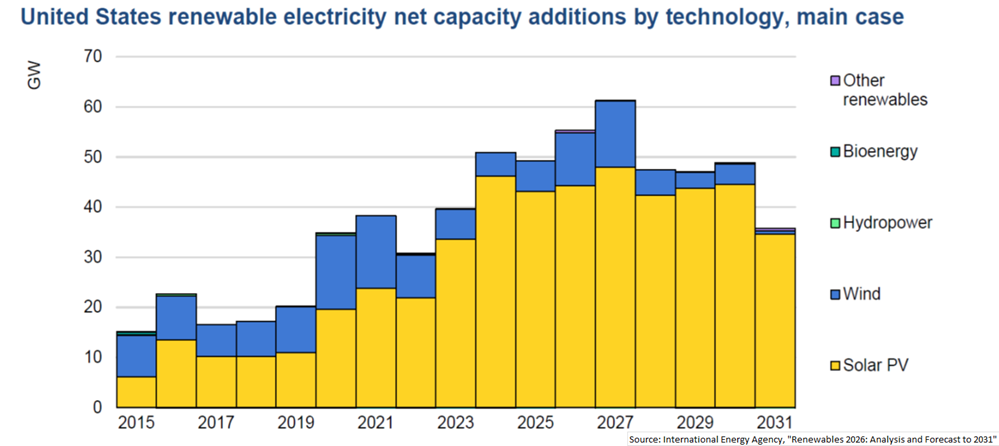 "Rapidly rising electricity demand from data centers" the agency noted in its report, is driving the growth of renewable generation in the U.S. "Solar PV technologies can bring new generation online very quickly while supply-chain constraints continue to delay gas turbine availability," it added.
Federal Clean Energy Production Credits for solar and wind are sunsetting, and developers are racing to complete projects to be eligible to secure those credits. Construction of new solar or wind generation either needed to be started by July 4, 2026, or be placed in service by the end of 2027, in order to be eligible for these tax credits.
In the U.S., solar and wind generation is expected to grow about 56 GW this year and 62 GW the next before slowing to an annual average of about 48 GW for the 2028-2030 period. In 2031, capacity additions are seen as falling to about 35 GW.
By the Numbers
- 800: The average annual amount, in gigawatts, of new renewable electric generation that is expected to begin operating over the 2026-2031 period.
- 4,770: The amount, in gigawatts, of new renewable electric generating capacity expected to come online between 2026 and 2031
- 43: The percentage of global electricity that will be generated by renewable technologies by yearend 2031, an increase from 33% in 2025
China's Expansion Falls, Then Grows Slowly
In 2025, the report said, China changed the way it supported renewable energy, shifting to a competitive auction from a fixed-price approach. That weakened the economics of renewable energy, leading to a wave of corporate bankruptcies; reduced manufacturing of solar cells and inverters; and lower levels of deployment in China itself.For the first nine months of 2026, Chinese solar PV additions were almost 55% lower than the comparable year-earlier period.
China's reduced production of solar panels, inverters and other renewables equipment could have a global impact, as China is still the world's dominant producer of solar technologies.
"China's global dominance of solar PV supply chains persists amid high financial strains and mounting bankruptcies," the report noted. It added that over 90% of major Chinese solar PV manufacturers have reported losses in 2026, and more than 70 companies have filed for bankruptcy since 2024, as overcapacity and falling prices have eroded margins. "Despite this industry turmoil, solar PV supply chains remain highly concentrated in China at every stage, from polysilicon to modules," it observed.
Wind capacity additions are expected to slow in China in 2026, but much less sharply than solar PV, as the commissioning of large-scale projects partly cushions the impact of recent policy reforms, the renewables report said. Faster wind deployment in Europe and the United States offsets China's slowdown, leaving global wind capacity additions broadly unchanged from last year's renewables report.
Rapid Expansion See in India and Other EMDEs
Aside from China, the 261-page IEA report said, worldwide annual renewable electric capacity additions are forecast to increase 27% between 2026 and 2031, mainly in emerging markets and developing economies (EMDEs) as strong policy momentum and growing energy security concerns accelerate deployment.Led by solar PV, annual renewable capacity additions across India, the Association of Southeast Asian Nations (ASEAN), sub-Saharan Africa, Latin America, the Middle East and North Africa (MENA) and Eurasia are projected to match those of advanced economies over the forecast period for the first time.
The IEA report noted that its outlook for renewables in India has been revised upward since last year's report, but the trends vary across technologies. Solar PV drives stronger overall growth, supported by rapid recent deployment; a large pipeline of awarded projects; and expanding uptake of rooftop systems backed by policy support. Pumped-storage hydropower also is gaining momentum thanks to "more efficient administrative processes and an expanding project pipeline," the IEA wrote.
On the other hand, the report said Indian onshore wind "is losing ground amid weaker deployment, limited auction volumes and increasing competition from solar PV paired with storage."
"India's robust growth continues to benefit from a decade of proactive policy support that has partly cushioned the electricity sector from the impacts of the energy crisis," the IEA wrote. "In both the ASEAN and sub-Saharan African markets, dual drivers underpin growth: first, some governments introduced more ambitious renewable energy targets following the Middle East (war); second, others adopted measures to accelerate the implementation of previously announced targets."
India is emerging "as an important source of diversification" in the solar power supply chain, the report said, partly offsetting a slowdown in China's production.
Key Takeaways
- Global renewable electric capacity additions are expected to fall 11% in 2026, largely the result of changes in the Chinese market, according to a new report from the International Energy Agency.
- However, the report, strong growth elsewhere is partly offsetting declines in Chinese capacity additions.
- Over the 2026-2031 period, worldwide renewable electric capacity additions are expected to grow a total of 4,770 gigawatts.
- By the end of 2031, approximately 43% of the world's electricity will come from renewables, up from about 33% in 2025.
About Industrial Info Resources
Industrial Info Resources (IIR) is the leading provider of industrial market intelligence. Since 1983, IIR has provided comprehensive research, news and analysis on the industrial process, manufacturing and energy related industries. IIR's Global Market Intelligence (GMI) helps companies identify and pursue trends across multiple markets with access to real, qualified and validated plant and project opportunities. Across the world, Industrial Info Resources is tracking over 250,000 current and future projects worth $30.2 trillion (USD).
/news/article.jsp
false
Want More IIR News Intelligence?
Make us a Preferred Source on Google to see more of us when you search.
Add Us On GoogleAsk Us
Have a question for our staff?
Submit a question and one of our experts will be happy to assist you.

Forecasts & Analytical Solutions
Where global project and asset data meets advanced analytics for smarter market sizing and forecasting.
Explore Our SolutionsRelated Articles
-
Is Wind Energy Primed For Expansion?November 12, 2026
-
PPL Pours Capital into PJM as Data Center Plans GrowNovember 11, 2026
-
Entergy Powers Up Texas, Louisiana for Data CentersNovember 11, 2026
-
Data Center Ballot Measures Pass by Wide Margins in Dozens o...November 10, 2026
-
DTE Boosts Spending Outlook, Eyes Data Center GrowthNovember 10, 2026

PECWeb Global Market Intelligence Platform
Identify opportunities, anticipate change, and execute with confidence. PECWeb connects the industrial intelligence you need, from projects and assets to operational events, all in one platform.
Discover PecwebIndustry Intel
-
Global Chemical Industry Outlook 2026: Ethylene, Hydrogen, CapExPodcast Episode / Nov 6, 2026
-
Southern Cone Investment Radar: Argentina, Chile & UruguayPodcast Episode / Oct 30, 2026
-
Mining Capital Spending 2026: Copper, Rare Earths, AluminumPodcast Episode / Oct 23, 2026
-
Brazil Critical Minerals 2027: Rare Earths, Lithium, CopperPodcast Episode / Oct 16, 2026
-
US Craft Labor Outlook 2026: Wages, Per Diems, Data CentersPodcast Episode / Oct 16, 2026