Production
IEA: Global Gas Market Fundamentals 'Remain Fragile'
Global natural gas consumption rose at a faster-than-average pace of 2.8% in 2024, to a record 4,212 billion cubic meters (Bcm), or about 148.7 trillion cubic feet (Tcf), according to a new first-quarter global gas report from the International Energy Agency (IEA)
Released Monday, January 27, 2025

Reports related to this article:
Written by John Egan for Industrial Info Resources (Sugar Land, Texas)--Global natural gas consumption rose at a faster-than-average pace of 2.8% in 2024, to a record 4,212 billion cubic meters (Bcm), or about 148.7 trillion cubic feet (Tcf), according to a new first-quarter global gas report from the International Energy Agency (IEA) (Paris, France). The IEA predicted further worldwide demand growth of slightly under 2%, to 4,292 Bcm (151.6 Tcf), in 2025.
North America (mainly the U.S.) remained the world's leading gas consumer, using about 1,178 Bcm (41.6 Tcf) in 2024. This year, the IEA predicted North American gas consumption would reach approximately 1,183 Bcm (41.7 Tcf). The IEA report said U.S. gas use was about 946 Bcm (33.4 Tcf) last year and will dip slightly to about 944 Bcm (33.37 Tcf) in 2025.
Gas use grew most rapidly in the Asia-Pacific region last year, driven by China, a trend that is expected to continue this year, the agency said in its "Gas Market Report, Q1 2025," which was released January 21.
The Asia-Pacific region used roughly 956 Bcm (about 37.8 Tcf) of gas in 2024. Of that, China accounted for about 426 Bcm (roughly 15 Tcf). In 2025, the Asia-Pacific region is expected to use 991 Bcm (about 35 Tcf) this year; of that, China is projected to account for approximately 455 Bcm (16 Tcf).
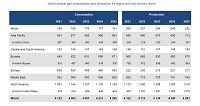
The world's next largest regional consumers of gas last year were Eurasia, mainly Russia, at 656 Bcm (23.2 Tcf), the Middle East (606 Bcm or 21.4 Tcf) and Europe (490 Bcm or 17.3 Tcf). This year, gas use is expected to grow to an estimated 671 Bcm or 23.7 Tcf in Eurasia and 625 Bcm or 22 Tcf in the Middle East.
Gas prices were somewhat higher in 2024 because new production did not keep up with new demand, extreme weather drove up demand and additions of liquefied natural gas (LNG) export terminals grew, but at a slower pace than earlier years, the IEA report said. Drawdowns from storage helped close the gap between demand and supply.
Worldwide production of gas rose slightly over 2% in 2024, to approximately 4,190 Bcm (about 151.6 Tcf). The U.S. remained the largest producer in 2024, producing about 1,060 Bcm (37.4 Tcf) last year. The IEA report expected U.S. production will rise this year to 1,074 Bcm (37.9 Tcf) in 2025. Overall North American gas production reached approximately 1,285 Bcm (45.4 Tcf) last year and is anticipated to increase to about 1,310 Bcm (46.3 Tcf) this year.
Gas continued to displace oil in industrial and power applications last year, a trend the energy agency expects will continue this year.
Looking out to 2025, the Paris-based energy agency said, "Global natural gas markets are set to remain tight in 2025 as demand continues to rise and supply expands more slowly than before the pandemic and energy crisis."
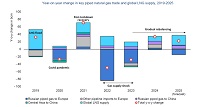
The report, which provides a thorough review of global and regional market developments in 2024 and an outlook for 2025, said that markets moved toward a gradual rebalancing last year after the supply shock that followed Russia's full-scale invasion of Ukraine in February 2022. Still, the global gas balance has remained "fragile," highlighting the need for greater international cooperation to enhance gas supply security, it added.
According to the report, similar dynamics are expected to persist in 2025 before the arrival of a wave of new LNG export capacity, led by the United States and Qatar, that is set to come online over the course of the second half of this decade.
Due to tighter market fundamentals and higher prices, growth in global gas demand is forecast to slow to below 2% this year. As in 2024, the growth is set to be largely driven by markets in Asia, with the region expected to account for more than half of the rise in global gas demand.
In a statement accompanying release of the gas report January 21, Keisuke Sadamori, the IEA's director of energy markets and security, noted, "Gas market fundamentals have improved over the past year, but for now, we are still seeing significant tightness due to rising demand and muted growth in LNG capacity. Heightened geopolitical uncertainty adds to the risks."
"While international cooperation on gas supply security has expanded since the recent energy crisis began," he continued, "greater efforts are needed from responsible producers and consumers, who should strengthen their collective efforts to reinforce the architecture for safe and secure global gas supplies."
As noted in the report, extremely cold winters or hot summers could boost gas demand, and prices, in 2025, which could cut into demand growth. This has been evident in the U.S. this year, as two separate cold snaps in January drove up demand, lowered production and boosted prices. For more on that, see January 23, 2025, article - U.S. Gas Production Curbed by Arctic Blast.
Global gas fundamentals also could be affected by the halt of Russian piped gas transit through Ukraine that started January 1. Although that halt does not pose "an imminent supply security risk for the European Union," the IEA said, it could increase European LNG import requirements and further tighten global market fundamentals in 2025.
For a variety of reasons, the IEA report termed the balance between global gas supply and demand market "fragile." One thing that could make the market more robust would be an increase in LNG exports and export terminals this year, which the agency expects.
Global LNG supply grew by 2.5% (approximately 13 Bcm or about one-half a Tcf) in 2024--well below its average growth rate of 8% between 2016 and 2020, the IEA report said. "Project delays, together with feedgas supply issues at certain legacy producers (including in Angola, Egypt and Trinidad and Tobago), weighed on LNG production growth (in 2024). However, growth in 2025 is set to nearly double, to 5%, or just over 25 Bcm or just shy of 1 Tcf, amid the expected start and ramping up of several large LNG projects, notably in North America, it added.
These additions include Phase 1 of Venture Global LNG's (Arlington, Virginia) Plaquemines LNG project, which loaded its first LNG cargo in December 2024, the Corpus Christi Stage 3 expansion and LNG Canada, IEA said. Africa and Asia also are expected to contribute to LNG supply growth in 2025, the agency forecast. The report noted that Russia's Arctic LNG 2 project is not considered as a source of firm LNG.
Subscribers to Industrial Info's Global Market Intelligence (GMI) Oil & Gas Project and Plant databases can read more information on the Corpus Christi and LNG Canada projects, and click here for a profile on the Plaquemines facility.
Industrial Info Resources (IIR) is the leading provider of industrial market intelligence. Since 1983, IIR has provided comprehensive research, news and analysis on the industrial process, manufacturing and energy related industries. IIR's Global Market Intelligence (GMI) platform helps companies identify and pursue trends across multiple markets with access to real, qualified and validated plant and project opportunities. Across the world, IIR is tracking over 200,000 current and future projects worth $17.8 Trillion (USD).
Want More IIR News Intelligence?
Make us a Preferred Source on Google to see more of us when you search.
Add Us On GoogleAsk Us
Have a question for our staff?
Submit a question and one of our experts will be happy to assist you.

Forecasts & Analytical Solutions
Where global project and asset data meets advanced analytics for smarter market sizing and forecasting.
Explore Our SolutionsRelated Articles
-
China Secures U.S-Based LNG ResourcesSeptember 15, 2026
-
Bechtel Achieves Milestone in Broad LNG Construction Portfol...September 10, 2026
-
U.S. States Planning the Most Industrial Spending in 2027September 08, 2026

PECWeb Global Market Intelligence Platform
Identify opportunities, anticipate change, and execute with confidence. PECWeb connects the industrial intelligence you need, from projects and assets to operational events, all in one platform.
Discover PecwebIndustry Intel
-
2026 US Data Center Outlook: Power, Land & CoolingPodcast Episode / Sep 18, 2026
-
2026 Global Power Demand Outlook: Gas, Nuclear & RenewablesPodcast Episode / Sep 18, 2026
-
2026 Oil & Gas CapEx Outlook: Middle East, LNG & PermianPodcast Episode / Sep 4, 2026
-
The Answer Age Starts with Trusted Data: Introducing IIR Envoy™ MCPPodcast Episode / Sep 1, 2026
-
European Chemicals and Transport Fuels OutlookPodcast Episode / Jul 10, 2026
