Automotive
Industry in Crisis - Will the U.S. Automotive Industry Survive?
*AUTOMOTIVE INDUSTRY SPOTLIGHT* For all of the problems besetting the automotive industry in general and the tier suppliers in particular, there is some thought that those suppliers that survive the beating could emerge stronger than they were before - includes Visteon facilities list
Released Thursday, June 02, 2005
Researched By Industrialinfo.com (Industrial Information Resources, Incorporated; Houston, Texas). This is not about competition from foreign manufacturers. It's not even about competition from homegrown competitors. It's about the rot within the industry, industry-wide - the rot that comes from far too many years of complaisance, far too many years of arrogance and posturing, and far too many years of making bad or ill-thought-out decisions - decisions that, in a smaller industry than the automotive industry, would have brought the house down decades earlier, but that, in fact, were hidden in a super-sized corporate maze, where everybody and nobody took responsibility for decisions and their outcomes. "The Buck Stops Here" philosophy apparently never found its way into corporate America, especially where the automotive industry is concerned. But as always happens, sooner or later, the other shoe has dropped.
If anyone thinks the problems of automotive giant General Motors (NYSE:GM)(Detroit, Michigan) just started last week, one should think again - think about a rash of bad decisions made over decades, think about why a company would ditch a viable division in order to jack up an ailing and hopelessly sinking division, think about why the company hoodahs seem obsessed with niche-market cars and pie-in-the-sky projects few people want or could afford, while pretending real problems in the more mundane world of business didn't exist, think about why there doesn't seem to be a recognizable and effective chain of command and responsibility, think about a lot of things. While one bad decision probably won't hurt a corporation in the long run, there comes a day when one more bad decision on top of all the others, will tip the scales, and, alas, there's no going back.
General Motors - and this really holds true for all of the erstwhile Big 3 - has spent the last ten years whipping its suppliers to punish them for losses due to its own internal shortcomings and, more lately refusing to reimburse them for the rapidly rising steel and plastics prices, over which they have absolutely no control, and the results have not been good for anybody concerned, neither OEM nor supplier. The number of suppliers, large and small, that have folded in the last decade is nothing short of scandalous. Some, like Metaldyne (Private) (Plymouth, Michigan), have managed, by chugging a heavy dose of reality and by having the good fortune to have leaders noted for their perspicacity, to engineer a comeback, but most haven't been that fortunate. (See related article, September 19, 2002 - To Be or Not to Be - That Is the Question... What Lies Ahead for U.S. Automotive Suppliers?.
And now Ford (NYSE:F) (Dearborn, Michigan) will reabsorb a hefty part of its failing Visteon (NYSE:VC) (Van Buren Township, Michigan) spin-off, one of the largest U.S.-based suppliers. Visteon, which was formed in 2000, plans to put 24 of its plants and technical centers into an LLC, which will be controlled by Ford (did anyone miss the poignant irony of that situation?) and headed up by former Federal-Mogul Corporation CEO, Frank Macher. Those facilities Ford hopes to sell to other suppliers, or, in a worst-case scenario, shutter them. Ford will also take on 17,500 Visteon union employees. But one might wonder how it is Visteon can give its new CEO a $3 million sign-up bonus, if it can't afford to pay its workers.
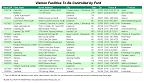 Click on chart at right to see list of plants with plant information.
Delphi (NYSE:DPH) (Troy, Michigan) is scrambling to restructure, too, as it reels from the closing of several General Motors plants earlier this year (and the possible closing of four more in the not-too-distant future). Delphi is considering selling twelve of its 23 U.S. plants, some as early as this summer, although which plants that might be has not been announced. However, the distress signals were loud and clear a couple of years ago, when Delphi formed its Automotive Holdings Group, a unit formed to try to restructure unprofitable or antiquated units, and to get them running efficiently again. See related article February 10, 2003 - First Aid for Ailing Delphi Plants.
The list of major Tier I suppliers that have opted for Chapter 11 protection is growing exponentially. Unfortunately, some of them won't achieve restructuring, and many smaller Tier II and Tier III suppliers that depend on the big guys for business will simply fold - no luxury of Chapter 11 protection for them.
The list grows daily: Collins & Aikman (NYSE:CKC) (Troy, Michigan), manufacturer of interior and exterior plastic components; Delphi (NYSE:DPH) (Troy, Michigan), maker of climate control and steering systems, cockpit and interior systems, powertrain cooling modules - if you've got a vehicle, you've got Delphi; ArvinMeritor (NYSE:ARM)(Troy, Michigan), provider of axles, brakes, transmissions, clutches, and door, roof, exhaust, and suspension systems; Tower Automotive (NYSE:ARM - delisted )(Troy, Michigan), producer of metal stampings and engineered assemblies, including body pillars, full frame assemblies, chassis, brake parts, and suspension links; Meridian Automotive (Private) (Dearborn, Michigan), maker of interior and exterior components and front- and rear-end modules (bumpers, energy-absorbing foam, plastic fascias; Intermet (OTC:INMTQ) (Troy, Michigan), one of the world's largest independent automotive ferrous and non-ferrous metals casters; Oxford Automotive (Private) (Troy, Michigan), which filed for bankruptcy protection for the second time in three years in December 2004 and had closed its North American injection molding plants in 2004, including a brand new one in McCalla, Alabama (which it sold to Corporación Gestamp (Madrid, Spain), and had sold its Ramos Arizpe, Mexico, plant to a subsidiary of Magna International (NYSE:MGA) (Aurora, Ontario), a multi-faceted Canadian conglomerate, and is concentrating all efforts on its European business. Oxford Europe is headquartered in Elancourt, France, and has stamping and assembly operations in France and Germany.
For all of the problems besetting the automotive industry in general and the tier suppliers in particular, there is some thought that those suppliers that survive the beating could emerge stronger than they were before. Some options for change include changing the adversarial relationship between suppliers and OEMs. OEMs must quit beating the suppliers over the head with Chinese pricing and threats of outsourcing. Comparing a U.S.-produced component to a Chinese component is not as straightforward as the OEMs seem to want us to believe it is. For one thing, Chinese manufacturers are not held to the same rigid quality standards Big 3 OEMs require of U.S. suppliers. Nor do the Chinese have to support R&D - they simply steal the technology from their foreign-devil transplants (the government has ruled that all foreign manufacturers must turn over their technology to their government-controlled Chinese partners by 2010, but meanwhile, they're stealing as much as they can, and apparently foreign companies don't have a prayer in Chinese courts). OEMs have also been guilty of shopping potential suppliers' designs to other suppliers, including foreign suppliers, both transplant and offshore. OEMs need to treat their suppliers and their technologies with more respect and more integrity. That includes not putting suppliers in a double bind concerning raw materials costs, which in no way is the fault of or in the control of the supplier.
Suppliers, on the other hand, will need to look into consolidation, for the purpose of producing modules. The benchmark here is the newly-formed module manufacturer, HBPO (head U.S. office in Troy, Michigan), a joint venture among Hella KG Hueck & Company (Lippstadt, Germany), a maker of automotive headlights and lighting accessories; Behr GmbH & Company (Stuttgart, Germany), the climate systems manufacturer; and Plastic Omnium (Paris:POM) (Levallois-Perret, France), maker of automotive parts, such as fuel systems, auto exterior panels, exterior trim, bumpers, and other plastic molded systems and high-performance resins. HBPO will produce integrated modules to OEMs. There must be more such pooling of resources, talent, and product among companies to produce more modules, which are less expensive and time-consuming overall for the OEM to install. The bottom line is still the bottom line, but we need some new answers to new questions, not the same old tired answers, which have long since proven themselves to be inadequate to the situation.
This is just the tip of the iceberg, as far as supplier problems go, and there will be a lot of short-term and long-term adjustments made in the industry, and we will see more bankruptcies as suppliers react to the closing of OEM plants, but one thing is certain: there is surely enough talent and intelligence in the industry to solve their problems and come out stronger and more able to compete on a global level. There is no going back. Detroit has not taken to globalization kindly, but now it has no choice but to adjust and compete on the world's terms. Detroit doesn't call the shots anymore, and the sooner and more graciously they accept that truth, the sooner the recovery.
Industrial Information Resources (IIR) is a Marketing Information Service company that has been in business for over 22 years. IIR is respected as a leader in providing comprehensive market information pertaining to the industrial processing, heavy manufacturing and energy related industries throughout the world.
Want More IIR News Intelligence?
Make us a Preferred Source on Google to see more of us when you search.
Add Us On GoogleAsk Us
Have a question for our staff?
Submit a question and one of our experts will be happy to assist you.

Forecasts & Analytical Solutions
Where global project and asset data meets advanced analytics for smarter market sizing and forecasting.
Explore Our Solutions
PECWeb Global Market Intelligence Platform
Identify opportunities, anticipate change, and execute with confidence. PECWeb connects the industrial intelligence you need, from projects and assets to operational events, all in one platform.
Discover PecwebIndustry Intel
-
Latin America Data Center Outlook 2026: Power, Hubs & GrowthPodcast Episode / Oct 9, 2026
-
Food and Beverage CapEx Outlook 2026: Tariffs, AI, AfricaPodcast Episode / Oct 9, 2026
-
North America Refining 2026: New Pipelines to PADD 5Podcast Episode / Oct 2, 2026
-
Biomanufacturing Onshoring 2026: GLP-1, CDMO and ReshoringPodcast Episode / Oct 2, 2026
-
2026 US Data Center Outlook: Power, Land & CoolingPodcast Episode / Sep 18, 2026