Pharmaceutical & Biotech
Pharma Focus: Biotech Manufacturing Tech Profile
In contrast to traditional pharmaceuticals, which are generally made by synthetic means, biotech drugs are derived from a living substance.
Released Thursday, June 09, 2005
Researched by Industrialinfo.com (Industrial Information Resources, Incorporated; Houston, Texas). The biotech drug sector continues to advance, from an estimated $12 billion in 1990, to roughly $27 billion in 2004. This is in contrast to the nearly $270 billion spent annually for so-called "traditional" pharmaceuticals, or as referred to by those in the industry, "small molecule therapeutics". As discussed in Industrialinfo.com's 2005 Pharmaceutical Industry Forecast, although biopharmaceuticals comprise roughly only 5% of the world's prescription drug sales, they account for six of the top fifty selling drugs, 13% of new medicines approved by the FDA in the 1990s, and about 18% of all drugs in development.
In contrast to traditional pharmaceuticals, which are generally made by synthetic means, biotech drugs are derived from a living substance. Products are typically made by a two-step process involving recombinant DNA and monoclonal antibodies. The first step is to isolate a gene and include it in another organism. Organisms that are often used include hamster ovary cells, e-coli bacteria, and yeast. Basically, the organism is combined with an antigen, a substance (i.e. toxin, bacteria) that, when introduced into the body, stimulates the production of an antibody, resulting in the treatment of the targeted diseases. These products are known as monoclonal antibodies.
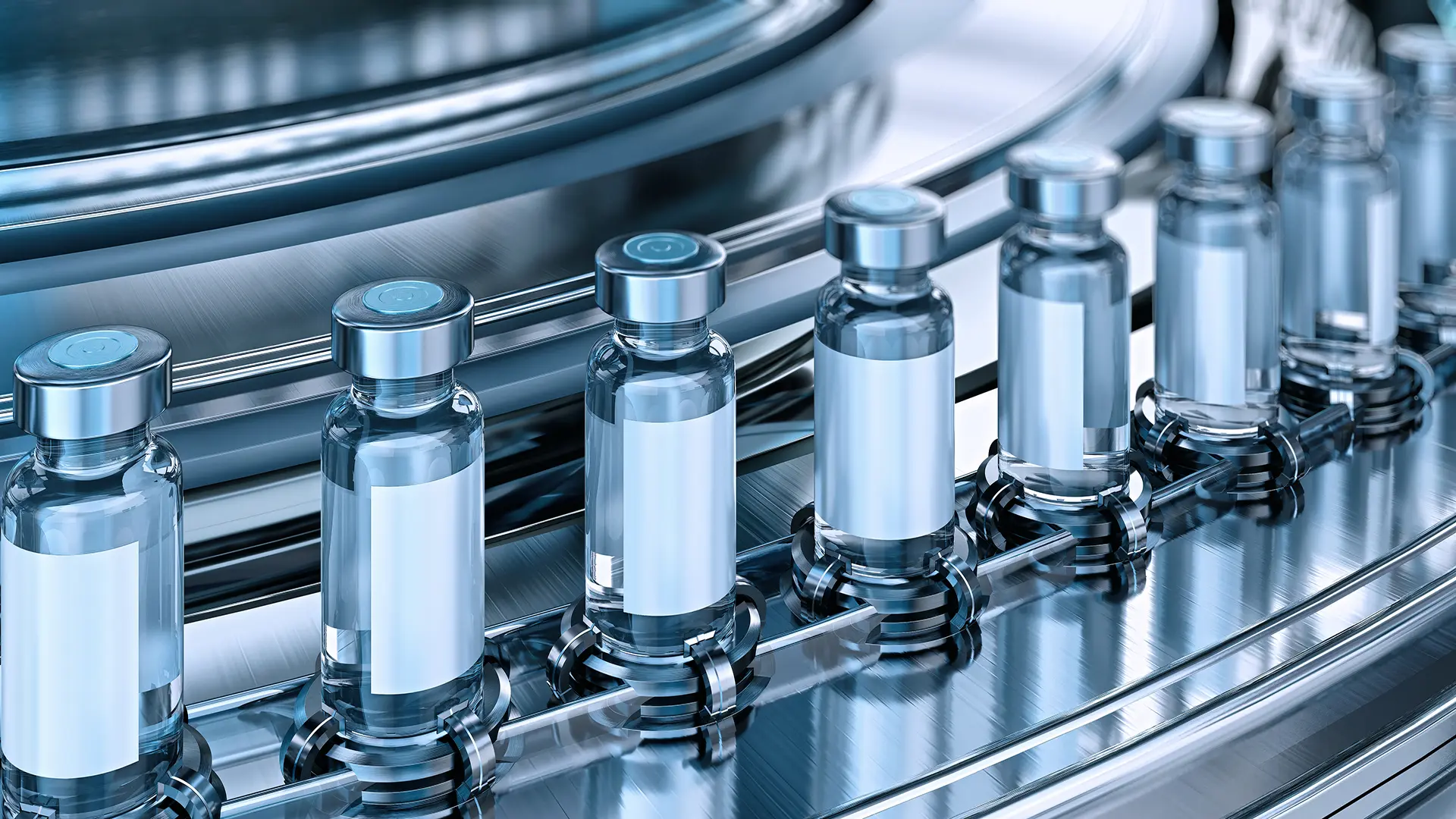
Traditionally, the process to manufacture this type of biotech drug has involved six steps. The first step is to take the modified cells and grow them in a starter culture in a clean environment. The next step is called bioreaction, whereby the starter culture multiplies in the presence of nutrients. For this, tanks up to 50,000-liter capacity are utilized. Then, the cells are harvested and separated from the fermentation broth. The methods used are filtration or chemical treatment. The product may be found in either the cells or in the broth. After the purification process to retrieve the desired protein (a sequence of amino acids), the product is then ready for filling into final-form packaging, such as an ampule that is ready to use for injection. The filling operation is usually done in two steps, bulk filling into large containers, then final fill.
Currently, biotech drugs are most often delivered by injectable form - there is a problem when they are taken by mouth in unmodified form, because the stomach might simply treat the substance as food. Extensive research is ongoing for effective alternative biotech drug delivery methods.
The Fluor Corporation (NYSE:FLR) (Aliso Viejo, California) is one of the leading designers and builders of biotech plants. Fluor, along with others in this growing field, note that the planning and construction of a typical major biotech manufacturing site includes manufacturing buildings, administrative space, quality control laboratories, warehousing, and central utilities.
It is more challenging to develop generic drugs to compete with existing biotech drugs. This challenge has resulted in the industry's work to devise a new name by which to call the less expensive, generic-type alternatives to the patented biotech drugs. Currently, the preferred term is "follow-on protein products," or FOPPs. In the biotech industry, patents alone are not the controlling factor in copying these drugs. Biotech products by nature are devilishly tough to duplicate.
As the tab for a single prescription of one successful biotech drug can run over $10,000 annually, insurers and consumers are clamoring for the FOPP's. The FDA is currently evaluating the situation, as it seeks to establish guidelines, but a definitive solution is not expected for several years.
There are a number of biotech drugs on the market that have sales over $1 billion annually. Some of these drugs include Amgen's Enbrel and Epogen (anemia), Centacor's MICADE (arthritis), Genentech's Avistin (cancer), and Biogen-Idec's Avonex (multiple sclerosis).
Industrial Information Resources (IIR) is a Marketing Information Service company that has been in business for over 22 years. IIR is respected as a leader in providing comprehensive market information pertaining to the industrial processing, heavy manufacturing and energy related industries throughout the world.
/news/article.jsp
false
Want More IIR News Intelligence?
Make us a Preferred Source on Google to see more of us when you search.
Add Us On GoogleAsk Us
Have a question for our staff?
Submit a question and one of our experts will be happy to assist you.

Forecasts & Analytical Solutions
Where global project and asset data meets advanced analytics for smarter market sizing and forecasting.
Explore Our SolutionsRelated Articles
-
Eli Lilly Advances U.S. Manufacturing BuildoutSeptember 24, 2026
-
U.S. States Planning the Most Industrial Spending in 2027September 08, 2026
-
U.S. Megaprojects to Watch for in 2027September 01, 2026
-
GLP-1 Drugs Drive Pharma Construction WaveAugust 27, 2026
-
El Niño Shapes North America Fall, Winter OutlookAugust 27, 2026

PECWeb Global Market Intelligence Platform
Identify opportunities, anticipate change, and execute with confidence. PECWeb connects the industrial intelligence you need, from projects and assets to operational events, all in one platform.
Discover PecwebIndustry Intel
-
North America Refining 2026: New Pipelines to PADD 5Podcast Episode / Oct 2, 2026
-
Biomanufacturing Onshoring 2026: GLP-1 Drives CapexPodcast Episode / Oct 2, 2026
-
2026 US Data Center Outlook: Power, Land & CoolingPodcast Episode / Sep 18, 2026
-
2026 Global Power Demand Outlook: Gas, Nuclear & RenewablesPodcast Episode / Sep 18, 2026
-
2026 Oil & Gas CapEx Outlook: Middle East, LNG & PermianPodcast Episode / Sep 4, 2026