Production
To Ward Off Climate Disaster, IEA Recommends Giving Extra Nudges to the Invisible Hand of the Market
Could a dramatic shift in government tax policies be used as a club to beat Oil and Gas companies into more actively and rapidly pursuing low- and no-carbon investments?
Released Tuesday, November 28, 2023

Written by John Egan for Industrial Info Resources (Sugar Land, Texas)--Could a dramatic shift in government tax policies be used as a club to beat Oil and Gas companies into more actively and rapidly pursuing low- and no-carbon investments? Quadrupling or more the taxes on cigarettes has cut the U.S. rate of adult smoking in half since 2009, estimated the U.S. Centers for Disease Control and Prevention (CDC) (Atlanta, Georgia). Can't the same be done for oil and natural gas? Surely global climate change poses a more significant, even existential, threat to life on this planet compared to the public health dangers of cigarette smoking, could be the argument mounted by some who are extremely concerned about global climate change.
Using tax policy in this blunt and punitive manner is not what the International Energy Agency (IEA) (Paris, France) has in mind. In a new report leading up to this year's U.N. Congress of Parties 28 (COP28) global climate conference, scheduled to begin November 30, the agency argues for a different, and more subtle, integrated use of tax and public policy to transform oil and gas markets to keep global average temperature gain since the pre-industrial times to 1.5⁰ Celsius, as provided in the 2015 Paris Agreement.
The Oil and Gas Industry in Net-Zero Transitions, released November 23, instead relies on the concepts of enlightened self-interest and the invisible hand of the market to convince oil and gas companies to massively shift their investment decisions to clean energy and away from hydrocarbons.
Worldwide, the oil and gas sector--which provides more than half of global energy supply and employs nearly 12 million workers--has been a "marginal" force at best in transitioning to a clean energy system, according to the report. Oil and gas companies currently account for just 1% of clean energy investment globally--and 60% of that comes from just four companies.
"The oil and gas industry is facing a moment of truth at COP28 in Dubai," IEA Executive Director Fatih Birol said in a statement accompanying the report. "With the world suffering the impacts of a worsening climate crisis, continuing with business as usual is neither socially nor environmentally responsible."
"Oil and gas producers around the world need to make profound decisions about their future place in the global energy sector," he continued. "The industry needs to commit to genuinely helping the world meet its energy needs and climate goals--which means letting go of the illusion that implausibly large amounts of carbon capture are the solution."
He said the IEA's 223-page report "shows a fair and feasible way forward in which oil and gas companies take a real stake in the clean energy economy while helping the world avoid the most severe impacts of climate change."
One of the challenges facing the IEA and climate activists is that the global oil and gas industry is a large and diverse industry. Though much of the media focuses on the handful of privately owned integrated supermajors like Exxon Mobil Corporation (NYSE:XOM) (Spring, Texas) or Shell plc (NYSE:SHEL) (London, England), those firms account for less than 13% of global production and reserves. National oil companies (NOCs) such as Saudi Aramco (Dhahran, Saudi Arabaia) and the National Iranian Oil Company (Tehran, Iran), account for more than half of production and 60% of reserves. So levying huge taxes on privately held supermajors won't get the world where it needs to be, climate-wise.
Instead, the IEA recommends an integrated set of supply- and demand-side initiatives that make investing in clean energy economically superior to investing in oil and gas. If decisionmakers at oil and gas companies will pursue options that are most economically advantageous to them, the IEA recommends even greater government intervention in energy markets to boost the economic return on clean energy investments, for both supply and demand, so that investing in those options generates better returns, at a lower risk, than investing in oil and gas.
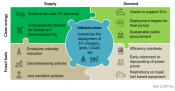 Click on the image at right to see the supply- and demand-side measures recommended by the IEA.
For all its wonders, the free market can't take care of everything, so some greater level of government intervention is required. The government actions IEA calls for sometimes are rendered in euphemisms and shorthand. On the supply side, the agency is vague on the types of "decommissioning" and "just" policies it wants to see. Similarly, on the demand side, the agency does not spell out what kinds of "restrictions on fossil fuel-based equipment" it feels are needed.
The cumulative effect of these varied steps will make the clean energy market irresistible to oil and gas companies. Their investments will accelerate the virtuous cycle of clean energy investing.
Argue with the IEA's approach if you want, but nearly all stakeholders recognize that, for all the dramatic changes energy markets have undergone in recent years, the transition to clean energy still is not taking place fast enough to ward off climate-driven threats to the planet.
Most countries are far away from fulfilling the basic pledges made in Paris in 2015. Some have increased carbon dioxide emissions rather than reduce them. Relying on nations to fulfil their pledges has not worked. Neither has shaming the hydrocarbon industry to change. To prevent a climate disaster, the IEA recommends harnessing the invisible hand of the market, but giving it a few additional sharp shoves.
Industrial Info Resources (IIR) is the leading provider of industrial market intelligence. Since 1983, IIR has provided comprehensive research, news and analysis on the industrial process, manufacturing and energy related industries. IIR's Global Market Intelligence (GMI) helps companies identify and pursue trends across multiple markets with access to real, qualified and validated plant and project opportunities. Across the world, IIR is tracking over 200,000 current and future projects worth $17.8 Trillion (USD).
/news/article.jsp
false
Want More IIR News Intelligence?
Make us a Preferred Source on Google to see more of us when you search.
Add Us On GoogleAsk Us
Have a question for our staff?
Submit a question and one of our experts will be happy to assist you.

Forecasts & Analytical Solutions
Where global project and asset data meets advanced analytics for smarter market sizing and forecasting.
Explore Our SolutionsRelated Articles
-
Kinder Morgan Gets Q3 Lift from U.S. Natural GasOctober 23, 2026
-
Winter 2026-27 Outlook: Strong El Niño Expected to Shape Nor...October 23, 2026
-
Long Road Ahead for LNG Recovery, Study FindsOctober 22, 2026

PECWeb Global Market Intelligence Platform
Identify opportunities, anticipate change, and execute with confidence. PECWeb connects the industrial intelligence you need, from projects and assets to operational events, all in one platform.
Discover PecwebIndustry Intel
-
Mining Capital Spending 2026: Copper, Rare Earths, AluminumPodcast Episode / Oct 23, 2026
-
Brazil Critical Minerals 2027: Rare Earths, Lithium, CopperPodcast Episode / Oct 16, 2026
-
US Craft Labor Outlook 2026: Wages, Per Diems, Data CentersPodcast Episode / Oct 16, 2026
-
Latin America Data Center Outlook 2026: Power, Hubs & GrowthPodcast Episode / Oct 9, 2026
-
Food and Beverage CapEx Outlook 2026: Tariffs, AI, AfricaPodcast Episode / Oct 9, 2026