Brazil: Efficiency, Innovation, and Opportunities in the Food & Beverage Industry
Video Language


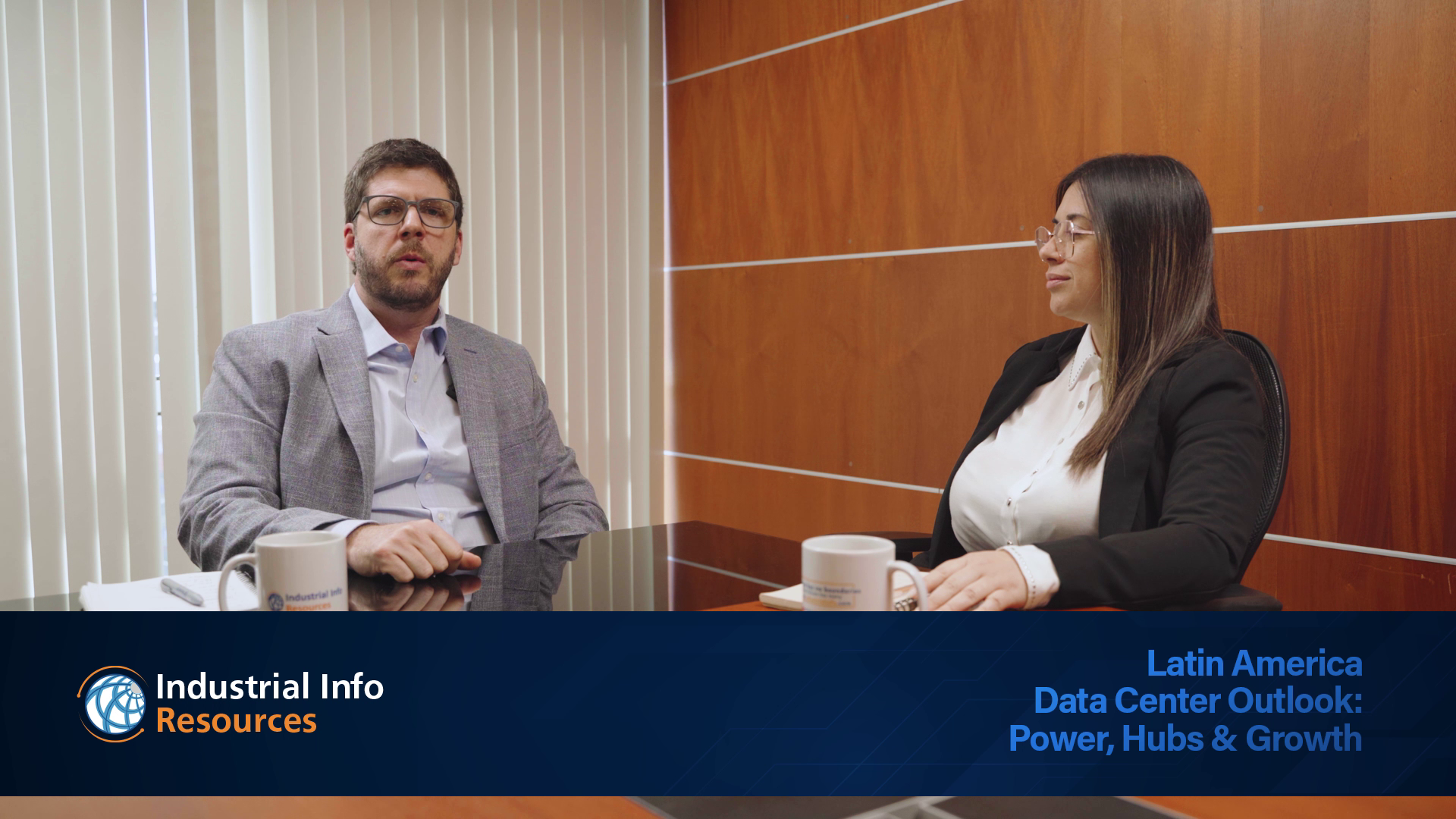
Is the Brazilian Food & Beverage industry shifting from a volume-driven model to a fully integrated, high-efficiency powerhouse? In this episode, Leonor Caminos (Assistant VP of Research – LATAM Petroleum Refining) sits down with Lidia Lozano Caro (Assistant VP of Research - LATAM Food & Beverage) to explore how the sector in Brazil is evolving to meet modern market demands. They examine the critical factors reshaping the region's competitiveness and creating new project opportunities.
[Intro] (00:00):
The food and beverage industry in Brazil is defined by trends and developments that go far beyond production volume. Today, we want to explore the market from an industrial perspective — how it works, how the system is structured, and how innovation is impacting every link in the chain. To analyze this topic, I want to welcome you to a new podcast from Industrial Info Resources, Navigating the Currents of Change. With over 40 years of experience in industrial market research, at Industrial Info we provide verified, reliable and up-to-date information on more than 12 industrial sectors globally, including project opportunities, plant profiles and equipment.
Leonor Caminos (00:59):
My name is Leonor Caminos. I am the regional Assistant Vice President for the Petroleum Refining Industry in Latin America at Industrial Info Resources. Today, I have the pleasure of being joined by Lidia Lozano Caro, Assistant Vice President responsible for the Food and Beverage and Pulp and Paper industries in Latin America. Lidia leads the regional research that identifies capital and maintenance projects, as well as production plants, supporting all our clients in staying connected with new trends and business opportunities. Welcome, Lidia.
Lidia Lozano Caro (01:34):
Thank you very much, Leonor, for the introduction. It is a pleasure for me to be here with you today.
Leonor Caminos (01:39):
The big question we want to explore today is: what is really happening behind the food and beverage industry in Brazil? We want to understand how it is structured, what drives it, and how innovation is transforming the entire production system.
Lidia Lozano Caro (01:55):
Well, the first thing to understand is that Brazil is not just about volume. It is an integrated system where agriculture, industry and energy are completely connected. Understanding that integration is key to identifying real and sustainable opportunities throughout the chain.
Leonor Caminos (02:07):
Right? So if we want to understand the industry, it is key to start at the base, which is agriculture. The field is ultimately where everything begins, Lidia. Could you tell us how this sector is moving today and what the most relevant challenges are?
Lidia Lozano Caro (02:25):
Brazil continues to expand its grain production and consolidate its global positioning. However, the determining factor is not only the volume produced, as I already mentioned, but the management of the post-production stages. And it is from this stage that the main challenges emerge, particularly in terms of infrastructure and storage management. Today, a large part of production lacks sufficient capacity or optimal storage conditions, which is generating losses, logistical pressure, and lower efficiency throughout the chain. Without an efficient storage system, the downstream industry loses predictability and competitiveness.
Leonor Caminos (03:00):
And it's in this context precisely where it's important to note that key sector players like Cargill and ADM are already moving to reverse this situation, along with leading cooperatives at a more regional level, like Caramuru, Comigo, and Coamo, to name a few. They're actively investing not only in new handling and storage plants, but also in expanding existing facilities. These investments include adding new silos, grain dryers and other key equipment, specifically aiming to improve infrastructure, increase storage capacity, and bring greater efficiency and resilience to the entire chain. So the main challenge isn't producing more, but better managing what's already produced and ensuring everything moves efficiently through the chain.
Lidia Lozano Caro (03:52):
I understand that once this bottleneck is overcome, the grain chain gains predictability and operational efficiency.
Leonor Caminos (03:58):
That's right. And here, Leonor — let me also mention that this same focus is reflected in other segments, because in parallel, Brazil continues to consolidate a highly integrated meat processing sector, including beef, poultry and pork, which is one of its main value-added drivers. These segments have a strong export orientation and operate with very significant economies of scale.
Lidia Lozano Caro (04:23):
In this context, what factors explain the strength and high degree of competitiveness of the meat processing industry compared to other sectors?
Leonor Caminos (04:27):
Integration forms a system in which primary production, industrial processing and distribution operate in a coordinated and aligned manner. This approach allows for capturing efficiencies throughout the entire value chain. However, it requires a steady flow of investment in technology, process optimization and operational control, precisely to sustain competitiveness over time. And it's within this framework that we see a particularly active investment dynamic from the sector's main players. JBS continues to lead this process, with over 55 active capital projects available in our database, aimed at capacity expansion, technological modernization and improving operational efficiency. At the same time, companies like Aurora Alimentos or LAR Agroindustrial Cooperative maintain a sustained investment strategy. And this happens, without a doubt, in a highly competitive environment, where players who don't keep up with this pace risk losing their relative market position.
Lidia Lozano Caro (05:30):
Sure, no doubt. So the challenges aren't just operational, but also strategic — that is, how to maintain efficiency, how to reduce costs, and even more importantly, how to adapt to increasingly demanding international standards.
Leonor Caminos (05:42):
That's right. Well, we've covered the agroindustrial sector and meat processing so far. Let's move on to another key sector of the industry — beverages. How is all this integration and efficiency reflected in this particular market?
Lidia Lozano Caro (05:52):
The beverage market is a highly developed sector, with a strong presence throughout Brazil and a wide-reaching logistics network. It operates on a very solid industrial base, where efficiency in production and distribution are critical factors. Plants cannot stop their activity, and any inefficiency translates directly into higher operating costs. And it's within this industrial framework that bottling companies continue to bet on large-scale investments to sustain and expand their operational capacity. A relevant example is Coca-Cola, which recently announced an investment of over $300 million to build a new bottling plant in the state of São Paulo. Although the site — that is, the city where this plant will be built — has not yet been defined, the project is in full development, and it's precisely these initiatives that reflect the need to keep up with growing demand, with a more modern and efficient infrastructure, reinforcing competitiveness in a very demanding industrial environment.
Leonor Caminos (06:57):
And speaking of operational continuity and efficiency, how is this sector evolving to stay competitive?
Lidia Lozano Caro (07:03):
It's evolving towards greater automation, optimization of production lines, and above all, real-time control — all aimed at improving performance, reducing losses and maintaining competitiveness.
Leonor Caminos (07:14):
If we look at key segments of the industry, such as the beer market — what makes it particularly interesting?
Lidia Lozano Caro (07:20):
The beer market is a sector that demands high levels of operational efficiency at all stages, from raw materials to distribution. In addition, I believe it serves as a good indicator of how the industry is evolving in terms of innovation, development and optimization. Leading companies like Ambev, Heineken or Grupo Petrópolis continue to lead the market, with constant investments in production, innovation, and especially in the premium beer segment, driving competition and growth in the sector.
Leonor Caminos (07:51):
Changing the subject a bit — now, Lidia, if I may, let's talk about technology. You've already mentioned it at some point today, and in past conversations we've had, you told me quite a bit about Industry 4.0 and new technologies. How is this trend being applied to improve production efficiency and performance in the food and beverage industry?
Lidia Lozano Caro (08:14):
It's being applied more and more. Digitalization and automation are no longer optional for companies. Plants are necessarily moving towards smarter models, with real-time monitoring, data analysis and greater integration of all those systems.
Leonor Caminos (08:31):
And where is all this reflected most clearly?
Lidia Lozano Caro (08:37):
Undoubtedly, in high-volume processes, where any improvement in efficiency has a direct impact on profitability. The focus is no longer just on producing more, as we've been mentioning, but on optimizing the entire operation through data management.
Leonor Caminos (08:48):
Another key topic in the industry that I don't want to miss mentioning, and that is certainly of great concern in the sector — energy. I'll stop on a phrase you said: plants cannot stop their activity. And we know that industrial plants are large consumers of energy, precisely because of these continuous operational processes. How are companies addressing this challenge today?
Lidia Lozano Caro (09:12):
As you well mentioned, energy is one of the most relevant pillars of the sector. Sources like solar energy are being incorporated to reduce costs and gain greater predictability. But the most interesting part seems to be in the utilization of waste. Many plants generate biogas from organic waste, especially in the food and beverage industry. This biogas, when refined, becomes biomethane, which can be injected into the natural gas grid or used as an energy source within the industrial plants themselves. In the food and beverage industry, this is mainly used to fuel boilers, generate steam, provide heat to various production processes, and in some cases also to produce electricity. In this way, fossil fuel consumption is reduced, energy costs go down, and progress is made toward a much more efficient and sustainable model within the chain.
Leonor Caminos (10:02):
And how does all this impact the operation and efficiency of the industry?
Lidia Lozano Caro (10:07):
This allows for the replacement of traditional fuels within the same production process. It's a gain in energy efficiency — costs are reduced, and the environment is improved, all simultaneously.
Leonor Caminos (10:19):
Could it be said that the production cycle is then almost completely closed?
Lidia Lozano Caro (10:24):
Exactly. And this is starting to become more and more relevant.
Leonor Caminos (10:31):
If we consider everything you've told us so far — from efficiency, automation, digitalization, and the use of biogas — where is the Brazilian food and beverage industry evolving?
Lidia Lozano Caro (10:43):
Undoubtedly toward more integrated, more efficient and more automated systems. Plants are evolving toward greater operational autonomy, with data-driven decisions and increasingly optimized processes.
Leonor Caminos (10:55):
And to wrap up, summarizing everything we've seen today — if you had to describe the Brazilian market in a single idea, what would that idea be?
Lidia Lozano Caro (11:01):
Well, I'd say it's a system where each part depends on the other for everything to function correctly. In the agricultural sector, the challenge is to improve storage and logistics, and make the product flow more orderly and efficient within the chain. On the other hand, the food and beverage industry takes that production volume and transforms it into added value through processes that aim to be more efficient and competitive. Ultimately, they aren't separate sectors, but parts of the same chain — everything ends up connecting in a common need.
Leonor Caminos (11:35):
What would that common need be?
Lidia Lozano Caro (11:38):
The backbone is clear — it is all about energy efficiency, smart automation, and the ongoing process of optimization. That's where competitiveness is defined.
Leonor Caminos (11:45):
Sure. And that's exactly where the most interesting opportunities arise, so to speak, for industry players?
Lidia Lozano Caro (11:50):
Without a doubt.
Leonor Caminos (11:55):
Perfect. Excellent, Lidia — this leaves us with a very clear picture of the whole discussion, and how the food and beverage industry in Brazil is evolving. Thank you very much for your contribution.
Lidia Lozano Caro (12:06):
Thank you so much.
Leonor Caminos (12:09):
And that's how we reach today's edition of our podcast on the subject. If you wish to delve deeper into any of the topics we covered today, don't hesitate to contact us, either by email or at the phone number shown on the screen. We thank you once again for your time, and hope that this information has been valuable in supporting your business decisions and strategies. Thanks for joining us, and until the next edition of Navigating the Currents of Change.
The food and beverage industry in Brazil is defined by trends and developments that go far beyond production volume. Today, we want to explore the market from an industrial perspective — how it works, how the system is structured, and how innovation is impacting every link in the chain. To analyze this topic, I want to welcome you to a new podcast from Industrial Info Resources, Navigating the Currents of Change. With over 40 years of experience in industrial market research, at Industrial Info we provide verified, reliable and up-to-date information on more than 12 industrial sectors globally, including project opportunities, plant profiles and equipment.
Leonor Caminos (00:59):
My name is Leonor Caminos. I am the regional Assistant Vice President for the Petroleum Refining Industry in Latin America at Industrial Info Resources. Today, I have the pleasure of being joined by Lidia Lozano Caro, Assistant Vice President responsible for the Food and Beverage and Pulp and Paper industries in Latin America. Lidia leads the regional research that identifies capital and maintenance projects, as well as production plants, supporting all our clients in staying connected with new trends and business opportunities. Welcome, Lidia.
Lidia Lozano Caro (01:34):
Thank you very much, Leonor, for the introduction. It is a pleasure for me to be here with you today.
Leonor Caminos (01:39):
The big question we want to explore today is: what is really happening behind the food and beverage industry in Brazil? We want to understand how it is structured, what drives it, and how innovation is transforming the entire production system.
Lidia Lozano Caro (01:55):
Well, the first thing to understand is that Brazil is not just about volume. It is an integrated system where agriculture, industry and energy are completely connected. Understanding that integration is key to identifying real and sustainable opportunities throughout the chain.
Leonor Caminos (02:07):
Right? So if we want to understand the industry, it is key to start at the base, which is agriculture. The field is ultimately where everything begins, Lidia. Could you tell us how this sector is moving today and what the most relevant challenges are?
Lidia Lozano Caro (02:25):
Brazil continues to expand its grain production and consolidate its global positioning. However, the determining factor is not only the volume produced, as I already mentioned, but the management of the post-production stages. And it is from this stage that the main challenges emerge, particularly in terms of infrastructure and storage management. Today, a large part of production lacks sufficient capacity or optimal storage conditions, which is generating losses, logistical pressure, and lower efficiency throughout the chain. Without an efficient storage system, the downstream industry loses predictability and competitiveness.
Leonor Caminos (03:00):
And it's in this context precisely where it's important to note that key sector players like Cargill and ADM are already moving to reverse this situation, along with leading cooperatives at a more regional level, like Caramuru, Comigo, and Coamo, to name a few. They're actively investing not only in new handling and storage plants, but also in expanding existing facilities. These investments include adding new silos, grain dryers and other key equipment, specifically aiming to improve infrastructure, increase storage capacity, and bring greater efficiency and resilience to the entire chain. So the main challenge isn't producing more, but better managing what's already produced and ensuring everything moves efficiently through the chain.
Lidia Lozano Caro (03:52):
I understand that once this bottleneck is overcome, the grain chain gains predictability and operational efficiency.
Leonor Caminos (03:58):
That's right. And here, Leonor — let me also mention that this same focus is reflected in other segments, because in parallel, Brazil continues to consolidate a highly integrated meat processing sector, including beef, poultry and pork, which is one of its main value-added drivers. These segments have a strong export orientation and operate with very significant economies of scale.
Lidia Lozano Caro (04:23):
In this context, what factors explain the strength and high degree of competitiveness of the meat processing industry compared to other sectors?
Leonor Caminos (04:27):
Integration forms a system in which primary production, industrial processing and distribution operate in a coordinated and aligned manner. This approach allows for capturing efficiencies throughout the entire value chain. However, it requires a steady flow of investment in technology, process optimization and operational control, precisely to sustain competitiveness over time. And it's within this framework that we see a particularly active investment dynamic from the sector's main players. JBS continues to lead this process, with over 55 active capital projects available in our database, aimed at capacity expansion, technological modernization and improving operational efficiency. At the same time, companies like Aurora Alimentos or LAR Agroindustrial Cooperative maintain a sustained investment strategy. And this happens, without a doubt, in a highly competitive environment, where players who don't keep up with this pace risk losing their relative market position.
Lidia Lozano Caro (05:30):
Sure, no doubt. So the challenges aren't just operational, but also strategic — that is, how to maintain efficiency, how to reduce costs, and even more importantly, how to adapt to increasingly demanding international standards.
Leonor Caminos (05:42):
That's right. Well, we've covered the agroindustrial sector and meat processing so far. Let's move on to another key sector of the industry — beverages. How is all this integration and efficiency reflected in this particular market?
Lidia Lozano Caro (05:52):
The beverage market is a highly developed sector, with a strong presence throughout Brazil and a wide-reaching logistics network. It operates on a very solid industrial base, where efficiency in production and distribution are critical factors. Plants cannot stop their activity, and any inefficiency translates directly into higher operating costs. And it's within this industrial framework that bottling companies continue to bet on large-scale investments to sustain and expand their operational capacity. A relevant example is Coca-Cola, which recently announced an investment of over $300 million to build a new bottling plant in the state of São Paulo. Although the site — that is, the city where this plant will be built — has not yet been defined, the project is in full development, and it's precisely these initiatives that reflect the need to keep up with growing demand, with a more modern and efficient infrastructure, reinforcing competitiveness in a very demanding industrial environment.
Leonor Caminos (06:57):
And speaking of operational continuity and efficiency, how is this sector evolving to stay competitive?
Lidia Lozano Caro (07:03):
It's evolving towards greater automation, optimization of production lines, and above all, real-time control — all aimed at improving performance, reducing losses and maintaining competitiveness.
Leonor Caminos (07:14):
If we look at key segments of the industry, such as the beer market — what makes it particularly interesting?
Lidia Lozano Caro (07:20):
The beer market is a sector that demands high levels of operational efficiency at all stages, from raw materials to distribution. In addition, I believe it serves as a good indicator of how the industry is evolving in terms of innovation, development and optimization. Leading companies like Ambev, Heineken or Grupo Petrópolis continue to lead the market, with constant investments in production, innovation, and especially in the premium beer segment, driving competition and growth in the sector.
Leonor Caminos (07:51):
Changing the subject a bit — now, Lidia, if I may, let's talk about technology. You've already mentioned it at some point today, and in past conversations we've had, you told me quite a bit about Industry 4.0 and new technologies. How is this trend being applied to improve production efficiency and performance in the food and beverage industry?
Lidia Lozano Caro (08:14):
It's being applied more and more. Digitalization and automation are no longer optional for companies. Plants are necessarily moving towards smarter models, with real-time monitoring, data analysis and greater integration of all those systems.
Leonor Caminos (08:31):
And where is all this reflected most clearly?
Lidia Lozano Caro (08:37):
Undoubtedly, in high-volume processes, where any improvement in efficiency has a direct impact on profitability. The focus is no longer just on producing more, as we've been mentioning, but on optimizing the entire operation through data management.
Leonor Caminos (08:48):
Another key topic in the industry that I don't want to miss mentioning, and that is certainly of great concern in the sector — energy. I'll stop on a phrase you said: plants cannot stop their activity. And we know that industrial plants are large consumers of energy, precisely because of these continuous operational processes. How are companies addressing this challenge today?
Lidia Lozano Caro (09:12):
As you well mentioned, energy is one of the most relevant pillars of the sector. Sources like solar energy are being incorporated to reduce costs and gain greater predictability. But the most interesting part seems to be in the utilization of waste. Many plants generate biogas from organic waste, especially in the food and beverage industry. This biogas, when refined, becomes biomethane, which can be injected into the natural gas grid or used as an energy source within the industrial plants themselves. In the food and beverage industry, this is mainly used to fuel boilers, generate steam, provide heat to various production processes, and in some cases also to produce electricity. In this way, fossil fuel consumption is reduced, energy costs go down, and progress is made toward a much more efficient and sustainable model within the chain.
Leonor Caminos (10:02):
And how does all this impact the operation and efficiency of the industry?
Lidia Lozano Caro (10:07):
This allows for the replacement of traditional fuels within the same production process. It's a gain in energy efficiency — costs are reduced, and the environment is improved, all simultaneously.
Leonor Caminos (10:19):
Could it be said that the production cycle is then almost completely closed?
Lidia Lozano Caro (10:24):
Exactly. And this is starting to become more and more relevant.
Leonor Caminos (10:31):
If we consider everything you've told us so far — from efficiency, automation, digitalization, and the use of biogas — where is the Brazilian food and beverage industry evolving?
Lidia Lozano Caro (10:43):
Undoubtedly toward more integrated, more efficient and more automated systems. Plants are evolving toward greater operational autonomy, with data-driven decisions and increasingly optimized processes.
Leonor Caminos (10:55):
And to wrap up, summarizing everything we've seen today — if you had to describe the Brazilian market in a single idea, what would that idea be?
Lidia Lozano Caro (11:01):
Well, I'd say it's a system where each part depends on the other for everything to function correctly. In the agricultural sector, the challenge is to improve storage and logistics, and make the product flow more orderly and efficient within the chain. On the other hand, the food and beverage industry takes that production volume and transforms it into added value through processes that aim to be more efficient and competitive. Ultimately, they aren't separate sectors, but parts of the same chain — everything ends up connecting in a common need.
Leonor Caminos (11:35):
What would that common need be?
Lidia Lozano Caro (11:38):
The backbone is clear — it is all about energy efficiency, smart automation, and the ongoing process of optimization. That's where competitiveness is defined.
Leonor Caminos (11:45):
Sure. And that's exactly where the most interesting opportunities arise, so to speak, for industry players?
Lidia Lozano Caro (11:50):
Without a doubt.
Leonor Caminos (11:55):
Perfect. Excellent, Lidia — this leaves us with a very clear picture of the whole discussion, and how the food and beverage industry in Brazil is evolving. Thank you very much for your contribution.
Lidia Lozano Caro (12:06):
Thank you so much.
Leonor Caminos (12:09):
And that's how we reach today's edition of our podcast on the subject. If you wish to delve deeper into any of the topics we covered today, don't hesitate to contact us, either by email or at the phone number shown on the screen. We thank you once again for your time, and hope that this information has been valuable in supporting your business decisions and strategies. Thanks for joining us, and until the next edition of Navigating the Currents of Change.
Please Select A Language
*This episode is brought to you by Industrial Info's Latin American Office in Argentina.