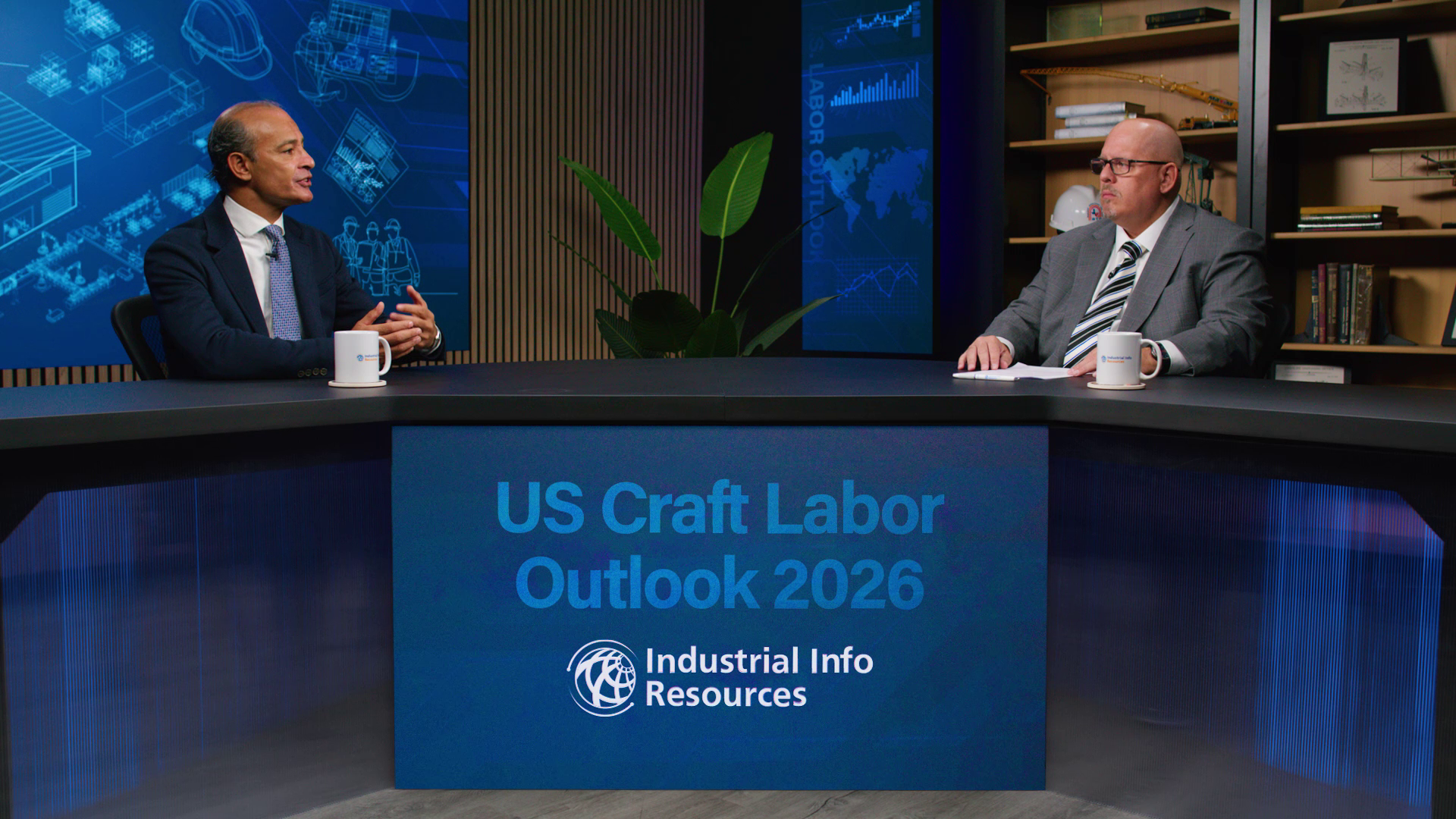



The US industrial construction market is surging with reshoring initiatives and a massive data center build-out, but is there enough skilled labor to meet this unprecedented demand? Join IIR's Michael Bergen, President, and Chris Smith, VP of Labor Analytic Solutions, as they unpack the forecasted capital spending boom and its profound impact on the North American craft labor pipeline. They analyze the root causes of current workforce shortages, the rising trajectory of construction wages, and innovative strategies, such as modular construction, designed to mitigate on-site manpower constraints. Discover how your organization can navigate this complex supply-demand imbalance and secure the resources necessary for future capital project execution.
[Intro] (00:00):
Right now, the US energy and industrial construction market is being supported by a raft of policy initiatives, executive orders and tax incentives that is pushing for greater levels of domestic production, regional capacity development and a focus on self-reliance amidst a strategic imperative on resource security. So the big question is, has this resulted in a new wave of construction activity across the US? And more importantly, is the construction, labor, manpower and knowhow in place and sufficient to meet this demand?
Shaheen Chohan (00:52):
Welcome to Navigating the Currents of Change. My name is Shaheen Chohan and I lead the Global Analytics here at Industrial Info Resources. For over 40 years, we have been providing market intelligence, data analytics and geospatial solutions to those companies involved in the design, construction and maintenance of plants and facilities across the energy and heavy industrial sectors across the world. I'm delighted to be joined by two of our subject matter experts. Mike Bergen, executive vice president, and also in the hot seat is Chris Smith, IIR's VP of Industrial Labor Analytics. Welcome, gentlemen.
Gentlemen, would it be right in saying that we're now in the midst of a new era of capital spending? So from the analysis that you guys conduct every quarter, what does the US forecasted capital spending look like over the near to mid-term?
Chris Smith (01:44):
So what we're seeing is that there is a steady growth in total spending and demand that we're forecasting. And what we're looking at right now, of course, in the chart that we have up is starting about 2018. And when we look at 2018, we've got about $321 billion in spending that we saw, and then moving out throughout the years, we're looking at a peak of $637 billion in 2027. Now that's pretty good growth — nearly double what we've seen in just under a decade. And then, of course, looking at the '21 through '25 time period on this chart, we're really seeing about a 14% growth that we saw in that. And now we're forecasting out — although the spending is kind of slowing down a little bit or leveling off, the number of spending or the amount of spending and the number of labor hours are really higher than what we've seen traditionally. Now, this growth is showing continued and increased investment across all industries, especially in technology. And that's where, on the technology portion, we're really seeing where the data centers are located.
Shaheen Chohan (02:59):
So clearly we can see data centers is really standing head and shoulders above all other sectors, as we can see here from the numbers. Just as a reality check — just really how big do you think the CapEx build-out associated with this sector is, and how is it going to shape out over the next midterm?
Chris Smith (03:18):
So yes, data centers really are a large part of the increased growth that we're seeing. And again, I referenced 2018 in the amount of spending that we had there — data centers really only encompassed about 2% in 2018, which is about $6.2 billion. But now we're forecasting and looking at spending here in 2026, it's really around about $157 to $158 billion. That's about a quarter of the total. So we went from 2% — and now we're looking at in 2026 to be at about 25% of the total.
Shaheen Chohan (03:52):
But why are we seeing such a large growth in capital commitments and indeed announcements? Why is that happening now associated with the data centers?
Chris Smith (04:05):
Well, the key drivers really are the need for massive data storage and processing power to support this push on AI, machine learning and things like that. But definitely I'll let Mike Bergen speak to some of this — he's got a really good handle.
Michael Bergen (04:23):
Thanks, Chris. Yeah. I mean, if you go back to your question about the new era that we're in for capital spending, we're really extending the era that we had been in during the Biden administration, where a lot of the stimulus was giving the reason for companies to manufacture here in the States. The stimulus plan basically gave them the opportunity to build manufacturing over here to get our supply chains back in shape. Now that we're in the Trump era, that same reshoring phase is here, and that is really to do with trying to avoid tariffs. And so we're seeing a lot of manufacturing being brought over here into the States.
In addition to that, we have this AI race going on right now with generative AI and the need for new compute power. The hyperscale facilities that are being built are going to support massive build-out that we see across not only consumers using generative AI and agents, but also the enterprise companies using the same applications or building out better applications to steer their business and so forth. And that's leading to a lot of new CapEx to be built out in these data centers. And so, as Chris said, we're tracking quite a bit of activity — last year in our own construction starts we saw over $200 billion actually start construction. Outside of that, the rest of the industry made up $271 billion. So that's almost like half and half, split between the two. And as we move into 2026, we think that number is going to go to about $250 billion — so that's the value of what actually starts construction for data centers. There probably will be some kind of a cap on that number because of the barriers they have to deal with right now. We know it's power, we know water is an issue, labor obviously is one of these issues too. And so you can only build out so much capacity at a time with the resources that you have.
In addition to that, this is feeding into the semiconductor industry, which — the massive amount of data centers that need to be built out or want to be built out can't get their hands on chips, the compute power. And that's why you see companies like Amazon and Meta, Google actually creating their own chips to really replace what Nvidia has been in the market of providing in that data center world. So we feel like this is probably the beginning stages of this build-out, so we could probably see a good, healthy build-out of hyperscale facilities through the end of the decade. I mean, the whole thing with Gemini — they just came out yesterday with their stats, and this really supports the generative AI build-out. They had grown to 750 million monthly active users on Gemini. And they have sold over 8 million paid seats of Gemini to enterprise companies in three months. So that's some huge numbers.
So when you see the build-out, you've got to justify — are they going to get a return on investment? So we're always looking for when's the exit point of this build-out. But if you continue to see that they're reporting stronger earnings, stronger numbers, cloud compute — I mean Amazon just did it today, they're up 24% on their cloud compute. Gemini was up 48%, Google up 48%. And so as those numbers continue to grow, it just shows you that the world is paying for that data center.
Shaheen Chohan (08:06):
I guess the big question is, data centers are sort of like a double-edged sword, right? On one hand, it's great because it's stimulus for all things construction. But the negative is it's going to suck in and absorb vast volumes of available labor that causes jeopardy for all other projects in its vicinity. Would that be a fair assessment?
Michael Bergen (08:29):
Yeah, absolutely. It does. And so if you even look at the map that we put up there for where the data center activity currently is — not what's being proposed — you can see that Texas is now leading the charge in new data center construction. That's right where the whole build-out of LNG, ethylene, all these processing plants are. And then, of course, you move over to Mississippi and we've got another big wave of data center construction happening there. And so folks will move where they're going to be paying the higher wages.
The double-edged sword is that you've got these massive billion-dollar complexes that are being built, but from an economic standpoint, they're employing very few people. So on one hand, it's good during construction. Once it's built, other than them paying taxes, it's not really employing people. And so that could be an issue.
Shaheen Chohan (09:33):
Now guys, over the last decade I guess we've been through — this could be akin to the third big mega CapEx build-out. We saw ethylene, the big waves of ethylene capacity development, then we saw LNG ramping up in new-build activity. And I guess this is a new type of industry and sector. What kind of impact does that have from a labor perspective? Chris — does the market now need a new type of craft labor skill set to be in the market to build these new data centers, or is it pretty much the same folks?
Chris Smith (10:04):
Well, there is a lot of the same folks that work in both the industrial, like LNG and ethylene, and also in data centers. Now, data centers are really specialized — they have a combination of commercial construction and industrial construction. And as Mike was saying, with all the chips and all of those things that go into them, really high-tech construction folks are involved. And so in these data centers, the electrical and mechanical systems are pretty intense — you've got high voltage, you've got backup generators, cooling systems, really precision HVAC and fire control systems. And all of those crafts that work on that type of equipment are definitely the same crafts that you're utilizing — electricians, millwrights and pipefitters.
Shaheen Chohan (10:58):
And I'm quite surprised, guys — for me, as a novice outside looking in, when I look at driving by a data center, they look pretty simple pieces of infrastructure, right? So I'm quite surprised that they are so labor intensive, bearing in mind the actual simplicity of what the infrastructure looks like. Why is that?
Michael Bergen (11:22):
Well, I think that if you're looking at the front of it, it looks like an office building. If you look in the back, you see all the backup power generation units that are back there, and there could be hundreds of units that are supporting that facility. Not only that, but because power is such a constraint right now, and getting utilities to come up to speed to meet the demand, we are seeing a lot of behind-the-meter power generation being built. So that even adds on to more of the industrial feel of that facility. Not to mention all the new Blackwell systems out there — the large chip manufacturers require water cooling to be in that process. And so that adds another piece of industrial complexity to it.
Shaheen Chohan (12:14):
So if we are in a situation where we're seeing increasing intensity on labor demand, and clearly just the sheer volume of on-site labor itself to help build these data centers, that's obviously creating huge amounts of physical complexity to project fulfillment. Is there anything that is being worked on — any new methodologies or approaches that can help reduce on-site labor demands?
Michael Bergen (12:33):
Sure. I mean, what we've transitioned to — and Chris can probably speak a little bit more to this — is that these facilities are not being built on site completely. There is a large portion of that that's modular built. So that means that the people on site aren't necessarily taking care of the entire job — you have fab shops that are putting together a lot of the skids that come into play there. And so it's really about transporting that equipment to the site and then plug and play.
Chris Smith (13:04):
Yeah, let us do it. That's really cutting the labor about 20 to 30%. And so what that helps do is speed up the building of the site — even as close as 50%, so you can cut it in half.
Shaheen Chohan (13:17):
Now, Chris — I'd like to, you've been in the labor market a long time. I'd like to step back and just take a walk down memory lane in a bit of history. How have we got to the situation that we're at, where I guess what I'm hearing is something akin to a labor supply-demand imbalance, where we're kind of short of labor, and if not today, it's certainly coming. How have we got ourselves into this situation?
Chris Smith (13:47):
Well, we got to go back in time a little bit to understand what happened. So around 1969, the country was in a recession, and companies started moving their manufacturing jobs overseas. So you lost jobs — well, you're in a recession, there's not work going on, so a lot of folks got out of the industry and out of the trades. So then in the '80s, we saw where, due to lack of funding, trade schools and high schools were stopping their vocational training — they were taking it out of the high schools. Colleges were no longer having those classes. And what that did, that really eroded the pipeline of labor — you were not bringing kids in and teaching them trades. And so that causes a severe deficit. And by the time the industry really recognized the problem, it was already kind of out of control.
Shaheen Chohan (14:49):
So are you seeing any kind of initiatives being put in place to kind of shore up labor supply and rebuild the craft labor pipeline — certainly to create, I guess, what's needed, the next generation of craft labor skills that need to come into the market? Is anything happening?
Chris Smith (15:07):
Yeah, absolutely. So they're bringing back the vocational training in the high schools and in the colleges, which is great, right? They're starting to train kids on welding and pipe fitting and really trying to beef up those programs. So owners and contractors are really beefing up their programs again — they're putting some efforts into restarting those vocational programs and then investing in workforce development. The unions are out there heavily recruiting — you see ads every day on the TV and on the radio where they're pushing for trying to get kids to come in and do the apprenticeship program, get paid while you're learning, which is great. But that's not going to solve the problem quickly, right? Even in the apprenticeship programs, it's going to take 4 to 5 years for someone who's in that apprenticeship program to graduate and come into being a journeyman and a productive, skilled craftsman.
And so what's happening while all of this training and stuff is going on is that the experienced workers are still retiring — they're aging out, they're leaving the workforce, and this is happening at a faster rate than what those that are in the training programs are coming out.
Shaheen Chohan (16:30):
Now, I think that some of the realization that college has gotten really expensive — kids don't want to come out with all that debt, parents definitely don't want them to. The trades are looking really attractive because of the six-figure income that some of them could make, getting paid double for overtime — things of that nature that are very attractive. But I think at some point in time we could see generative AI coming into play here. It's in manufacturing, pharmaceuticals — they've got it implemented throughout the whole value chain of what they produce. Would we not see maybe more modular build being done, but within the shop you have fewer people because we have more robotics and that generative AI solution coming into play there?
Chris Smith (17:09):
Yeah, I think that is definitely a possibility. But when I think about generative AI, I still go back to my history working in the plants. I don't think a robot has the critical thinking skills of a craftsman working on equipment to make that decision of, am I tightening this bolt too tight, or does the sound of this piece of equipment match what the instruments are saying? And so yeah, I think there is going to be a place for AI and robotics with manufacturing and stuff, as far as out in the field putting something together and doing maintenance on something — I still think there's that human ingenuity that has to be there.
Michael Bergen (18:06):
Yeah, I think it's more about generative AI side by side with people, as it's being done right now, because you have more preventative maintenance programs that have been implemented through generative AI to help identify a part that's going to fail in the near future. But could that actually see its way into the manufacturing of a module that could be then brought into the plant? As we move forward, we may see that just hiring people is going to slow down, because the need for people across all industries' spectrum is going to shorten up, because generative AI is going to provide a lot of solutions to make people more efficient. And so what that's going to do is cause people to look elsewhere to find jobs. And so those jobs definitely in the construction industry will come about. And we didn't even touch on like — we're wanting to spend more money on our military, every country in the world is now, it seems. But even in the existing fleet that we have of equipment, there's not enough mechanics out there to take care of the equipment that we have. And so you just have a big hole that needs to be filled of people to take those jobs.
Shaheen Chohan (19:30):
Yeah, I actually want to come back to a comment you made just a little while earlier about salaries and wages. I mean, in any given market, when you see a supply-demand imbalance, it has a reciprocal effect and impact on prices and costs. What is the impact today on craft labor wages? Bearing in mind we are in something — as you said, Chris — a bit of a deficit.
Chris Smith (19:57):
Yeah, absolutely. So what we've seen since we started this study is really that since about 2014, we've seen the average construction wage grow about 21%. And right now, as of our last forecast report that we've put out, we're still estimating another approximately 11% growth out to 2030. Again, this is really due to the labor pressure, because of the deficit of folks that are out there and the amount of demand that's continually coming. Every quarter we're seeing more and more demand. But that demand is still outpacing that growth of supply, and when that happens, you just continually create that labor deficit.
Shaheen Chohan (20:49):
Now, in terms of how workers like to operate — I mean, I like going home every evening — is it still possible to get a good, highly skilled craft worker to travel from one side of the country to the other? Will people travel to the right project?
Chris Smith (21:02):
I do think there are still folks that are out there, but what we are seeing is travel fatigue — we are seeing a lot of travel fatigue, as we've been discussing, this build-out and this demand has really been growing. And so a lot of these folks have been on the road for months and months and even years. And the cost of the inflation that's happened — the cost of gasoline going up, of food going up, of hotels going up — is it really becoming profitable for them to continue to be on the road? They're tired of it. A lot of them are tired of it — they want to go home, be with the family. Plus, it's cheaper to work at home because now you've got all these additional inflated costs, and per diem in some places is just not keeping up.
Shaheen Chohan (22:00):
Yeah, well, I guess also, as a project owner, cost management — you'd prefer to hire from folks who are within the environment of the project, right? You're not paying for them to stay in hotels and that sort of thing. So the ability for the project owner to be able to manage his cost down and get more profitability and success of the project — is that changing some of the kind of construction methodologies? I mean, I think we talked about modular building — do you see that and other things coming into play that can help developers perform construction more efficiently and effectively?
Chris Smith (22:36):
Yeah, I think it really would come back to that modular build. How can we get it constructed and then move to the site? Because we can get it built in a shop where there's local folks there — they're there every day — and then get it moved. I guess the transportation and getting it to the site would be the difficulty, maybe, depending on how big they're building the modules. But then you would then need fewer folks on site to plug and play.
Shaheen Chohan (23:06):
Now, look — I'm going to ask you both to gaze into the crystal ball and take a look at what the market potentially is going to look like beyond 2026, which is clearly already showing yet another high bar level of construction activity for this year. Certainly I think it's going to challenge some of those projects, as you said, Mike, a little earlier. Do you see any relief in activity going out to, let's say, 2030? Mike, I'll let you have that question.
Michael Bergen (23:42):
Yeah, I think that if we were to hit a downturn — a deeper downturn than what we would anticipate — that may slow things down. But at this point in time it looks pretty strong. I mean, not only are we experiencing a build-out in data center activity, but that's triggering a lot of other industries to expand — power being one of them. You look at what we're tracking in power — most of that generation equipment, including nuclear, is probably 3 to 5 years out as far as the build is concerned. And so that's going to be ramping up just when all this activity is going on. And then LNG is another — you know, several phases of build-out that we can experience here in the next couple of years as well. So there is a pretty bright crystal ball out there, if you will, of activity that could potentially happen.
I think with the current administration's move to make America First and streamline permitting processes, and just continuing to put pressure on foreign imports — that it will spur a lot of growth here. I was reading today where Siemens is going to be investing $1.5 billion into the US to manufacture, probably turbines. We had the same thing with GE Vernova, right? And a lot of that heavy manufacturing to satisfy the demand of growth coming from the industry could very well keep that momentum going through this decade.
Chris Smith (25:18):
Yeah. And personally, I think that we are now only seeing the tip of the iceberg of this reshoring potential that's going to possibly come. And I think this is going to possibly happen across multiple industries, from pharmaceuticals to semiconductors, you name it. I think we really are on this new crest of a wave.
Shaheen Chohan (25:34):
So with that, Chris, I just want your closing statements. Give us a couple of big themes that you think are going to be really important for those who've tuned in to really keep an eye on.
Chris Smith (25:40):
Well, I think it's really about understanding the market, right. You need to really understand when you're planning your projects, or you're going out there to hire labor — understand where the pockets of labor are, what needs to be done on the project. You really need to plan ahead of time, right — be early in the process. Don't get to where, "Man, I'm on my project, I can't get labor. What's wrong? My per diem is not high enough, my wages are too low." You really got to be proactive in your risk management on that. And one way to do that really is through getting yourself some trusted data. Industrial Info — that's what we do here, right? We provide trusted data for you to be able to understand the market, understand what the labor market is doing, understand what the wage rates are, where the supply is, where it's not, and really what's happening. And I think that if you leverage that data, it'll just be much more beneficial to you — and any young folks out there who've tuned in trying to think what career they should embark on, let's get into the trades.
Shaheen Chohan (27:01):
There you go. There you go. And Mike, some closing thoughts, views on what we should be looking out for in the next couple of years?
Michael Bergen (27:06):
Yeah, I think just to Chris's point, the one thing that we do well is that we're tracking the wage rates across the country and what we call the zones of the different states. And that's just a very helpful tool for owners and developers to utilize so that they understand what the going wage rates are in that region for the 12 different crafts that we track. And so it definitely does help with them doing negotiations for wages, so that you're not overpaying, and you know when you're underpaying and you need to raise it up to keep your workers on site. So it'll be an interesting next five years to see the development of all these different initiatives that are in place right now, and how it actually gets achieved through the labor force.
Shaheen Chohan (27:53):
That brings us to the conclusion of our discussion, and that really just leaves me to say a couple of thank yous. First, to you, Mike, and to you, Chris — a very big thanks to you both for sharing your insights and perspectives. I really enjoyed the conversation, and also, of course, to all of you out there who've taken the time to join us today. I hope we have helped you all better navigate some of the currents of change that we're seeing.
Right now, the US energy and industrial construction market is being supported by a raft of policy initiatives, executive orders and tax incentives that is pushing for greater levels of domestic production, regional capacity development and a focus on self-reliance amidst a strategic imperative on resource security. So the big question is, has this resulted in a new wave of construction activity across the US? And more importantly, is the construction, labor, manpower and knowhow in place and sufficient to meet this demand?
Shaheen Chohan (00:52):
Welcome to Navigating the Currents of Change. My name is Shaheen Chohan and I lead the Global Analytics here at Industrial Info Resources. For over 40 years, we have been providing market intelligence, data analytics and geospatial solutions to those companies involved in the design, construction and maintenance of plants and facilities across the energy and heavy industrial sectors across the world. I'm delighted to be joined by two of our subject matter experts. Mike Bergen, executive vice president, and also in the hot seat is Chris Smith, IIR's VP of Industrial Labor Analytics. Welcome, gentlemen.
Gentlemen, would it be right in saying that we're now in the midst of a new era of capital spending? So from the analysis that you guys conduct every quarter, what does the US forecasted capital spending look like over the near to mid-term?
Chris Smith (01:44):
So what we're seeing is that there is a steady growth in total spending and demand that we're forecasting. And what we're looking at right now, of course, in the chart that we have up is starting about 2018. And when we look at 2018, we've got about $321 billion in spending that we saw, and then moving out throughout the years, we're looking at a peak of $637 billion in 2027. Now that's pretty good growth — nearly double what we've seen in just under a decade. And then, of course, looking at the '21 through '25 time period on this chart, we're really seeing about a 14% growth that we saw in that. And now we're forecasting out — although the spending is kind of slowing down a little bit or leveling off, the number of spending or the amount of spending and the number of labor hours are really higher than what we've seen traditionally. Now, this growth is showing continued and increased investment across all industries, especially in technology. And that's where, on the technology portion, we're really seeing where the data centers are located.
Shaheen Chohan (02:59):
So clearly we can see data centers is really standing head and shoulders above all other sectors, as we can see here from the numbers. Just as a reality check — just really how big do you think the CapEx build-out associated with this sector is, and how is it going to shape out over the next midterm?
Chris Smith (03:18):
So yes, data centers really are a large part of the increased growth that we're seeing. And again, I referenced 2018 in the amount of spending that we had there — data centers really only encompassed about 2% in 2018, which is about $6.2 billion. But now we're forecasting and looking at spending here in 2026, it's really around about $157 to $158 billion. That's about a quarter of the total. So we went from 2% — and now we're looking at in 2026 to be at about 25% of the total.
Shaheen Chohan (03:52):
But why are we seeing such a large growth in capital commitments and indeed announcements? Why is that happening now associated with the data centers?
Chris Smith (04:05):
Well, the key drivers really are the need for massive data storage and processing power to support this push on AI, machine learning and things like that. But definitely I'll let Mike Bergen speak to some of this — he's got a really good handle.
Michael Bergen (04:23):
Thanks, Chris. Yeah. I mean, if you go back to your question about the new era that we're in for capital spending, we're really extending the era that we had been in during the Biden administration, where a lot of the stimulus was giving the reason for companies to manufacture here in the States. The stimulus plan basically gave them the opportunity to build manufacturing over here to get our supply chains back in shape. Now that we're in the Trump era, that same reshoring phase is here, and that is really to do with trying to avoid tariffs. And so we're seeing a lot of manufacturing being brought over here into the States.
In addition to that, we have this AI race going on right now with generative AI and the need for new compute power. The hyperscale facilities that are being built are going to support massive build-out that we see across not only consumers using generative AI and agents, but also the enterprise companies using the same applications or building out better applications to steer their business and so forth. And that's leading to a lot of new CapEx to be built out in these data centers. And so, as Chris said, we're tracking quite a bit of activity — last year in our own construction starts we saw over $200 billion actually start construction. Outside of that, the rest of the industry made up $271 billion. So that's almost like half and half, split between the two. And as we move into 2026, we think that number is going to go to about $250 billion — so that's the value of what actually starts construction for data centers. There probably will be some kind of a cap on that number because of the barriers they have to deal with right now. We know it's power, we know water is an issue, labor obviously is one of these issues too. And so you can only build out so much capacity at a time with the resources that you have.
In addition to that, this is feeding into the semiconductor industry, which — the massive amount of data centers that need to be built out or want to be built out can't get their hands on chips, the compute power. And that's why you see companies like Amazon and Meta, Google actually creating their own chips to really replace what Nvidia has been in the market of providing in that data center world. So we feel like this is probably the beginning stages of this build-out, so we could probably see a good, healthy build-out of hyperscale facilities through the end of the decade. I mean, the whole thing with Gemini — they just came out yesterday with their stats, and this really supports the generative AI build-out. They had grown to 750 million monthly active users on Gemini. And they have sold over 8 million paid seats of Gemini to enterprise companies in three months. So that's some huge numbers.
So when you see the build-out, you've got to justify — are they going to get a return on investment? So we're always looking for when's the exit point of this build-out. But if you continue to see that they're reporting stronger earnings, stronger numbers, cloud compute — I mean Amazon just did it today, they're up 24% on their cloud compute. Gemini was up 48%, Google up 48%. And so as those numbers continue to grow, it just shows you that the world is paying for that data center.
Shaheen Chohan (08:06):
I guess the big question is, data centers are sort of like a double-edged sword, right? On one hand, it's great because it's stimulus for all things construction. But the negative is it's going to suck in and absorb vast volumes of available labor that causes jeopardy for all other projects in its vicinity. Would that be a fair assessment?
Michael Bergen (08:29):
Yeah, absolutely. It does. And so if you even look at the map that we put up there for where the data center activity currently is — not what's being proposed — you can see that Texas is now leading the charge in new data center construction. That's right where the whole build-out of LNG, ethylene, all these processing plants are. And then, of course, you move over to Mississippi and we've got another big wave of data center construction happening there. And so folks will move where they're going to be paying the higher wages.
The double-edged sword is that you've got these massive billion-dollar complexes that are being built, but from an economic standpoint, they're employing very few people. So on one hand, it's good during construction. Once it's built, other than them paying taxes, it's not really employing people. And so that could be an issue.
Shaheen Chohan (09:33):
Now guys, over the last decade I guess we've been through — this could be akin to the third big mega CapEx build-out. We saw ethylene, the big waves of ethylene capacity development, then we saw LNG ramping up in new-build activity. And I guess this is a new type of industry and sector. What kind of impact does that have from a labor perspective? Chris — does the market now need a new type of craft labor skill set to be in the market to build these new data centers, or is it pretty much the same folks?
Chris Smith (10:04):
Well, there is a lot of the same folks that work in both the industrial, like LNG and ethylene, and also in data centers. Now, data centers are really specialized — they have a combination of commercial construction and industrial construction. And as Mike was saying, with all the chips and all of those things that go into them, really high-tech construction folks are involved. And so in these data centers, the electrical and mechanical systems are pretty intense — you've got high voltage, you've got backup generators, cooling systems, really precision HVAC and fire control systems. And all of those crafts that work on that type of equipment are definitely the same crafts that you're utilizing — electricians, millwrights and pipefitters.
Shaheen Chohan (10:58):
And I'm quite surprised, guys — for me, as a novice outside looking in, when I look at driving by a data center, they look pretty simple pieces of infrastructure, right? So I'm quite surprised that they are so labor intensive, bearing in mind the actual simplicity of what the infrastructure looks like. Why is that?
Michael Bergen (11:22):
Well, I think that if you're looking at the front of it, it looks like an office building. If you look in the back, you see all the backup power generation units that are back there, and there could be hundreds of units that are supporting that facility. Not only that, but because power is such a constraint right now, and getting utilities to come up to speed to meet the demand, we are seeing a lot of behind-the-meter power generation being built. So that even adds on to more of the industrial feel of that facility. Not to mention all the new Blackwell systems out there — the large chip manufacturers require water cooling to be in that process. And so that adds another piece of industrial complexity to it.
Shaheen Chohan (12:14):
So if we are in a situation where we're seeing increasing intensity on labor demand, and clearly just the sheer volume of on-site labor itself to help build these data centers, that's obviously creating huge amounts of physical complexity to project fulfillment. Is there anything that is being worked on — any new methodologies or approaches that can help reduce on-site labor demands?
Michael Bergen (12:33):
Sure. I mean, what we've transitioned to — and Chris can probably speak a little bit more to this — is that these facilities are not being built on site completely. There is a large portion of that that's modular built. So that means that the people on site aren't necessarily taking care of the entire job — you have fab shops that are putting together a lot of the skids that come into play there. And so it's really about transporting that equipment to the site and then plug and play.
Chris Smith (13:04):
Yeah, let us do it. That's really cutting the labor about 20 to 30%. And so what that helps do is speed up the building of the site — even as close as 50%, so you can cut it in half.
Shaheen Chohan (13:17):
Now, Chris — I'd like to, you've been in the labor market a long time. I'd like to step back and just take a walk down memory lane in a bit of history. How have we got to the situation that we're at, where I guess what I'm hearing is something akin to a labor supply-demand imbalance, where we're kind of short of labor, and if not today, it's certainly coming. How have we got ourselves into this situation?
Chris Smith (13:47):
Well, we got to go back in time a little bit to understand what happened. So around 1969, the country was in a recession, and companies started moving their manufacturing jobs overseas. So you lost jobs — well, you're in a recession, there's not work going on, so a lot of folks got out of the industry and out of the trades. So then in the '80s, we saw where, due to lack of funding, trade schools and high schools were stopping their vocational training — they were taking it out of the high schools. Colleges were no longer having those classes. And what that did, that really eroded the pipeline of labor — you were not bringing kids in and teaching them trades. And so that causes a severe deficit. And by the time the industry really recognized the problem, it was already kind of out of control.
Shaheen Chohan (14:49):
So are you seeing any kind of initiatives being put in place to kind of shore up labor supply and rebuild the craft labor pipeline — certainly to create, I guess, what's needed, the next generation of craft labor skills that need to come into the market? Is anything happening?
Chris Smith (15:07):
Yeah, absolutely. So they're bringing back the vocational training in the high schools and in the colleges, which is great, right? They're starting to train kids on welding and pipe fitting and really trying to beef up those programs. So owners and contractors are really beefing up their programs again — they're putting some efforts into restarting those vocational programs and then investing in workforce development. The unions are out there heavily recruiting — you see ads every day on the TV and on the radio where they're pushing for trying to get kids to come in and do the apprenticeship program, get paid while you're learning, which is great. But that's not going to solve the problem quickly, right? Even in the apprenticeship programs, it's going to take 4 to 5 years for someone who's in that apprenticeship program to graduate and come into being a journeyman and a productive, skilled craftsman.
And so what's happening while all of this training and stuff is going on is that the experienced workers are still retiring — they're aging out, they're leaving the workforce, and this is happening at a faster rate than what those that are in the training programs are coming out.
Shaheen Chohan (16:30):
Now, I think that some of the realization that college has gotten really expensive — kids don't want to come out with all that debt, parents definitely don't want them to. The trades are looking really attractive because of the six-figure income that some of them could make, getting paid double for overtime — things of that nature that are very attractive. But I think at some point in time we could see generative AI coming into play here. It's in manufacturing, pharmaceuticals — they've got it implemented throughout the whole value chain of what they produce. Would we not see maybe more modular build being done, but within the shop you have fewer people because we have more robotics and that generative AI solution coming into play there?
Chris Smith (17:09):
Yeah, I think that is definitely a possibility. But when I think about generative AI, I still go back to my history working in the plants. I don't think a robot has the critical thinking skills of a craftsman working on equipment to make that decision of, am I tightening this bolt too tight, or does the sound of this piece of equipment match what the instruments are saying? And so yeah, I think there is going to be a place for AI and robotics with manufacturing and stuff, as far as out in the field putting something together and doing maintenance on something — I still think there's that human ingenuity that has to be there.
Michael Bergen (18:06):
Yeah, I think it's more about generative AI side by side with people, as it's being done right now, because you have more preventative maintenance programs that have been implemented through generative AI to help identify a part that's going to fail in the near future. But could that actually see its way into the manufacturing of a module that could be then brought into the plant? As we move forward, we may see that just hiring people is going to slow down, because the need for people across all industries' spectrum is going to shorten up, because generative AI is going to provide a lot of solutions to make people more efficient. And so what that's going to do is cause people to look elsewhere to find jobs. And so those jobs definitely in the construction industry will come about. And we didn't even touch on like — we're wanting to spend more money on our military, every country in the world is now, it seems. But even in the existing fleet that we have of equipment, there's not enough mechanics out there to take care of the equipment that we have. And so you just have a big hole that needs to be filled of people to take those jobs.
Shaheen Chohan (19:30):
Yeah, I actually want to come back to a comment you made just a little while earlier about salaries and wages. I mean, in any given market, when you see a supply-demand imbalance, it has a reciprocal effect and impact on prices and costs. What is the impact today on craft labor wages? Bearing in mind we are in something — as you said, Chris — a bit of a deficit.
Chris Smith (19:57):
Yeah, absolutely. So what we've seen since we started this study is really that since about 2014, we've seen the average construction wage grow about 21%. And right now, as of our last forecast report that we've put out, we're still estimating another approximately 11% growth out to 2030. Again, this is really due to the labor pressure, because of the deficit of folks that are out there and the amount of demand that's continually coming. Every quarter we're seeing more and more demand. But that demand is still outpacing that growth of supply, and when that happens, you just continually create that labor deficit.
Shaheen Chohan (20:49):
Now, in terms of how workers like to operate — I mean, I like going home every evening — is it still possible to get a good, highly skilled craft worker to travel from one side of the country to the other? Will people travel to the right project?
Chris Smith (21:02):
I do think there are still folks that are out there, but what we are seeing is travel fatigue — we are seeing a lot of travel fatigue, as we've been discussing, this build-out and this demand has really been growing. And so a lot of these folks have been on the road for months and months and even years. And the cost of the inflation that's happened — the cost of gasoline going up, of food going up, of hotels going up — is it really becoming profitable for them to continue to be on the road? They're tired of it. A lot of them are tired of it — they want to go home, be with the family. Plus, it's cheaper to work at home because now you've got all these additional inflated costs, and per diem in some places is just not keeping up.
Shaheen Chohan (22:00):
Yeah, well, I guess also, as a project owner, cost management — you'd prefer to hire from folks who are within the environment of the project, right? You're not paying for them to stay in hotels and that sort of thing. So the ability for the project owner to be able to manage his cost down and get more profitability and success of the project — is that changing some of the kind of construction methodologies? I mean, I think we talked about modular building — do you see that and other things coming into play that can help developers perform construction more efficiently and effectively?
Chris Smith (22:36):
Yeah, I think it really would come back to that modular build. How can we get it constructed and then move to the site? Because we can get it built in a shop where there's local folks there — they're there every day — and then get it moved. I guess the transportation and getting it to the site would be the difficulty, maybe, depending on how big they're building the modules. But then you would then need fewer folks on site to plug and play.
Shaheen Chohan (23:06):
Now, look — I'm going to ask you both to gaze into the crystal ball and take a look at what the market potentially is going to look like beyond 2026, which is clearly already showing yet another high bar level of construction activity for this year. Certainly I think it's going to challenge some of those projects, as you said, Mike, a little earlier. Do you see any relief in activity going out to, let's say, 2030? Mike, I'll let you have that question.
Michael Bergen (23:42):
Yeah, I think that if we were to hit a downturn — a deeper downturn than what we would anticipate — that may slow things down. But at this point in time it looks pretty strong. I mean, not only are we experiencing a build-out in data center activity, but that's triggering a lot of other industries to expand — power being one of them. You look at what we're tracking in power — most of that generation equipment, including nuclear, is probably 3 to 5 years out as far as the build is concerned. And so that's going to be ramping up just when all this activity is going on. And then LNG is another — you know, several phases of build-out that we can experience here in the next couple of years as well. So there is a pretty bright crystal ball out there, if you will, of activity that could potentially happen.
I think with the current administration's move to make America First and streamline permitting processes, and just continuing to put pressure on foreign imports — that it will spur a lot of growth here. I was reading today where Siemens is going to be investing $1.5 billion into the US to manufacture, probably turbines. We had the same thing with GE Vernova, right? And a lot of that heavy manufacturing to satisfy the demand of growth coming from the industry could very well keep that momentum going through this decade.
Chris Smith (25:18):
Yeah. And personally, I think that we are now only seeing the tip of the iceberg of this reshoring potential that's going to possibly come. And I think this is going to possibly happen across multiple industries, from pharmaceuticals to semiconductors, you name it. I think we really are on this new crest of a wave.
Shaheen Chohan (25:34):
So with that, Chris, I just want your closing statements. Give us a couple of big themes that you think are going to be really important for those who've tuned in to really keep an eye on.
Chris Smith (25:40):
Well, I think it's really about understanding the market, right. You need to really understand when you're planning your projects, or you're going out there to hire labor — understand where the pockets of labor are, what needs to be done on the project. You really need to plan ahead of time, right — be early in the process. Don't get to where, "Man, I'm on my project, I can't get labor. What's wrong? My per diem is not high enough, my wages are too low." You really got to be proactive in your risk management on that. And one way to do that really is through getting yourself some trusted data. Industrial Info — that's what we do here, right? We provide trusted data for you to be able to understand the market, understand what the labor market is doing, understand what the wage rates are, where the supply is, where it's not, and really what's happening. And I think that if you leverage that data, it'll just be much more beneficial to you — and any young folks out there who've tuned in trying to think what career they should embark on, let's get into the trades.
Shaheen Chohan (27:01):
There you go. There you go. And Mike, some closing thoughts, views on what we should be looking out for in the next couple of years?
Michael Bergen (27:06):
Yeah, I think just to Chris's point, the one thing that we do well is that we're tracking the wage rates across the country and what we call the zones of the different states. And that's just a very helpful tool for owners and developers to utilize so that they understand what the going wage rates are in that region for the 12 different crafts that we track. And so it definitely does help with them doing negotiations for wages, so that you're not overpaying, and you know when you're underpaying and you need to raise it up to keep your workers on site. So it'll be an interesting next five years to see the development of all these different initiatives that are in place right now, and how it actually gets achieved through the labor force.
Shaheen Chohan (27:53):
That brings us to the conclusion of our discussion, and that really just leaves me to say a couple of thank yous. First, to you, Mike, and to you, Chris — a very big thanks to you both for sharing your insights and perspectives. I really enjoyed the conversation, and also, of course, to all of you out there who've taken the time to join us today. I hope we have helped you all better navigate some of the currents of change that we're seeing.
Please Select A Language
*This episode is brought to you by Industrial Info's Latin American Office in Argentina.