Industrial Manufacturing
DOI Plan Would Cut Colorado River Water Allocations for Arizona, California & Nevada
The Interior Department is calling for a reallocation of Colorado River resources that is displeasing many U.S. states.
Released Friday, August 07, 2026

Written by John Egan for IIR News Intelligence (Sugar Land, Texas)
Summary
A federal plan to reallocate water from the Colorado River among seven Western and Southwestern states could upend current and planned industrial development, agriculture and the lives of the roughly 40 million people living in those states.Colorado River Compact Signed in a Different Era
Over a century ago, seven arid Western and Southwestern states -- Arizona, California, Colorado, Nevada, New Mexico, Utah and Wyoming -- that were dependent on water from the Colorado River hammered out an agreement to allocate the river's water, creating the Colorado River Compact, which was recognized by the federal government. Subsequently, Mexico was added to the compact.Under the 1922 compact, four Upper Basin states, Wyoming, Colorado, Utah and New Mexico, received a total 7.5 million acre-feet (AF) of water from the Colorado River each year while the three Lower Basin states -- Arizona, California and Arizona -- also received the same 7.5 million AF of water per year. Subsequently, Mexico was added to the compact; it was allocated 1.5 million AF annually. An acre-foot of water is approximately 326,000 gallons, which can sustain between two and four families of four for a year. It is the amount of water that covers an acre of land to a depth of one foot. But many things have changed since 1922, when that compact was signed. Back then, about 5.8 million people lived in those seven states. Today, the population has risen nearly six-fold, to an estimated 40 million people.
And the compact was signed when inflows to the river, chiefly from snowfall, amounted to about 18 million acre-feet (AF) per year, a historically high amount. But more recently, annual inflows to the river have dropped to approximately 13 million AF per year.
Demands on the river -- from cities, businesses and agriculture -- have risen sharply at a time when inflows have fallen appreciably.
In fact, since 2000, the Basin has been experiencing one of the worst multi-decade droughts of the last 1,200 years, the U.S. Department of Interior (DOI) said July 31 in releasing its multi-volume "Final Environmental Impact Statement on Post-2026 Operational Guidelines and Strategies for Lake Powell and Lake Mead."
Despite four years of negotiation, the seven states have been unable to agree to a new formula that divides a shrinking river among a rising population.
The Colorado River provides water for approximately 11% of Americans, irrigates land producing 15% of U.S. food output, and generates power for millions of people and businesses in the seven basin states.
By the Numbers
- 1.5 million: Number of acre-feet of water per year from the Colorado River that the Department of Interior plans to reduce to Arizona, California and Nevada, which are known as the Colorado River Lower Basin states.
- 40 million: Number of people across seven states that depend on water from the Colorado River.
Interior Steps in with New Allocations
On July 31, the Interior Department, which oversees the operation of several large reservoirs and hydroelectric dams on the Colorado River and its tributaries, told the seven states how the river's dwindling water will be allocated for the next decade, displeasing nearly every party. Litigation is almost certain.The four Upper Basin states will continue to receive their allocation of 7.5 AF per year for a decade starting October 1, 2026, though the department may seek voluntary reductions of up to 200,000 AF annually, according to Interior's final environmental impact statement (EIS). The three Lower Basin states will lose about 1.5 million AF annually, a number that could increase to 3 million AF if the drought worsens.
The document did not address Mexico's share of the river, as that was agreed to in a treaty that must be amended. But since that treaty came two decades after the original compact was signed in 1922, Mexico's water rights are considerably junior to the seven states.
A different set of water reductions could emerge if the states are able to come to an agreement among themselves before the start of the next water year, October 1, 2026. Assuming they do not reach agreement, Interior's water cuts would be apportioned this way:
- Arizona would lose an estimated 760,000 AF, or roughly 247 billion gallons, of water per year, because it has the most junior water rights of the Lower Basin states.
- California's annual allocation would be cut by 440,000 AF, approximately 143 billion gallons of water.
- Nevada would lose about 50,000 AF per year.
The Interior Department is legally obligated to manage operations at large hydroelectric generators at the Hoover Dam and Glen Canyon Dam, which hold back lakes Mead and Powell, respectively. Interior manages the water levels of those lakes mainly for the purpose of generating hydroelectricity. Reservoir levels at both have fallen so low in recent years that hydroelectric generation has had to be curtailed.
The combined design electric generating capacity of those two hydroelectric generators is about 3,399 megawatts (MW), but they have produced far less than their nameplate capacity as the drought worsens.
In the seven Colorado River Basin states, Industrial Info Resources data show more than 3,600 proposed projects across all industries, worth about $1.93 trillion. Any or all of these could be affected by cutbacks in electricity or water. Industrial Manufacturing, Electric Power and Metals & Minerals are the industries with the greatest dollar value of proposed projects scheduled to be constructed in these seven states. Readers can access that list of proposed projects here to learn details of each project, including scope and schedules, contact info for contractors and personnel, investment value and key equipment needs.
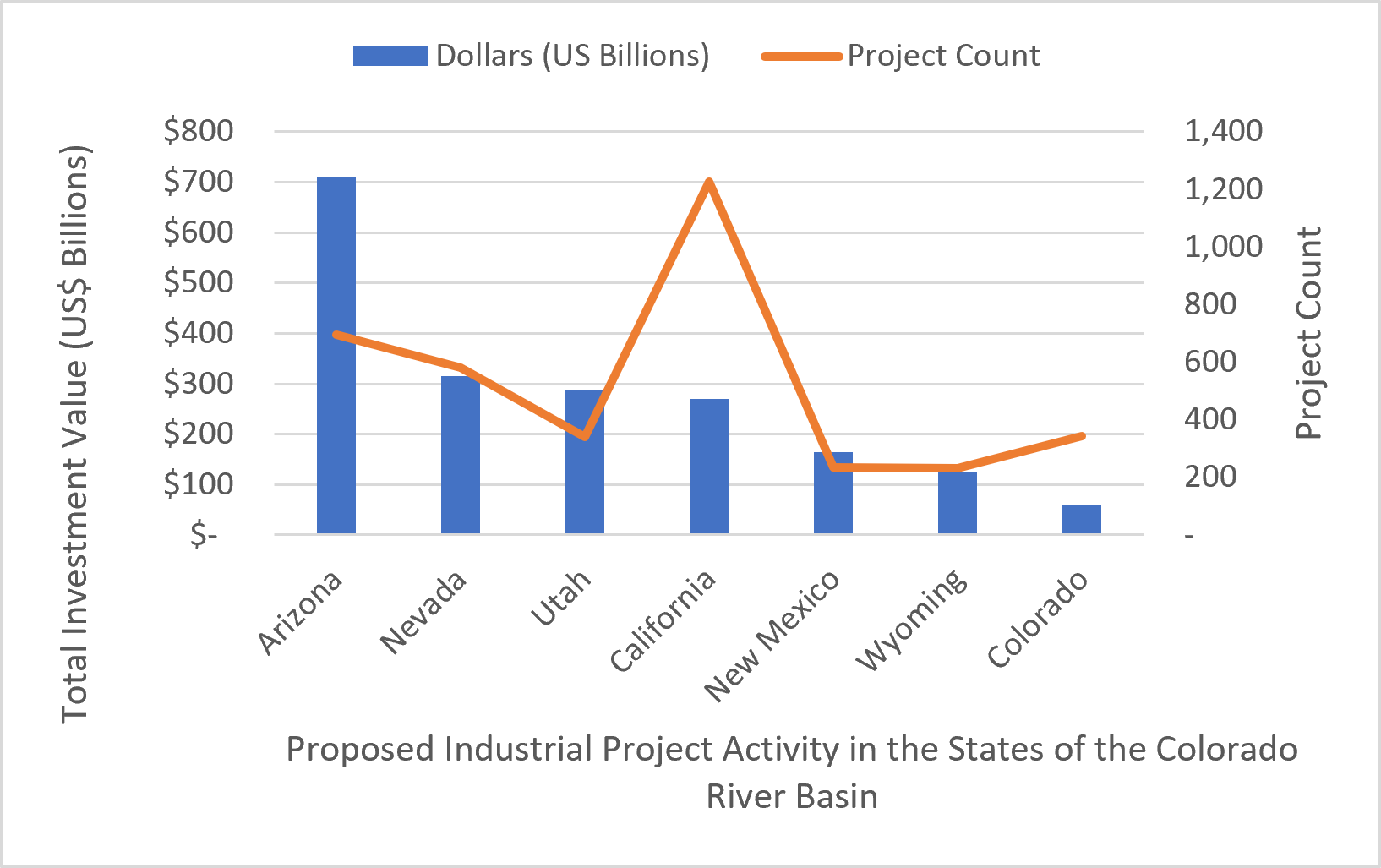 But looking more narrowly at Arizona, California and Nevada, the three Lower Basin states slated to have their water allocations cut, Industrial Info Resources is tracking about 2,500 proposed capital projects worth approximately US$1.3 trillion. Arizona, home to a number of water-thirsty proposed semiconductor manufacturing projects, is far and away the most vulnerable state, with 694 proposed capital projects worth about $712 billion across all 12 industries being tracked. Readers can access this list of project activity in three Lower Basin states here.
The industry in the Lower Basin states with the greatest level of proposed capital project activity is Industrial Manufacturing, with 586 proposed projects valued at approximately $717 billion, followed by Electric Power (839 projects worth $419 billion), and Metals & Minerals (401 scheduled projects valued at $120 billion).
"The proposal responds to a fundamental reality: the Colorado River no longer reliably produces enough water to support all the uses and expectations built around it," J.B. Hamby, California's Colorado River Commissioner, said in a statement. "That challenge is shared across the Basin, and addressing it requires specific, measurable reductions in water use by every state."
Key Takeaways
- After years of fruitless negotiation among seven states, the U.S. Department of the Interior on July 31 cut water allocations from the Colorado River to Arizona, California and Nevada for the water year beginning October 1, 2026.
- The cutbacks, set at 1.5 million acre-feet per year, could rise to 3 million acre-feet per year if the current drought in the Southwest continues.
- Litigation is expected.
- The cutbacks, if they survive expected legal challenges, could upend planned industrial project development in the Lower Basin states of Arizona, California and Nevada.
- Industries with the greatest exposure to water cuts in the Lower Basin states are Industrial Manufacturing, Power and Metals & Minerals.
About Industrial Info Resources
Industrial Info Resources (IIR) is the leading provider of industrial market intelligence. Since 1983, IIR has provided comprehensive research, news and analysis on the industrial process, manufacturing and energy related industries. IIR's Global Market Intelligence (GMI) helps companies identify and pursue trends across multiple markets with access to real, qualified and validated plant and project opportunities. Across the world, Industrial Info Resources is tracking over 250,000 current and future projects worth $30.2 trillion (USD).
/news/article.jsp
false
Want More IIR News Intelligence?
Make us a Preferred Source on Google to see more of us when you search.
Add Us On GoogleAsk Us
Have a question for our staff?
Submit a question and one of our experts will be happy to assist you.

Forecasts & Analytical Solutions
Where global project and asset data meets advanced analytics for smarter market sizing and forecasting.
Explore Our SolutionsRelated Articles
-
Blackstone Upbeat on Long-Term Outlook for U.S. Data CentersOctober 23, 2026
-
Roofing Materials Production Drives Multiple U.S. Constructi...October 22, 2026
-
ABB Builds Backlog with Canadian Mining, U.S. Tech WorkOctober 21, 2026
-
Argentina y Brasil lideran los cinco principales proyectos d...October 21, 2026

PECWeb Global Market Intelligence Platform
Identify opportunities, anticipate change, and execute with confidence. PECWeb connects the industrial intelligence you need, from projects and assets to operational events, all in one platform.
Discover PecwebIndustry Intel
-
Mining Capital Spending 2026: Copper, Rare Earths, AluminumPodcast Episode / Oct 23, 2026
-
Brazil Critical Minerals 2027: Rare Earths, Lithium, CopperPodcast Episode / Oct 16, 2026
-
US Craft Labor Outlook 2026: Wages, Per Diems, Data CentersPodcast Episode / Oct 16, 2026
-
Latin America Data Center Outlook 2026: Power, Hubs & GrowthPodcast Episode / Oct 9, 2026
-
Food and Beverage CapEx Outlook 2026: Tariffs, AI, AfricaPodcast Episode / Oct 9, 2026