Metals & Minerals
IEA: Global Critical Minerals Risks Became Realities in 2025
The global economy experienced its first taste of critical minerals supply chain disruptions last year, the result of rising demand, increasing prices, supply chain concentrations and wider use of trade restrictions on various minerals that are used in energy, the military, transportation and consumer electronics, according to a new report from the International Energy Agency.
Released Wednesday, July 22, 2026
Written by John Egan for IIR News Intelligence (Sugar Land, Texas)
Summary
The global economy experienced its first taste of critical minerals supply chain disruptions last year, the result of rising demand, increasing prices, supply chain concentrations and wider use of trade restrictions on various minerals that are used in energy, the military, transportation and consumer electronics, according to a new report from the International Energy Agency.Critical Minerals Supply Chains: From Risk to Reality
The International Energy Agency (IEA) has for years warned about a fragile supply chain for a variety of critical minerals, including rare earth minerals, but in 2025 those risks became real, and further potential shocks are evident on the horizon, the agency said in its annual "Global Critical Minerals Outlook," report, released July 16.According to Industrial Info Resources data, there are nearly 9,000 active capital critical minerals-related projects globally, with a total investment value of US$1.32 trillion.
In 2025, the IEA report said, "the economic risks of highly concentrated supply chains materialized at scale. In April 2025, the Chinese government introduced major export controls on seven heavy rare earth elements, with significant impacts across downstream industries, forcing some automakers to reduce utilization rates or temporarily halt operations. In October 2025, they were further expanded, extending proposed restrictions to internationally made products containing rare earths sourced from China or produced using Chinese technologies."
Although China suspended these expanded measured for one year, until this coming November, the agency said the vulnerabilities remain.
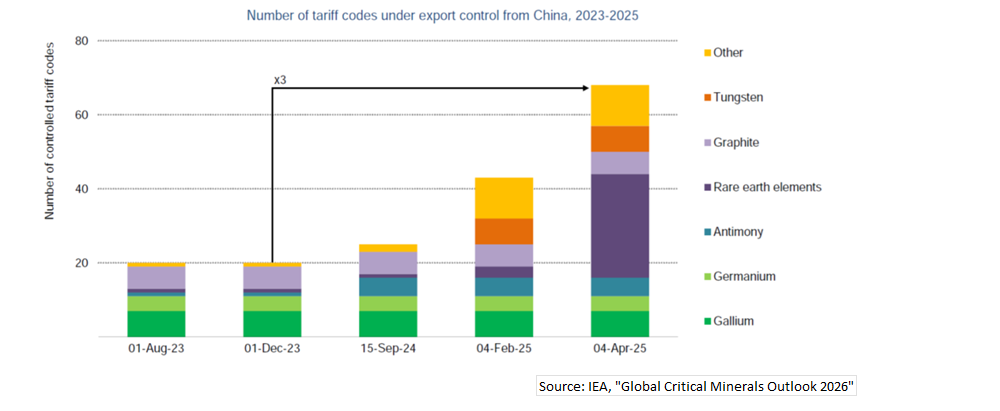
"The recent proliferation of export controls has transformed concerns around high supply concentration from a theoretical vulnerability into an immediate economic security challenge," the report said.
The IEA report grouped the minerals it assessed into these categories:
- Battery minerals, including lithium, nickel, cobalt, graphite, high-purity manganese and purified phosphoric acid.
- Rare earth elements, mainly four magnet-related elements: neodymium, praseodymium, dysprosium and terbium.
- Base metals, including aluminum, copper, lead, tin and zinc.
- Alloy metals, such as chromium, molybdenum and vanadium.
- Strategic minor minerals, which include antimony, bismuth, gallium, germanium, tantalum, tellurium, titanium and tungsten.
Joseph Govreau, VP Metals & Minerals Research for Industrial Info Resources, observed, "Miners and processors of critical minerals mentioned in the IEA report are taking notice, and we've seen a significant increase in project activity for mining and processing projects during this time period."
Strong Demand, Export Controls Push Up Prices
Strong demand growth for critical minerals, coupled with highly concentrated mining and processing of those minerals as well as some export controls, have pushed up the prices for a variety of minerals.In 2024 and 2025, global demand grew meaningfully for key minerals used in energy, particularly lithium, graphite and cobalt. Other energy-related minerals, such as rare earths, nickel and copper, notched slower demand growth, the IEA said.
This demand growth, coupled with highly concentrated mining and processing of those minerals and, in some cases, export controls, drove prices upward for a variety of minerals between January 2025 and April 2026, the report said. Prices for base metals such as aluminum, copper and tin rose by an average of about 33% over that period, with copper prices reaching record highs.
Battery mineral prices also rose sharply following a downturn in 2023 and 2024, with lithium prices more than doubling and cobalt prices shooting up by around 130%.
A third category of minerals, used in magnets, including neodymium and praseodymium, also saw sharp price escalations over that time.
Price gains since January 2025 were particularly pronounced for what the agency termed "strategic minor minerals," such as tungsten and tantalum. Tungsten prices shot up 620% between January 2025 and April 2026 while tantalum prices rose nearly 200%. For more on tungsten, see June 1, 2026, article - China Restrictions Lead to Tungsten Supply Crunch.
Prices for indium and bismuth, two other strategic minor minerals, each rose approximately 100% over that 16-month period.
By the Numbers
- 620%: Average price increase for tungsten between January 2025 and April 2026
- 190%: Average price increase for tantalum over that same period
- 130%: Average price increase for cobalt over that same 16-month period
- 110%: Increase in price for neodymium between January 2025 and April 2026
Price Gains Don't Translate into Higher Prices -- Yet
While price increases for some critical minerals have been eye-popping, the good news is that those minerals are used in very small amounts, so their price escalations should not materially drive up the costs of goods made with them. Moreover, the report said that outlays to strengthen supply chains and expand supply and processing capacity should not cause additional big gains in the price of finished goods made with those materials.For example, the report said, critical minerals account for around one-quarter of battery cell costs but only about 3% of the price of an average electric vehicle, while rare earths represent around 40% of permanent magnet costs, but less than 1% of a vehicle's value.
"While diversified supply can come at a higher cost, this can be viewed as a mineral security premium in a time of geopolitical uncertainty--a form of economic insurance against major supply risks," IEA's Birol said.
Greater Action Needed to Diversify Supply Chains
Outright cutoffs of critical minerals exports, as opposed to price increases, could create global shockwaves in various industries, the IEA said. It recognized that nations are increasing efforts and investments to diversify the supply of critical minerals and build more resilient supply chains. For more on that, see: February 10, 2026, article - Trump Announces $12 Billion Plan to Stockpile Critical Minerals; April 9, 2026, article - IEA Highlights Strengthening Rare Earth Supply Chains; and July 14, 2026, article - U.S. Army Announces Base Lease Agreements with Critical Minerals Miners.In advanced economies, governments pledged investments totaling about US$65 billion in 2025, four times the level of investment in 2023, the IEA report said. But it noted there remains a big gap between commitments and actual outlays. Moreover, it said commitments remain disproportionately concentrated in mining, with refining being starved for investment.
Beyond money and policies, the IEA report encouraged nations to think holistically about what is needed to establish truly resilient critical minerals supply chains. Resolution of existing technology and equipment bottlenecks, and building a skilled workforce, also are necessary.
Key Takeaways
- Global trends, such as strong demand growth, rising prices and continued high concentrations of mining and processing, coupled with some export controls, turned potential supply chain risks into realities for some critical minerals in 2025, according to a report from the International Energy Agency.
- Governments in advanced economies have quadrupled their pledges to invest in critical minerals supply chains, but actual outlays trail commitments.
- Investments to diversify critical minerals supply chains remain too concentrated in mining and not in downstream activities such as processing.
About Industrial Info Resources
Industrial Info Resources (IIR) is the leading provider of industrial market intelligence. Since 1983, IIR has provided comprehensive research, news and analysis on the industrial process, manufacturing and energy related industries. IIR's Global Market Intelligence (GMI) helps companies identify and pursue trends across multiple markets with access to real, qualified and validated plant and project opportunities. Across the world, Industrial Info Resources is tracking over 250,000 current and future projects worth $30.2 Trillion (USD).
Want More IIR News Intelligence?
Make us a Preferred Source on Google to see more of us when you search.
Add Us On GoogleAsk Us
Have a question for our staff?
Submit a question and one of our experts will be happy to assist you.

Forecasts & Analytical Solutions
Where global project and asset data meets advanced analytics for smarter market sizing and forecasting.
Explore Our SolutionsRelated Articles
-
Brazil Rare Earth Mine Gets U.S. Backing Through US$1.55 Bil...September 04, 2026
-
Niger Takes Control of Uranium MiningSeptember 04, 2026
-
Nuclear Power Push Triples U.S. Uranium Production in 2025, ...September 03, 2026

PECWeb Global Market Intelligence Platform
Identify opportunities, anticipate change, and execute with confidence. PECWeb connects the industrial intelligence you need, from projects and assets to operational events, all in one platform.
Discover PecwebIndustry Intel
-
2026 Oil & Gas CapEx Outlook: Middle East, LNG & PermianPodcast Episode / Sep 4, 2026
-
The Answer Age Starts with Trusted Data: Introducing IIR Envoy™ MCPPodcast Episode / Sep 1, 2026
-
European Chemicals and Transport Fuels OutlookPodcast Episode / Jul 10, 2026
-
2026 European Petroleum Refining Project OutlookPodcast Episode / Jun 26, 2026
-
Brazil: Efficiency, Innovation, and Opportunities in the Food & Beverage IndustryPodcast Episode / Jun 12, 2026