Power
New Zealand's State-Owned Power Companies Face Market Clashes on Coal and Gas Prices
The temper and tone of the scene at one extreme can be demonstrated by the public reaction to Transpower's, the state's grid operator, plan to make the country's largest city - includes chart
Released Thursday, April 28, 2005
Researched by Industrialinfo.com (Industrial Information Resources Incorporated; Houston, Texas). Demand for increased electricity generation, availability of thermal coal stocks, the price of gas supply, and the market options of independent operators in a scenario including major state-controlled power enterprises, makes the current New Zealand energy and resource scene one of the most intriguing power shows in town.
The temper and tone of the scene at one extreme can be demonstrated by the public reaction to Transpower's, the state's grid operator, plan to make the country's largest city, Auckland, more self-sufficient in power, by building a string of pylons for 200 kilometers through central North Island, crossing private lands and virgin territory. The local station, TV ONE, reports that effigies have been burnt, Transpower staff shouted down, and even death threats made.'
The negative reaction to the $370 million pylon project has caused the newly established Electricity Commission (EC) to put back a decision on the 400kV line for a year. This is the first time that Transpower has had to take a proposal to the newly formed EC.
Transpower (TP) is now seeking approval for a $125 million national grid upgrade, for which consumers will bear the main cost. TP is looking at what lines could 'run hotter' and improving voltage flow at substations and squeezing transmission technology in North and South Island. Other alternatives being considered by the EC include new power plants near Auckland, subsidized energy efficiency programs, more domestic use of gas, and higher peak electricity charges for Auckland's consumers.
With national demand for power growing at a rate equivalent to 120 MW of additional generation a year, the state-owned Genesis Energy (GEN) has suspended plans for two 400 MW power plants on North Island, until they are satisfied that Solid Energy (SE) is able to provide secure coal feedstock supplies. GEN and SE agree that there is only about 50 million tons of coal easily recoverable in the Waikato region in North Island. Dr Don Elder, SE Chief Executive Officer, said, " the issue here is about prices. Our reserves estimates have not changed. We have always said there are 200 to 300 million tons of coal in the Waikato, and we stand by that. He added, "The physical amount of coal has not disappeared. The issue is the amount of coal people want will always be governed by the end price of electricity."
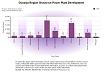 Industrialinfo.com is tracking 36 grassroot power plant projects in the Oceania Region, which includes New Zealand and Australia. These projects have a total investment value of $6.5 billion. Click on the image at right to view a chart showing the breakdown of this spending by state.
With a 380 MW gas-fed combined cycle power plant now under construction at the GEN Huntly site, 70 kilometers south of Auckland, where their established 1,000 MW thermal power station is situated, GEN's Chief Executive, Murray Jackson, has said that even topped up with imports available, coal would only provide certainty of supply for Huntly for seventeen years. He has asked for an independent report on how to recover 100 million tons of coal from the Huntly West Mine. This is a project, which would be technically difficult and costly. A joint effort between GEN and SE on CO2 capture and 'clean' generation technology could also make decisions and approvals on thermal power projects easier to achieve.
Construction of the new $370 million Huntly e3p combined-cycle plant should have started eighteen months ago, but was stalled over concerns about adequate gas supplies. The government then promised to compensate GEN if the fuel ran out. GEN is now confident about gas supplies from existing and new fields. Some critics of the siting of the new plant at Huntly say that it compounds supply problems and that it should have been built in Auckland to take pressure off the overloaded national grid and avoid blackouts in the city. Huntly, naturally, welcomes the boost to the local economy and 200 new jobs.
The pricing of gas-fed generation is also a bone of contention. Richard Tweedie, Managing Director of Todd Energy (TEN) (Wellington), New Zealand's largest domestic oil and gas explorer and producer, said at the annual New Zealand Power Summit in March that LNG importation could 'materially damage the gas market. He said that if such generators as Contact Energy and GEN decided to import LNG, then Todd Energy would use its gas entitlements to make electricity and sell that power into the wholesale market, rather than sell gas directly. He said his company was investigating the construction if its own 200 MW power station.
TEN has interests in a number of commercial gas fields including Maui, Kapuni, McKee, and Mangaweha, and prospects in the $730 million Pohokura project.
Tweedie claimed that electricity prices had been sold on a misrepresentation. Generators were still burning cheap Maui gas in their power stations, not the more expensive gas coming into the market. New wholesale gas prices were around $50 per gigajoule, while Maui gas cost companies $1.45 to $2.18 per gigajoule. Industry sources say that in fact while Maui gas is still the sole feed for some power stations, many have a mix with more expensive supplies.
Tweedie also said that insufficient competition in the electricity sector had led to 'significant market dysfunction,' with government protecting and favoring its own enterprises - Meridian, Genesis, Mighty River Power, and the national grid operator, Transpower. The big power generators were also the country's biggest power retailers, able to match their supply with demand from their business and residential customers.
View Project Report - 87300017
Industrialinfo.com is the leading provider of global industrial market research. We specialize in helping companies develop information solutions to maximize their sales and marketing efforts.
/news/article.jsp
false
Want More IIR News Intelligence?
Make us a Preferred Source on Google to see more of us when you search.
Add Us On GoogleAsk Us
Have a question for our staff?
Submit a question and one of our experts will be happy to assist you.

Forecasts & Analytical Solutions
Where global project and asset data meets advanced analytics for smarter market sizing and forecasting.
Explore Our SolutionsRelated Articles
-
Global Power Construction Spending Led by Nuclear, WindAugust 24, 2026
-
Duke Energy Files 2026 Carolinas' Resource PlanAugust 24, 2026
-
Denmark Drives Offshore Wind AmbitionsAugust 24, 2026

PECWeb Global Market Intelligence Platform
Identify opportunities, anticipate change, and execute with confidence. PECWeb connects the industrial intelligence you need, from projects and assets to operational events, all in one platform.
Discover PecwebIndustry Intel
-
European Chemicals and Transport Fuels OutlookPodcast Episode / Jul 10, 2026
-
2026 European Petroleum Refining Project OutlookPodcast Episode / Jun 26, 2026
-
Brazil: Efficiency, Innovation, and Opportunities in the Food & Beverage IndustryPodcast Episode / Jun 12, 2026
-
2026-2027 Investment Radar for Mexico, Central America & the CaribbeanPodcast Episode / May 29, 2026
-
Innovations Shaping the Next Era of Power GenerationPodcast Episode / May 22, 2026