Power
S&P Global: New Climate Scenarios Say Paris Agreement 'No Longer Possible'
S&P Global says the goal of the Paris Agreement to hold the global temperature gain to 1.5° Celsius above Industrial Revolution levels is unattainable
Released Monday, June 16, 2025
Written by John Egan for Industrial Info Resources (Sugar Land, Texas)--Last month, S&P Global became one of the first analytic firms to publicly acknowledge what many have long suspected: that the goal of the Paris Agreement, which sought to hold the global temperature gain to 1.5° Celsius above Industrial Revolution levels, has become unattainable.
Speaking to about 125 attendees at S&P Global's "Carbon Management Americas 2025," held May 13-15 in Denver, Colorado, Jeff Moore, S&P Global's associate director, scenarios and energy transition, began his talk with this caution: "Any claim of a definitive long-term view of the energy future should be met with skepticism and close scrutiny."
He then reviewed why: Global fossil fuel use continued to rise throughout the 2000-2023 period, leading to steadily rising emissions of greenhouse gases, at a time when a consensus was emerging that the world needed to reduce its use of those fuels as a way to cut carbon emissions. That global consensus included government leaders, climate scientists, corporate leaders, consultants and leaders of non-governmental organizations. For nearly two decades, the U.S. has gone back and forth on the need to reduce GHGs.
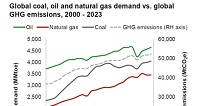
"Fossil fuel demand has been rising and rising" since 2000, which "continues to surprise us year after year," Moore said. "Global greenhouse gas emissions have also risen because the world is using more fossil fuels."
Moore said the same about renewable electric generation: "Renewables also has surprised us to the upside year after year."
The data showed that "worldwide fossil fuel demand is very sticky," he said. "Global energy demand is very sticky."
So when the data no longer aligns with the model, good modelers come up with a new model that reflects updated data.
Until now, S&P Global had been using five climate change scenarios, which were prepared in July 2024.The base case was called "Inflections," the low-emissions case was called "Green World" and a case where the world failed to collaborate on GHG reduction was called "Discord." None of those three scenarios was expected to hold the global average temperature gain under 1.5° Celsius by 2100. All envisioned fossil fuels accounted for a large plurality, or even a majority of total primary energy demand. The temperature gain to 2100 was projected to be 2.4° C in the Inflections case, 3.1°C in the Discord scenario and 1.8° C in the Green World case.
S&P Global's mid-2024 climate scenarios also included two net-zero cases, one called "Accelerated Carbon Capture, Use and Sequestration" and the other "Multi-tech Mitigation," where, through a combination of means, fossil fuel use declined sharply and the global average temperature gain to 2100 was held to 1.5° C.
But Moore said recent energy use data showed that "limiting warming to 1.5° C is no longer possible. That's the key underpinning for our new scenarios." S&P Global will be rolling out the five new climate scenarios in the coming weeks. Below is a summary.
- House View, the new base case, sees a moderate pace to the energy transition. Global fossil fuel use falls but remains at about 50% of overall primary energy use around the world. The average temperature gain to 2100 is about 2.5° C.
- Renaissance, which replaced the Green Rules case, envisions a delayed start to the energy transition, then an accelerated pace. This slow-then-fast case has emerging markets playing a key role in a late-but-accelerated energy transition. In this case, global average temperature gain is held under 2° C by 2100.
- Adaptation, an update of the Discord case, balances fossil fuel-powered growth with heightened concerns about climate change. The pace of the transition is slow, and temperatures rise about 3° C by 2100.
- Fracture is characterized by accelerated technological progress set against a weak policy and governance background. In this case, artificial intelligence (AI) does not meet expectations. The temperature gain is projected to be about 2° C by 2100.
- Net-Zero 2050, which Moore said "is not in the realm of possibility," contemplated an energy transition that holds the temperature gain to 1.5° C.
- Slower global population growth
- Demand for electric power will grow in both relative and absolute terms; and
- A repeat of the dramatic economic growth experienced by China from the 1990s to the 2020s will not happen.
Industrial Info Resources (IIR) is the leading provider of industrial market intelligence. Since 1983, IIR has provided comprehensive research, news and analysis on the industrial process, manufacturing and energy related industries. IIR's Global Market Intelligence (GMI) platform helps companies identify and pursue trends across multiple markets with access to real, qualified and validated plant and project opportunities. Across the world, IIR is tracking over 200,000 current and future projects worth $17.8 Trillion (USD).
/news/article.jsp
false
Want More IIR News Intelligence?
Make us a Preferred Source on Google to see more of us when you search.
Add Us On GoogleAsk Us
Have a question for our staff?
Submit a question and one of our experts will be happy to assist you.

Forecasts & Analytical Solutions
Where global project and asset data meets advanced analytics for smarter market sizing and forecasting.
Explore Our SolutionsRelated Articles
-
NextEra Eyes Strong Backlog, Data Center Hub StrategyOctober 23, 2026
-
Winter 2026-27 Outlook: Strong El Niño Expected to Shape Nor...October 23, 2026

PECWeb Global Market Intelligence Platform
Identify opportunities, anticipate change, and execute with confidence. PECWeb connects the industrial intelligence you need, from projects and assets to operational events, all in one platform.
Discover PecwebIndustry Intel
-
Mining Capital Spending 2026: Copper, Rare Earths, AluminumPodcast Episode / Oct 23, 2026
-
Brazil Critical Minerals 2027: Rare Earths, Lithium, CopperPodcast Episode / Oct 16, 2026
-
US Craft Labor Outlook 2026: Wages, Per Diems, Data CentersPodcast Episode / Oct 16, 2026
-
Latin America Data Center Outlook 2026: Power, Hubs & GrowthPodcast Episode / Oct 9, 2026
-
Food and Beverage CapEx Outlook 2026: Tariffs, AI, AfricaPodcast Episode / Oct 9, 2026