Power
Wind, Solar Capacity Grew 16% in 2024 in 'Disorderly' Energy Transition
Worldwide primary energy use rose 2% in 2024, according to the recently released 'Statistical Review of World Energy,' published by the Energy Institute (EI) (London, England) and consultants Kearney (Chicago, Illinois) and KPMG (London).
Released Tuesday, July 08, 2025
Written by John Egan for Industrial Info Resources (Sugar Land, Texas)--Worldwide primary energy use rose 2% in 2024, according to the recently released "Statistical Review of World Energy," published by the Energy Institute (EI) (London, England) and consultants Kearney (Chicago, Illinois) and KPMG (London). Last year's electricity demand growth was double that, at 4%, confirming other analysts' views that the world is entering an era of electrification. But on a combined basis, wind and solar generation grew a record 16% around the world, offering hope to those fighting global warming.
The report, released June 26, noted that renewables' growth in 2024 was nearly nine times that of primary energy demand growth, and four times electric demand growth. But the report, and speakers at a press event to release the study, rued that fossil fuel use continued to grow as well last year.
Over the last decade, worldwide electric use has grown by an average of 2.6% per year, which is double the rate of overall energy use, the report said, adding, "This highlights how the global energy system is electrifying at pace."
In 2024, total installed solar capacity increased by 32%, EI said. For those countries with significant solar generation, China, India and the U.S. were the fastest growing solar markets on a percentage basis. Other countries, such as Brazil, Greece, Lithuania and Saudi Arabia, also grew rapidly, but the growth rate came on a smaller base.
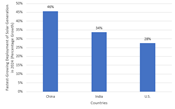 Click on the image at right to see how fast the largest solar markets grew in 2024.
 Growth in windpower additions has slowed markedly in recent years, falling to 11% last year. In 2024, on a percentage basis, the fastest-growing large markets for wind power were Australia, China, India, Germany and the U.S. Measuring on a percentage gain obscures important differences in market size: China and Australia each grew their wind generation capacity by 18% last year, but China's installed wind capacity (521,746 MW) is more than 30 times larger than Australia's (15,288 MW).
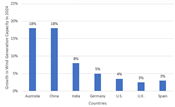 Click on the image at right to see how fast the largest wind markets grew in 2024.
 On its website, the EI said its purpose is to "accelerate a just global energy transition to net zero." Consistent with that, the report and speakers voiced concern that the world's increased hydrocarbon use could threaten the coals of the Congress of the Parties 28 (COP28), where nearly 200 nations pledged to hold average long-term temperature gain to 1.5° Celsius above Industrial Revolution levels.
Speakers at the June 26 press event noted that, compared to generating electricity from fossil fuels, renewables offered lowered risks and far less transportation costs. However, they noted that integrating renewables into each country's grid was not always an easy task, particularly if that country's electric system was dominated by large, baseload generators.
"This year's data reflects a complex picture of the global energy transition," EI President Andy Brown said June 26. "Electrification is accelerating, particularly across developing economies where access to modern energy is expanding rapidly. However, the pace of renewable deployment continues to be outstripped by overall demand growth, 60% of which was met by fossil fuels. The result is a fourth consecutive year of record emissions, highlighting the structural challenges in aligning global energy consumption with climate goals."
He added that the world has been "buffeted by crises over the last five years, many involving energy." His colleague Nick Wayth, chief executive of EI, said the "overlapping crises over the last five years," including the COVID-19 pandemic, the supply chain crisis, the Russian invasion of Ukraine and the ensuing reordering of global energy trade, "show the vulnerabilities of fossil fuels to geopolitical risks."
Nonetheless, Wayth said the world energy system was several years into an "immense transformation," though not exactly the one his organization was seeking. Rather than renewable energy supplanting fossil fuels, as EI hoped, all forms of energy, including fossil fuels, hit new record usage last year. He and other speakers at the press event said it has been a process of "energy addition rather than energy substitution.
Wayth noted that the dramatic growth of renewables in recent years avoided using nearly 40 exajoules (EJ) of energy, most of which would have come from fossil fuels, and prevented the release of about 10 gigatons of carbon dioxide (CO2).
Despite the rapid runup of renewables in recent years, approximately 86% of the world's primary energy still came from fossil fuels in 2024. In a year when oil accounted for about 34% of global primary energy demand, coal 28% and natural gas 25%, renewables such as wind and solar accounted for just over 5% of primary energy use, slightly more than nuclear power and about double the percentage of hydroelectricity.
But focusing more narrowly on overall electric fuel mix, 17% of the world's electricity came from renewables last year, the EI report said. Hydroelectric generation accounted for another 14% and nuclear about 9%. So the EI authors and speakers underscored how 40% of the world's electricity last year came from non-fossil fuels.
Wafa Jafri, a partner at KPMG and leader of its energy and natural resources strategy group, observed: "The world is electrifying at speed, but at a time when the use of fossil fuels for all purposes also increased. Renewable generation is growing, but falling short of the pace needed to meet climate targets set out at the U.N. climate summit," the COP 28 in 2023. For more on COP28, see December 15, 2023, article - U.N. Climate Summit Endorsed Transition Away from Fossil Fuels, but Questions Remain.
Jafri continued: "COP28 set out a bold vision to triple global renewables by 2030, but progress is proving uneven. Despite the rapid growth we have seen globally, we are still not at the pace required, as (overall) energy demand continues to rise."
She said this year's report shows that Europe "has been facing a reality check (on renewables), with rising interest rates and supply chain costs slowing progress on renewables, while China and other emerging markets continue to drive growth at scale. What's emerging is not a uniform transition, but a disorderly one."
Industrial Info Resources (IIR) is the leading provider of industrial market intelligence. Since 1983, IIR has provided comprehensive research, news and analysis on the industrial process, manufacturing and energy related industries. IIR's Global Market Intelligence (GMI) platform helps companies identify and pursue trends across multiple markets with access to real, qualified and validated plant and project opportunities. Across the world, IIR is tracking over 200,000 current and future projects worth $17.8 Trillion (USD).
Want More IIR News Intelligence?
Make us a Preferred Source on Google to see more of us when you search.
Add Us On GoogleAsk Us
Have a question for our staff?
Submit a question and one of our experts will be happy to assist you.

Forecasts & Analytical Solutions
Where global project and asset data meets advanced analytics for smarter market sizing and forecasting.
Explore Our SolutionsRelated Articles
-
Global Power Construction Spending Led by Nuclear, WindAugust 24, 2026
-
Duke Energy Files 2026 Carolinas' Resource PlanAugust 24, 2026

PECWeb Global Market Intelligence Platform
Identify opportunities, anticipate change, and execute with confidence. PECWeb connects the industrial intelligence you need, from projects and assets to operational events, all in one platform.
Discover PecwebIndustry Intel
-
European Chemicals and Transport Fuels OutlookPodcast Episode / Jul 10, 2026
-
2026 European Petroleum Refining Project OutlookPodcast Episode / Jun 26, 2026
-
Brazil: Efficiency, Innovation, and Opportunities in the Food & Beverage IndustryPodcast Episode / Jun 12, 2026
-
2026-2027 Investment Radar for Mexico, Central America & the CaribbeanPodcast Episode / May 29, 2026
-
Innovations Shaping the Next Era of Power GenerationPodcast Episode / May 22, 2026