Industrial Manufacturing
Black & Veatch Report Showcases Need to Digitize U.S. Water Utilities
U.S. water utilities face a daunting array of challenges.
Released Tuesday, July 21, 2020

Written by John Egan for Industrial Info Resources (Sugar Land, Texas)--Even during their best years, U.S. water utilities face a daunting array of challenges: aging infrastructure, aging workforce, climate change, supply and resiliency issues, and shifting regulatory mandates, among other perennial challenges. And this year will not go down as one of the industry's best, as the COVID-19 pandemic strains the finances of many water utilities.
The two-pronged answer to many of the questions facing water utilities, according to Black & Veatch's Strategic Directions: Water Report, is data and advanced technology. Deploying both to drive decision-making will help water utilities become digital, which will lower costs, streamline processes and free up capital that can be invested in replacing aging equipment.
The report, released in mid-June, makes clear that there is a large book of business in the U.S. water utility industry, both for engineering and construction companies as well as technology providers. But firms angling for business may have to find ways to creatively address the 800-pound elephant in the room: how to pay for the needed upgrades.
Black & Veatch (Overland Park, Kansas) fielded an online survey to water utility practitioners during a three-week period in March, when COVID-19 was intensifying across the country. The report, based on responses from nearly 300 respondents, continues the company's annual analyses of critical strategic issues facing industries that Black & Veatch serves.
The vital importance of data and digital technologies to transform the industry is amplified in the report's executive summary, titled, "Digital Water Expands in Use, Importance in a Time of Climate Change, Pandemics." The term "digital water" refers to the digitization trend among water utilities, mainly through their broader deployment of various types of information technology (IT) and operational technology (OT) to propel better decision-making and optimize use of the utility's assets.
"Aging infrastructure and the graying of the industry's retirement- bound workforce remains a vexing issue, decades in the making," Cindy Wallis-Lage, president of Black & Veatch's water business, writes in that opening section of the report. "Climate change continues to assert itself in dramatic ways - from a 'mega-drought' gripping a large swath of the western United States to intense flooding elsewhere - that test the ability of water utilities either to provide enough water or effectively handle historic inundations."
"Now more than ever, stakeholders faced with such complexities continue to embrace the promise of 'digital' or 'smart" water,' Wallis-Lage continued. "That means harnessing data to precisely track consumption, drive customer engagement, optimize performance and prioritize investment dollars. Increased sustainability and resilience through informed asset management (AM) and planning are the rewards, along with the invaluable, holistic view of the water system."
The importance of taking a more holistic, digitized approach to water utility operations is highlighted by another perennial truism in the industry: Funding, tight in most years, is likely to get even tighter. Commercial and industrial (C&I) customers - some of the biggest water consumers - sharply cut back usage this spring as many facilities halted operations during the nation's coronavirus crisis. Many utilities granted unemployed and furloughed workers payment extensions. Both squeezed the finances of water utilities. A water trade group estimated the pandemic will cut revenue at water utilities $13.9 billion.
A revenue shortfall like that means "incorporating digital water (upgrades) to capitalize on a utility's data is more critical than ever to ensure the greatest return on capital and operational investments," said Wallis-Lage.
Indeed, a majority of respondents said they were collecting lots of data, but not leveraging it effectively. Smaller percentages were split between collecting lots of data and leveraging it effectively, on the one hand, and collecting some data and leveraging it effectively.
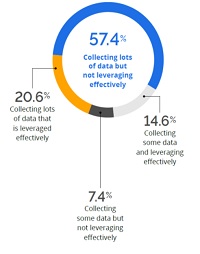
"Enter the power of data to gain insight about when, where and how much to invest in our systems," Wallis-Lage commented. "The opportunity to gather and integrate data using our current data collection systems - combined with evolving next-generation, cost-effective sensors and smart devices - provides the input to allow for the predictive analytics to detect leaks, forecast usage, reduce costs and everything in between."
The water industry "is an asset-intensive, rate-restricted industry that requires informed decision-making to effectively balance capital investment and rising operational expenses with resistance to rate increases," according to a chapter written by four Black & Veatch water experts. "This makes the water industry notoriously complex, variable and uncertain."
"The industry, therefore, is an ideal candidate for a technological overhaul and transformation that would build new, data-driven solutions for effective asset management, efficient operations and remote system management, reducing operating costs.
"This overhaul will rely on better use of existing data," continue the subject-matter experts (SMEs), "coupled with new sensors, information integration and data analytics to achieve a sought-after result called 'digital water.'"
Unfortunately, those SMEs cautioned, most U.S. water utilities "have a long way to go with digital sensors, communications and data analytics before they can reach the desired future state as a digital water utility."
Becoming a digital water utility requires an optimal blend of data quality, data access and data leverage, the report said.
These four SMEs recommend adoption or improvement of asset-management business practices coupled with broader deployment of remote system monitoring sensors. Other systems typically deployed by digital utilities include energy management, document management, business intelligence and enterprise resource management.
"Going forward, water utilities will need to properly deploy digital data acquisition and wield data analytics in utility operations and maintenance," the SMEs wrote. "That would preserve their existing infrastructure, address burdensome O&M costs, reduce water waste, determine where new investments in infrastructure would be most effective, and reap the benefits of smart water analytics and data sharing to drive intelligence-based decisions in operations and infrastructure investment."
The Strategic Directions: Water Report covers a wide range of other topics beyond becoming a digital water utility, but it seems the changes associated with that journey offer the industry the greatest opportunity to transform itself.
Some other critical takeaways from the report include:
- Climate change is playing a larger role in water supply planning, with 55% of respondents including it in their future forecasting - a shift in mindset over previous years.
- Natural or man-made disasters (nearly 84%) and catastrophic failure of infrastructure (56%) were the two most significant resilience-related concerns among respondents.
- Water and wastewater utilities actively are responding to mandates by conducting resilience and vulnerability assessments; more than half - 54% - have done so in the past year, with an additional 22% having carried that out in the past two to three years. This shows utilities are taking threats seriously and addressing vulnerabilities to become more resilient.
- When it comes to the confidence level of their utility's ability to meet current and still-evolving contaminant levels established by state and federal agencies, responses varied. One-third voiced extreme confidence in their adherence to dynamic standards for various contaminants, slightly more than those who considered themselves very or moderately confident.
- Faced with the specter of climate change and increasingly extreme weather events, nearly 60% of respondents say water reclamation and reuse are part of their sustainability goals and metrics, demonstrating that an expanding portfolio of water reuse strategies is becoming the norm.
- One-third of respondents say their customers probably don't understand what it takes to supply them with clean, potable water, as well as wastewater and stormwater services -- making it incumbent on the utility to help them appreciate the cost involved. Industrial Info Resources (IIR), with global headquarters in Sugar Land, Texas, six offices in North America and 12 international offices, is the leading provider of global market intelligence specializing in the industrial process, heavy manufacturing and energy markets. Industrial Info's quality-assurance philosophy, the Living Forward Reporting Principle, provides up-to-the-minute intelligence on what's happening now, while constantly keeping track of future opportunities. Follow IIR on: Facebook - Twitter - LinkedIn. For more information on our coverage, send inquiries to info@industrialinfo.com or visit us online at https://www.industrialinfo.com.
/news/article.jsp
false
Want More IIR News Intelligence?
Make us a Preferred Source on Google to see more of us when you search.
Add Us On GoogleAsk Us
Have a question for our staff?
Submit a question and one of our experts will be happy to assist you.

Forecasts & Analytical Solutions
Where global project and asset data meets advanced analytics for smarter market sizing and forecasting.
Explore Our SolutionsRelated Articles
-
Data Centers Push Vistra to Grow U.S. Nuclear, Natural Gas F...August 25, 2026
-
Typhoon Saudel Threatens Okinawa, Eastern ChinaAugust 25, 2026
-
China's 'New Type' Power Storage Now Half of Global CapacityAugust 24, 2026
-
Evergy Sees Opportunities in Midwest's Data Center BuildoutAugust 19, 2026
-
Texas Governor Pauses New Data Centers, Mirroring Growing U....August 19, 2026

PECWeb Global Market Intelligence Platform
Identify opportunities, anticipate change, and execute with confidence. PECWeb connects the industrial intelligence you need, from projects and assets to operational events, all in one platform.
Discover PecwebIndustry Intel
-
European Chemicals and Transport Fuels OutlookPodcast Episode / Jul 10, 2026
-
2026 European Petroleum Refining Project OutlookPodcast Episode / Jun 26, 2026
-
Brazil: Efficiency, Innovation, and Opportunities in the Food & Beverage IndustryPodcast Episode / Jun 12, 2026
-
2026-2027 Investment Radar for Mexico, Central America & the CaribbeanPodcast Episode / May 29, 2026
-
Innovations Shaping the Next Era of Power GenerationPodcast Episode / May 22, 2026