Power
Facing Potentially Huge Wildfire Liabilities, California's PG&E Outlines Capital Spending Plans
Pacific Gas and Electric outlines its capital budget plans for 2018 and 2019.
Released Monday, June 18, 2018
Reports related to this article:
Project(s): View 7 related projects in PECWeb
Plant(s): View 7 related plants in PECWeb
(Editor's note: This article incorrectly reported the number and value of active PG&E projects being tracked by Industrial Info. It has since been corrected.)
Written by John Egan for Industrial Info Resources (Sugar Land, Texas)--California's remaking of its energy market can be seen in changes to the capital spending plans of the state's major utilities, including Pacific Gas and Electric Company (San Francisco, California), the electric and gas utility unit of PG&E Corporation (NYSE:PGC) (San Francisco). In the not-too-distant past, the state's investor-owned utilities spent heavily on building fossil-fueled electric generation projects and long transmission lines. But now the spending trend is toward renewable generation, distribution system modernization, electricity storage, energy efficiency, and, in Pacific Gas and Electric's case, wildfire mitigation.
On June 8, the California Department of Forestry and Fire Protection (CAL FIRE) released a report on its investigation into the causes of 12 of the wildfires in Northern California that took place last October. Several of the fires were found to have originated when a tree came into contact with Pacific Gas and Electric equipment, though the agency did also find a few instances where fires started after the utility's equipment failed.
That report also found the utility violated state law governing vegetation management in eight of the wildfires, including blazes that killed nine people. In a separate investigation released in May, PG&E also was also found to be at fault for four other wildfires last October.
Analysts reportedly have estimated PG&E's total liability for these fires to be as high as $10 billion to $12 billion. PG&E has offered no estimate of its potential liability. But in a June 8 filing with the U.S. Securities and Exchange Commission (SEC) (Washington, D.C.), the utility and its corporate parent said they "expect that they will record a significant liability for losses associated" with last October's wildfires. That estimated liability will appear in the company's second quarter financial report.
Turning away from wildfire liabilities, Pacific Gas and Electric has a capital budget of about $6.3 billion for 2018 and $6 billion for 2019, up from 2017's actual capital investments of approximately $5.8 billion. Most of the spending for each year goes to the utility's regulated electric and gas distribution operations (its general rate case), but there also are significant outlays for gas transmission and electric transmission projects.
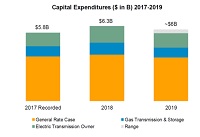
Industrial Info is tracking 44 active projects from the utility worth approximately $1.06 billion. However, longstanding plans to build several big-ticket items, such as pumped-storage projects, have been delayed for years and may never take place, given the way the energy market is evolving. Pacific Gas and Electric provides electricity to about 5.4 million customers and natural gas to roughly 4.5 million customers in northern and central California.
California electric utilities are operating under strict mandates to increase their reliance on renewable energy and lower their greenhouse gas emissions. The state has required electric utilities to get 50% of their electricity from renewable resources by 2030, one of the highest renewable portfolio standards (RPS) in the nation. Another California law requires electric utilities to lower their greenhouse gas emissions by 40% by 2030 compared to a 1990 baseline. Both of those mandates are pushing utilities away from gas-fired generation and toward non-emitting resources, including distributed energy resources (DERs) like rooftop solar and battery storage.
And while pumped storage projects might sound like a good fit for a low-emitting electricity market, the big price tags associated with those projects are a critical factor working against them. Utilities in the Golden State are not expecting customer load to grow much in the next few years, largely the result of prior years' heavy investments in customer programs to reduce energy use. That's another factor limiting the attractiveness of pumped storage projects.
The California Public Utilities Commission (CPUC) (San Francisco, California) recently ordered Pacific Gas and Electric to not rely on three gas-fired generators owned by Calpine (Houston, Texas) to provide energy and system voltage requirements in northern California. Instead, regulators instructed the utility to seek non-emitting resources to meet those needs. For more on that, see May 2, 2018, article - California Ends the Gas Power Gold Rush.
Separately, rather than replace an aging Oakland power plant, or build new transmission lines to serve that area, Pacific Gas and Electric investigated meeting the area's electric needs through a combination of energy efficiency, DERs and other measures that supported the state's clean energy goals.
Earlier this year, the CPUC approved Pacific Gas and Electric's plan to close its two-unit, 2,256-megawatt Diablo Canyon nuclear plant and replace the lost generation with a variety of non-emitting resources on the supply and customer side of the meter. The Diablo Canyon decommissioning project is the largest project on the utility's plate, valued at about $3.7 billion.
In a May 3 earnings call, officials from the holding company, PG&E Corporation, said they were working with its communities to enact enhanced vegetation measures in wildfire-prone areas, developing microgrids and hardening its distribution system (in part by replacing wood utility poles with non-wood poles).
Separately, in a May 7 business update, officials noted the electric and gas utility units were investing billions of dollars in safety upgrades. These investments follow the catastrophic San Bruno pipeline explosion in 2010, which killed eight people, injured many more and destroyed dozens of homes roughly two miles from the San Francisco International Airport. The utility was fined over $1 billion for that accident, and it was compelled to make hefty investments in gas pipeline safety.
PG&E officials also noted their electric utility was one of the greenest in the country: roughly 80% of its electricity comes from carbon-free resources, roughly twice the national average. Officials also noted that the electric utility unit was advancing a variety of programs to meet the state's clean energy initiatives, including grid modernization, renewable integration projects, energy efficiency programs, energy storage options, electric vehicle infrastructure and state infrastructure modernization projects in rail and water.
Each month, PG&E officials said, the electric utility unit was interconnecting about 4,000 rooftop solar units to its electric system. Customers also were adding about 3,300 electric vehicles each month. The average electric vehicle consumes roughly 50% of the electricity used by a typical home, so greater penetration of electric vehicles is driving greater demand for electricity, though hefty investments in the distribution system are needed to meet that new demand. By 2030, PG&E officials estimated, there will be roughly 2 million electric and "clean" vehicles in the utility's service area. Officials also noted the technology advancement and cost declines for battery electric storage systems, which should lead to greater deployments in the future.
Company officials on May 7 emphasized that California's clean-energy policies were driving capital investment decisions in the electric business. They added the electric utility unit was positioning itself for growth in a fast-changing environment, principally by confronting climate change and its effects head-on.
Industrial Info Resources (IIR), with global headquarters in Sugar Land, Texas, six offices in North America and 12 international offices, is the leading provider of global market intelligence specializing in the industrial process, heavy manufacturing and energy markets. Industrial Info's quality-assurance philosophy, the Living Forward Reporting Principle, provides up-to-the-minute intelligence on what's happening now, while constantly keeping track of future opportunities. Follow IIR on: Facebook - Twitter - LinkedIn. For more information on our coverage, send inquiries to info@industrialinfo.com or visit us online at https://www.industrialinfo.com.
/news/article.jsp
false
Want More IIR News Intelligence?
Make us a Preferred Source on Google to see more of us when you search.
Add Us On GoogleAsk Us
Have a question for our staff?
Submit a question and one of our experts will be happy to assist you.

Forecasts & Analytical Solutions
Where global project and asset data meets advanced analytics for smarter market sizing and forecasting.
Explore Our SolutionsRelated Articles
-
Nuclear Resurgence Spurs Permitting, Supply Chain IssuesJuly 24, 2026
-
U.S. Extends Operating License for TVA's Alabama Nuclear Pla...December 16, 2025

PECWeb Global Market Intelligence Platform
Identify opportunities, anticipate change, and execute with confidence. PECWeb connects the industrial intelligence you need, from projects and assets to operational events, all in one platform.
Discover PecwebIndustry Intel
-
2026 US Data Center Outlook: Power, Land & CoolingPodcast Episode / Sep 18, 2026
-
2026 Global Power Demand Outlook: Gas, Nuclear & RenewablesPodcast Episode / Sep 18, 2026
-
2026 Oil & Gas CapEx Outlook: Middle East, LNG & PermianPodcast Episode / Sep 4, 2026
-
The Answer Age Starts with Trusted Data: Introducing IIR Envoy™ MCPPodcast Episode / Sep 1, 2026
-
European Chemicals and Transport Fuels OutlookPodcast Episode / Jul 10, 2026
